
The Dead Who Will Not Leave
You are standing in a doorway you have crossed a thousand times when something stops you — not a sound, not a shape, but a quality of air, a density in the corner of the room that your body registers before your mind has the vocabulary for it. You do not turn around. You already know that turning around will resolve nothing, because what you feel is not behind you in any direction that a body can face. It is simply there, occupying the same coordinates as the ordinary world, superimposed on it the way a second exposure ruins a photograph and makes it, paradoxically, more true.

Western civilization has been having this experience for at least three thousand years and has never once agreed on what to do with it. The discomfort is not incidental. It is structural. The ghost, in virtually every form it has taken across the cultures that built Europe and its extensions, is not primarily a supernatural phenomenon — it is a problem of permission. The dead are supposed to leave. When they do not, everything that the living have constructed on the assumption of their departure becomes temporarily uninhabitable.
Homer understood this with an economy that later traditions would spend centuries trying to dilute. In the eleventh book of the Odyssey, the shades that crowd toward Odysseus at the edge of the underworld are not frightening because they are monstrous. They are frightening because they are hungry, and their hunger is recognizable. Elpenor, who fell from a roof while drunk and whose body still lies unburied on Circe’s island, does not ask for vengeance or resolution in any dramatic sense. He asks for a grave marker and a decent oar planted in the earth. The horror is in the modesty of the request — that a man might be trapped between worlds not because of some cosmic crime but because the living forgot to finish a small administrative task. Greek funerary practice, with its obsessive attention to the proper rites, was not ritual for the sake of the divine. It was a technology of severance, designed to ensure that the dead moved in one direction and stayed there.
What makes this anxiety so persistent is that it is not actually about death. It is about the management of obligation. Sociologist Émile Durkheim, writing in 1912 in The Elementary Forms of Religious Life, argued that mourning rituals exist not to process grief in any psychological sense but to reconstruct the social group that a death has damaged. The funeral is a repair operation on the living collective. But this reading, precise as it is, leaves something out: the specific terror of the ghost is that it arrives when the repair has been declared complete and the living have already resumed their arrangements. The ghost is the evidence that the repair failed, that something was left unresolved, unpaid, unacknowledged — and that the unacknowledged has a tendency to persist with a patience that the living find obscene.
The Romans named this category of lingering dead the lemures, and they dedicated three nights in May — the ninth, eleventh, and thirteenth — to a ceremony called the Lemuria, described in detail by Ovid in the Fasti. The paterfamilias would rise at midnight, walk barefoot through the house making a specific gesture with his fingers, and throw black beans over his shoulder nine times without looking back, repeating a formula of expulsion. The instruction not to look back is not incidental. It is the same prohibition given to Orpheus, to Lot’s wife, to anyone who has ever stood at the threshold between the kept world and the world that refuses to stay buried. Looking back is the act that collapses the distance, that confirms the presence by acknowledging it, that transforms a manageable haunting into something mutual and binding.
Cathnafola - A Paranormal Investigation
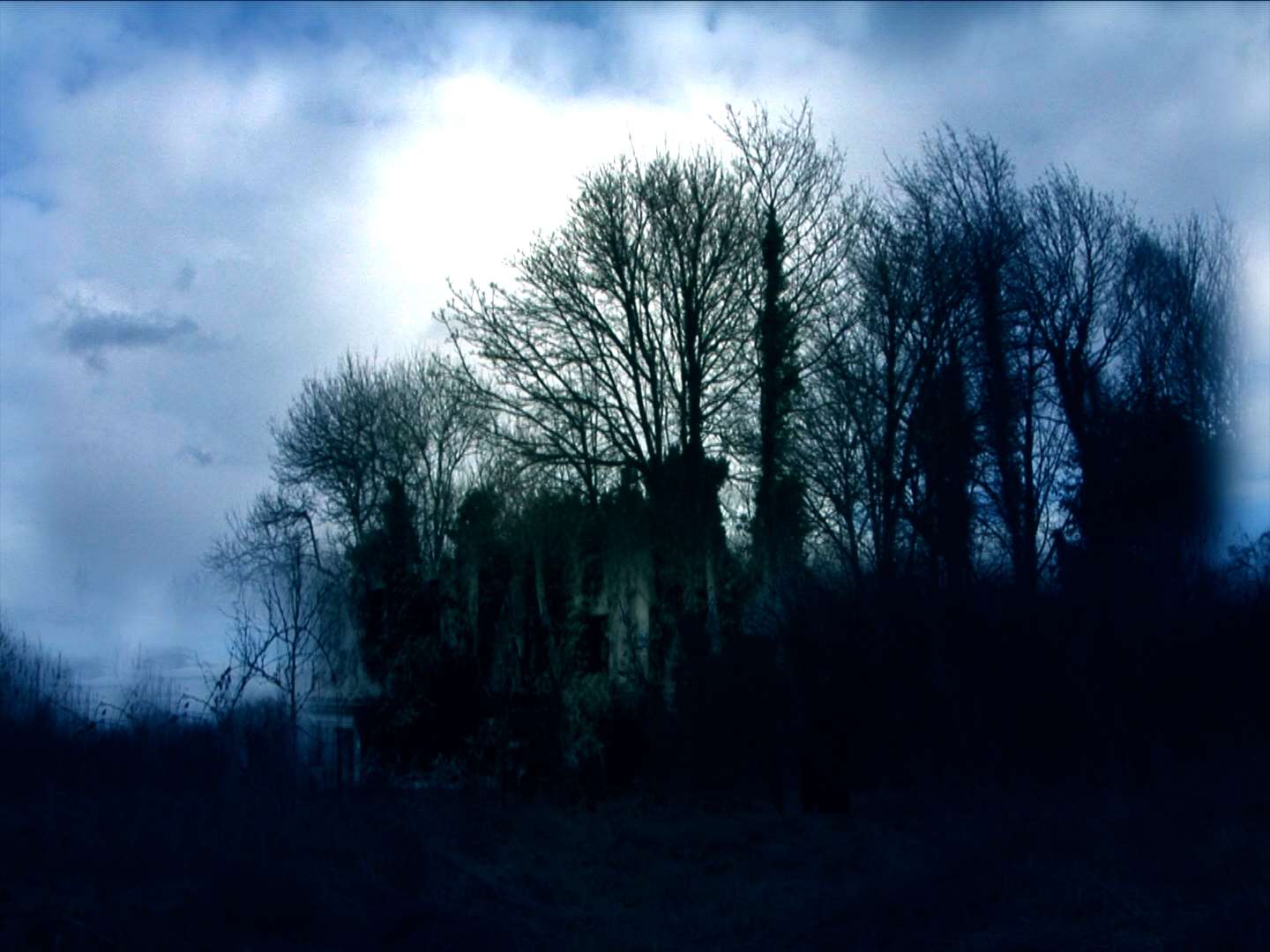
Documentary, horror, by Jason Figgis, USA, 2014.
In "Cathnafola", everything begins when renowned paranormal investigator Chris Halton of Haunted Earth UK receives footage filmed by three teenagers at the ruins of Cathnafola House in Ireland. Determined to unearth the truth behind the location’s bloody past, Halton embarks on a nighttime exploration of the infamous ruins—and soon uncovers terrifying and disturbing revelations.
LANGUAGE: English
SUBTITLES: Spanish, French, German, Portuguese
Shades, Larvae, and the Roman Fear of Return
You wake before dawn on the ninth of May and find your father standing barefoot at the threshold of the house, his eyes averted from the darkness beyond the door, his lips moving in a count of nine while black beans fall from his open hand into the street behind him. He does not look back. To look back is to invite what he is trying to refuse.
The Romans did not experience the dead as a uniform category. Roman theology, with a precision that the modern world has largely abandoned in favor of comfortable vagueness, distinguished between the Lares, who were ancestral spirits bound to the household and genuinely protective of it, and the Larvae, which Apuleius describes in his second-century philosophical treatise De Deo Socratis as the violent, purposeless remnants of those who died in bitterness or without proper burial. The Latin word larva means both ghost and mask, and that double meaning is not accidental. What the Romans feared was not the dead in themselves but the dead who had become unrecognizable, who had lost the coherent identity that ritual sustains and now wore only the hollow form of a face. A Lar remembered who it was. A Larva had forgotten, and that forgetting made it dangerous.
The Lemuria, celebrated on the seventh, ninth, and eleventh of May, was a festival built entirely around the management of this danger. Ovid describes it in the Fasti with enough sociological precision to make it read less like mythology and more like a public health ordinance. The paterfamilias rose at midnight, walked barefoot through the house to avoid the contact of leather with sacred ground, washed his hands three times, placed black beans in his mouth, and cast them backward over his shoulder nine times without looking, reciting the formula that told the spirits to take the beans and leave the family in peace. The color black mattered: black beans were a food of the dead, offered to entities who existed at a remove from the living world’s warmth and color. The number nine mattered: odd numbers in Roman ritual belonged to the chthonic, to what lies beneath. The refusal to look backward mattered most of all, because attention was understood as a form of invitation, a way of confirming that something had a claim on your world.
What this reveals is a civilization whose relationship to time was radically non-linear. The Roman calendar was not simply a schedule of civic and agricultural events. It was a map of vulnerability, a document that acknowledged certain periods when the membrane between the present and its violent unfinished business became permeable. The dies parentales in February, the Lemuria in May — these were not celebrations of ancestors but negotiations with them, carefully choreographed attempts to discharge an obligation that would otherwise accumulate into catastrophe. The sociologist Robert Hertz, writing in 1907 in his essay on the collective representation of death, argued that secondary mortuary rites across cultures serve to complete the social death that biological death leaves unfinished. The Roman system understood this intuitively and built it into the infrastructure of the year itself.
The deeper implication is that the Larva represented not simply a dead person but a failure of the living. An unburied body, a spirit not properly mourned, a debt of ritual left unpaid — these were community failures, not private ones, and the restless dead that resulted were understood as evidence of collective negligence. The horror was not supernatural in the modern escapist sense. It was social and diagnostic. When something came back, it came back because something had been left undone, and the question the returning figure forced onto the living was not whether the dead could walk but whether the living had actually done what they claimed to have done for those who preceded them.

The Christian Repackaging of Pagan Haunting
You are kneeling in a church that was built on top of a temple, and the stones beneath the altar were cut for a different god entirely. This is not metaphor — it is the documented archaeological reality of dozens of early Christian sites across Roman Gaul, Britain, and the Iberian Peninsula, where the Church did not erase what was already there but simply installed a new roof over an older foundation and called the structure its own.
The same architectural logic governed the Church’s treatment of ghost belief. The official position — the one delivered from pulpits, inscribed in condemnations, repeated in episcopal letters — was that pagan communion with the dead was demonic deception, that the figures appearing to the living were either devils in disguise or fabrications of a grieving mind. And yet the Church fathers who issued these condemnations were working within a tradition that had already absorbed the problem entirely. The New Testament itself contains a scene in which the disciples see a figure walking toward them across water and immediately assume it is a phantom, using the Greek word phantasma — a term carrying centuries of classical ghost belief, dropped into the Gospel of Matthew without apparent theological anxiety. Scripture had not resolved the question of wandering souls. It had simply inherited it.
Augustine of Hippo, writing in the early fifth century, devoted considerable attention to the question in his Confessions and later in the treatise De cura pro mortuis gerenda, On the Care to be Taken for the Dead, where he examined whether the dead could actually appear to the living and whether prayers offered for them had any effect. His conclusion was careful and strategically unresolved: the dead do not control their own appearances, God may permit them to manifest for specific purposes, and the prayers of the faithful may genuinely alter the condition of the departed. This was not an elimination of the ghost. It was a bureaucratic reassignment — the wandering soul had been placed under new management.
What Augustine gestured toward, the institutional Church eventually codified into architecture. The doctrine of Purgatory, formally defined at the Second Council of Lyon in 1274, was among the most consequential theological decisions of the medieval period, though it is rarely discussed in those terms. What the Council accomplished was the creation of an official middle geography — not heaven, not hell, a transitory space where souls lingered in purifying suffering before their final destination. The theological implications for ghost belief were immediate and structural: the apparition at the bedside was no longer necessarily a demon or a hallucination. It could be a soul in genuine distress, trapped in that intermediate zone, appearing to a living relative with a specific and urgent request. The Church had given haunting a zip code.
This geography generated an economy. Masses said for the dead, indulgences purchased on their behalf, prayers offered at specific altars — all of these now had a quantifiable theological function, reducing the time a soul spent in Purgatorial suffering. Jacques Le Goff, in his 1981 study La Naissance du Purgatoire, argued that the formalization of this doctrine was not merely theological but deeply social, reshaping inheritance patterns, the construction of chantry chapels, and the political authority of the clergy who alone could administer the relevant rites. The ghost had become a revenue stream. And because the ghost was now theologically real, institutionally recognized, and economically productive, the Church had no incentive to argue it out of existence — only to control the conditions under which it could be acknowledged and appeased.
What this produced in ordinary people was a remarkably stable form of theological anxiety that could be neither fully resolved nor cleanly abandoned, because the institution that told you the ghost might be real was also the only institution authorized to do anything about it.
What the Ghost Wants and What That Reveals About the Living
You are standing in a house that does not belong to you anymore, and you know it, and still you cannot leave. That is the structure of every ghost story Western culture has ever produced, and it is worth pausing to notice how strange that is — not the haunting itself, but the reason assigned to it. The ghost does not stay because it loves the place. It stays because something is owed.
This insistence on debt as the engine of haunting is not accidental. It is the signature of a civilization that has organized itself around contracts — legal, moral, theological — and that has never quite trusted those contracts to hold. The ghost, in Western narrative logic, is the proof that they did not. It materializes precisely where the system failed: where the murder went unpunished, where the will was forged, where the confession was swallowed rather than spoken. It is not a supernatural phenomenon so much as a juridical one — the return of a claim the living institutions could not or would not process.
Jacques Derrida, writing in Specters of Marx in 1993, gave this structure a name: hauntology, a coinage that displaces ontology — the study of what exists — with the study of what persists without existing, what is neither present nor absent but structurally prior to both. For Derrida, the specter is not a figure of the past but a figure of the future that never arrived, a promise that was made and then broken and that keeps returning to demand its settlement. He was writing about the ghost of communism circling a triumphant capitalism that declared history finished, but the logic cuts far deeper than politics. It describes the condition of any culture that makes pledges it cannot honor and then tries to close the books anyway.
The particular anxiety this reveals in Western society is that closure is a fiction. Verdicts are returned, sentences served, monuments erected, treaties signed — and still something remains unresolved, still circulating beneath the official record. The ghost story externalizes this suspicion into narrative form, giving it a figure, a voice, a demand. It lets the culture rehearse the fear that no accounting is ever truly final, that every settlement leaves a remainder, and that the remainder does not disappear simply because it has been declared irrelevant. In this sense the haunted house is not a horror setting. It is an epistemological condition.
What sharpens this into something almost unbearable is how often the ghost’s unfinished business is not its own failure but someone else’s. The victim returns, not the perpetrator. It is the wronged party who cannot rest, who must traverse the indignity of remaining visible in a world that moved on without delivering what it owed. There is a brutal irony embedded in this convention that Western culture has largely chosen not to examine: the ghost is punished twice. First by the original violence, then by the compulsion to haunt — to remain anchored to the site of the wound, unable to dissolve into whatever comes after, until the living are finally inconvenienced enough to act. Justice, in this cosmology, requires not just a crime but a sufficiently persistent disruption before it becomes tolerable for the living to pursue.
This is why the ghost’s demand so rarely reads as threat in the oldest versions of these stories. It reads as petition. The Roman legal tradition actually formalized this: the larvae, spirits of the unavenged dead, were understood to have legal standing in a conceptual sense — their disturbance of the household was a form of ongoing complaint. Pliny the Younger, writing around 100 CE, recorded the case of a philosopher named Athenodorus who rented a haunted house in Athens precisely because the low price signaled an outstanding claim no one had yet resolved, and who spent the night following the ghost to the place where bones lay buried and unreported.
The Enlightenment's Failed Exorcism
You are sitting in a candlelit room in 1762 London, and the scratching sounds coming from the walls of Cock Lane have already destroyed one man’s reputation, nearly sent another to the gallows, and drawn Samuel Johnson himself — lexicographer, Christian moralist, the most celebrated intellect in England — to crouch in the dark beside a child’s bed, waiting for a dead woman to knock twice for yes.
The rationalist project was supposed to make this impossible. Locke had argued in 1690 that the mind arrives in the world as a blank slate, meaning that ghost beliefs were not innate knowledge but learned error — superstitions poured into the empty vessel by credulous nurses and parish priests. By the mid-eighteenth century, educated Europeans had developed what might be called a grammar of dismissal: apparitions were attributable to melancholy, to indigestion, to the particular suggestibility of women and the uneducated. David Hume’s 1748 essay on miracles had constructed an epistemological cordon — testimony about supernatural events could never outweigh the uniform experience of natural law. The ghost was being legislated out of credible reality, not through exorcism but through mockery, the more devastating weapon.
What the rationalists failed to account for was the social function of the ghost, which no philosophical argument could reach because it operated below argument. Johnson’s investigation of the Cock Lane Ghost — the knocking attributed to “Scratching Fanny,” supposedly the spirit of a woman named Fanny Lynes who had died of smallpox — concluded, correctly, that the sounds were produced by a young girl hiding a piece of wood in her clothing. Johnson published his findings. The crowds did not disperse. The belief persisted in the city’s lower parishes in a form that the exposure could not touch, because the ghost of Fanny Lynes was not primarily a factual claim. It was a concentrated expression of every suspicion held by London’s poor about the propertied men who controlled their lives and deaths and went unpunished for it.
Industrialization arrived and did something to human communities that no previous disruption in European history had accomplished with such speed and totality. Between 1760 and 1830, enclosure acts in Britain removed common land from millions of rural families, erasing the specific fields, boundaries, trees, and graves around which several generations had organized their sense of who they were. The philosopher Simone Weil, writing in 1949 in The Need for Roots, identified rootedness — the organic connection to a particular past and a particular community — as the most essential and most neglected of human needs. When that connection is severed by force, the severed end does not simply die; it generates images. The ghost proliferated precisely in the populations being most violently uprooted, which is why ghost literature in Britain surges not during the medieval period, when everyone already believed without needing stories to sustain belief, but during the nineteenth century, when the new industrial poor needed the dead to remain somewhere, to occupy the land from which the living had been expelled.
The rationalist intervention thus produced the opposite of its intended result. By declaring ghosts inadmissible in the domain of serious inquiry, it drove them downward into the cultural substrata where they became inarticulate but structurally necessary. The factory worker in Manchester who told stories about the spirit haunting the mill’s top floor was not failing to apply Humean epistemology. He was doing something Hume had no category for: constructing a moral claim about ownership, about whose life had been consumed by that building, about the kind of debt that wages do not settle. The ghost became the figure that accounting systems cannot process, the remainder left over when profit has been extracted and the human cost has been declared irrelevant to the ledger.
What survives ridicule is always worth examining more carefully than what survives acceptance, because ridicule targets the surface while the root goes untouched underground.
A vision curated by a filmmaker, not an algorithm
In this video I explain our vision
The Victorian Séance as Social Technology

You are in a darkened parlor in Boston, 1869, and the woman across the table from you has not slept properly in three years. Her son died at Antietam. She has read the condolence letters, attended the services, accepted the casseroles, and performed the entire choreography of respectable grief, and none of it has touched the specific wound of not knowing what became of him in the final seconds, whether he was afraid, whether he called for her. She is not here because she is gullible. She is here because every other institution available to her has offered language without answer.
The spiritualist movement that swept through America and Britain between the 1850s and 1880s enrolled over eight million declared adherents by 1870, a figure that dwarfs almost every contemporary religious revival of the period, and yet historians have systematically filed it under the category of collective delusion rather than examining what structural need it was precisely engineered to meet. The American Civil War alone produced approximately 620,000 military deaths, with hundreds of thousands more from disease and displacement, all arriving with a particular epistemic horror that industrial warfare had introduced: mass anonymous death, bodies unidentified and unrecovered, families who received no remains and therefore no ceremony of finality. Ann Braude’s 1989 study “Radical Spirits: Spiritualism and Women’s Rights in Nineteenth-Century America” documents how spiritualist communities formed densest concentrations in the geographic corridors most saturated by war grief, a spatial distribution that does not suggest superstition so much as epidemiological response.
What the séance provided was not consolation in the sentimental sense but rather a formal structure for continued relationship with the dead, a technology of contact that gave grief somewhere to go beyond the wall of silence that orthodox Protestant theology had installed. Calvinism in particular had made the afterlife largely inaccessible to the living, a sovereign territory of God’s inscrutable will where the deceased were neither reachable nor available for negotiation. The medium cracked that wall open and replaced doctrinal silence with direct testimony, however manufactured or unconsciously constructed it may have been. The psychological function was closer to what Pierre Janet would later call “fixed ideas” — not delusion but unassimilated experience demanding a form through which to complete itself.
The dimension that almost every popular account erases entirely is the question of who was doing the mediumship and what it cost them socially to stop. Women constituted the overwhelming majority of practicing mediums, and the trance state provided the single condition under which a woman’s public speech was institutionally tolerated: she was not speaking, the spirit was speaking through her. This allowed women like Cora Scott and Victoria Woodhull to address large mixed-gender audiences on abolition, suffrage, and labor rights, positioned as vessels rather than agents, which was precisely the loophole available to them. Braude traces directly how the spiritualist lecture circuit became a pipeline into the suffrage movement, with women training their public voice in trance before removing the trance framing and speaking in their own names, sometimes years later. The ghost was a political instrument before it was anything else.
What this reveals about the ghost as a cultural form is something the Victorian period made brutally legible: the figure of the returned dead is always also the figure of whoever cannot speak through legitimate channels. When Frederick Myers and Edmund Gurney founded the Society for Psychical Research in London in 1882 and began systematically collecting and cataloguing ghost testimony, they believed they were doing empirical science, and in a narrow sense they were. But the pattern in the testimonies they gathered showed almost no variation across class and geography — the ghost appeared at the moment of maximum institutional silence, precisely where the official story had left a gap too large for the living to step over without falling in.
Freud's Ghost and the Return of the Repressed
You are standing in a room you grew up in, and something is wrong with it. Not the furniture, not the light — something structural, something in the proportion of the walls or the angle of the door, and you cannot name it, but your body has already named it for you. This is not a ghost story. This is a neurological event Sigmund Freud spent thirty years building toward before he finally wrote it down in 1919, in an essay that changed what haunting means permanently.
Das Unheimliche — translated inadequately as “the uncanny” — begins with an act of philological violence. Freud notices that the German word for homely, familiar, safe (heimlich) contains within its own etymology its opposite: the concealed, the hidden, the secret. The word for comfort and the word for concealment share a root. From this linguistic fracture, Freud builds an entire architecture of dread: the uncanny is not the foreign or the monstrous but the familiar made strange, the intimate suddenly unrecognizable. What frightens us most is not what comes from outside but what was always inside and has now surfaced without warning.
The ghost, in this framework, is no longer a dead person who has returned. It is a repressed psychological content — a memory, a desire, a guilt, a wound — that was buried alive and is now forcing its way back through the floorboards of consciousness. The burial was never complete. It never is. The psyche does not have a graveyard; it has a cellar, and the cellar has no lock that holds permanently. Ernest Jones, Freud’s biographer and a psychoanalyst himself, extended this logic in his 1931 study On the Nightmare to argue that entire categories of supernatural folklore — the incubus, the revenant, the figure pressing down on the chest in sleep — are projections of unconscious material that the waking mind cannot accommodate. The ghost is what you could not say, given a body and sent back to you in the dark.
This reframing did something counterintuitive to the ghost’s cultural power. Rationalism had tried to defuse haunting by relocating it to the realm of error — superstition, misperception, the uneducated mind’s failure to distinguish the real from the imagined. Freud did the opposite. He confirmed the experience while dissolving the external referent. The ghost is real as an experience, he insisted, because it is produced by a real psychic mechanism — the return of the repressed — but what returns is not the dead. It is the living self’s unfinished business with its own history. This made the ghost vastly more difficult to escape. You can leave a haunted house. You cannot leave your own memory.
What Freud had done, without quite naming it this way, was to relocate the site of haunting from geography to identity. The nineteenth century’s haunted house — Wilkie Collins‘s crumbling manors, the spectral corridors of Victorian sensation fiction — was already beginning to function as an externalized psyche, a spatial metaphor for the compartmentalized self. Freud collapsed the metaphor into diagnosis. The house was never the problem. The self was always the house, and the ghost was always something the self had locked away in 1891 or 1907 or at the age of seven during an event it subsequently refused to narrate even to itself.
What followed in the twentieth century’s literary and theoretical imagination was a haunting that had no resolution available to it, because the protocol of exorcism — confronting the ghost, naming it, releasing it — depends on the ghost being external and finite. When the specter is woven into the subject’s own cognitive architecture, naming it does not release it. Sometimes naming it only makes it more present, more articulate, more insistent about what it came back to say.
The Haunted Present and the Debt We Refuse to Name
You drive through a small town in the American South on a Tuesday afternoon, and something in the quality of the light over a particular field makes your chest tighten before your mind has formed a single coherent thought. The body knows the history the road sign does not mention.
Toni Morrison gave this phenomenon a name precise enough to cut: rememory, developed across the architecture of Beloved in 1987, the idea that trauma does not merely persist in the minds of those who survived it but becomes embedded in physical space itself, a kind of material haunting that can ambush people who were never present for the original wound. The crucial and destabilizing move Morrison makes is that rememory is not metaphor. It is, within her moral logic, ontological. The ghost does not represent grief. The ghost is what happens when official history refuses to metabolize what actually occurred, leaving the unprocessed residue to circulate in walls, in soil, in the nervous systems of people walking through landscapes they were told are neutral.
Western ghost traditions have always trafficked in this dynamic without being willing to say so directly. The country house with its restless spirit, beloved in English Gothic fiction from the eighteenth century onward, is almost never examined for what the wealth that built it required. The elegant rooms in which something moves at night were furnished by plantation labor, by enclosure acts that displaced rural peasantry, by colonial extraction that the architecture quietly celebrates while the ghost story attached to the property produces a frisson that never names its own source. The haunting becomes aestheticized, converted into entertainment, precisely at the moment when it might otherwise become accusation.
Scholars of colonial history have documented how this displacement operates structurally. Patrick Wolfe‘s analysis of settler colonialism, particularly his 2006 essay on its logic as a structure rather than an event, demonstrates that the dispossession of indigenous peoples is not a historical episode that concluded but an ongoing arrangement whose continuation requires that the original violence remain unrepresented, present but deniable. Ghost stories attached to Western landscapes often perform exactly this function: they acknowledge that something is wrong with a place while systematically misidentifying what that wrong thing is. The haunting becomes geological, blamed on ancient curse or anonymous spiritual unrest, and the specific human beings who died, who were removed, whose languages were erased from the land’s very nomenclature, are dissolved into atmospheric mood.
American horror as a popular genre has occasionally cracked open this evasion by accident. Films produced without conscious political intention have placed their supernatural threats in newly built suburbs, in houses constructed over sites where something was previously and violently cleared away. The audience is invited to feel dread at the return of the displaced without ever being asked to identify with the displaced themselves. The horror is experienced from the position of the settler who cannot understand why the ground refuses to be peaceable property.
What the contemporary moment demands, and what makes ghost stories in the twenty-first century politically volatile in ways earlier centuries could not anticipate, is that the formerly voiceless archives are opening. Digitized records, land deed research, community oral history projects, forensic archaeology of massacre sites — all of these are producing documentation that transforms what was once deniable atmospheric weight into specific named events on specific named dates with specific named perpetrators and victims. The ghost, in this context, is not becoming less real. It is becoming more legible, which is an entirely different and far more uncomfortable phenomenon for cultures that organized their self-understanding around the premise that whatever happened before had been cleanly resolved into the past.
The landscape does not agree. The field in certain light on a Tuesday afternoon continues to know what the road sign was designed to make you forget.
👻 Between Worlds: Spirits, Death, and the Beyond
Western tradition has long been haunted by the presence of ghosts — figures suspended between life and death, memory and forgetting. Exploring their roots means traveling through folklore, literature, Gothic imagination, and the deepest fears of the human soul. These articles illuminate the cultural landscape from which ghost stories have always emerged.
M.R. James: Ghosts and the Terror of the Everyday
M.R. James is one of the great architects of ghost fiction in the English-speaking world, transforming the supernatural into a disturbance lurking within the ordinary domestic sphere. His stories explore how the past refuses to stay buried, erupting into the present through cursed objects, haunted libraries, and ancient manuscripts. Reading James is an essential step in understanding why ghosts in Western tradition so often embody unresolved history.
GO TO THE SELECTION: M.R. James: Ghosts and the Terror of the Everyday
Sheridan Le Fanu: Irish Gothic and Domestic Horror
Sheridan Le Fanu brought Irish Gothic sensibility to bear on the ghost story, rooting supernatural dread in crumbling family houses and repressed secrets. His work bridges folklore and literary tradition, showing how ghosts function as mirrors of guilt, loss, and social anxiety. Le Fanu’s domestic horror remains one of the defining pillars of the Western spectral imagination.
GO TO THE SELECTION: Sheridan Le Fanu: Irish Gothic and Domestic Horror
Venetian Legends and Ghosts of the Lagoon
Venice, with its labyrinthine canals and slowly sinking palaces, has always been one of the most ghost-haunted cities in Western literary imagination. Venetian legends weave together history, tragedy, and the supernatural in ways that reveal how place itself can become a repository for unquiet souls. This article explores the spectral mythology of the lagoon city, where the boundary between the living and the dead seems permanently blurred.
GO TO THE SELECTION: Venetian Legends and Ghosts of the Lagoon
The Vampire Myth: History and Symbolism
The vampire myth, a cousin to ghost lore, springs from the same deep cultural soil that nourished Western beliefs about the restless dead. This article traces how the vampire emerged from Eastern European folklore and evolved into a rich symbol of death’s refusal to release its hold on the living. Understanding the vampire’s origins illuminates the broader Western obsession with spirits that linger beyond their rightful end.
GO TO THE SELECTION: The Vampire Myth: History and Symbolism
Discover the Cinema of the Invisible on Indiecinema
If these shadowy traditions have stirred your curiosity, Indiecinema streaming is the place to follow the thread further. Our curated selection of independent and arthouse films explores ghosts, memory, and the uncanny with a depth and freedom that mainstream cinema rarely allows. Come and discover the films that dare to look beyond the veil.
👉 EXPLORE THE CATALOG: Watch Indie Films in Streaming
A vision curated by a filmmaker, not an algorithm
In this video I explain our vision

