
The Rustling Behind the Wainscot
You are reading in a rented room, late, the kind of late where the building has gone quiet in a way that feels deliberate, and something in the paragraph before you produces a sensation you cannot immediately name. It is not the sentence about the figure at the window, nor the detail about the teeth. It is the line about the bedsheets — folded on the chair, exactly where you left them, exactly as anyone would leave them — that makes you set the book down and look at your own folded linen with a feeling close to accusation. The lamp is doing nothing wrong. The wainscot is simply the wainscot. And yet something has shifted in the room, not outside it, and you understand, with a clarity that is almost insulting, that Montague Rhodes James has just done something to you that no locked door can undo.

James published his first collection, Ghost Stories of an Antiquary, in 1904, and what distinguished it immediately from the prevailing Gothic tradition was not sophistication of prose or novelty of monster, but a precise and almost clinical understanding of where terror actually lives. The Victorians had built their horror in castles, crypts, and foreign soils — Transylvania, the Orient, the hereditary ruin. James moved the scene of dread into the English countryside inn, the cathedral library, the well-appointed guest bedroom, the scholar’s study with its familiar chaos of papers. He did not bring the uncanny into safe space as a violation. He revealed that safe space had always been a performance, a collective agreement to ignore what was already there.
This distinction matters enormously, and it has been consistently undervalued by critics who read him as a craftsman of atmosphere rather than as a diagnostician of ordinary life. Sigmund Freud‘s 1919 essay on the unheimlich — the uncanny — argued that the most profound terror is not produced by the foreign or the monstrous, but by the familiar made strange, the home that is not quite home, the face you recognize that belongs to no one you know. James arrived at the same structure not through psychoanalytic theory but through an almost obsessive attention to the texture of daily comfort: the creak of furniture, the smell of old paper, the particular silence of a room after a fire dies. He understood that comfort is not the absence of threat but the trained refusal to perceive it.
His scholars and antiquarians — the recurring type he populated his stories with — are men who have spent their lives organizing knowledge, cataloguing the past, imposing taxonomic order on things that predate that order entirely. Their professional identity is the management of the dead: manuscripts, artifacts, architectural surveys, ecclesiastical records. They are, without exception, men who believe that sufficient expertise constitutes a form of protection. What James does to them, with surgical patience, is demonstrate that expertise does not reclassify danger. It merely gives you a more precise vocabulary for describing your own dissolution.
The horror, then, is not that something supernatural enters the world. The horror is that the world was never as organized as the cataloguing suggested. A brass seal purchased at a country auction in “Oh, Whistle, and I’ll Come to You, My Lad” does not introduce menace into a neutral setting — it activates menace that the setting was always quietly containing. The beach, the inn, the bed with its white spare pillow are not corrupted by the object. They are revealed. And what they reveal is that the familiar has been, at every moment, a provisional arrangement, a temporary consensus between human beings who agreed not to look too carefully at what their ordinary routines were built on top of.
This is why the folded linen made you stop. Not because it moved. Because it didn’t.
Simon Marsden’s Haunted Life In Pictures
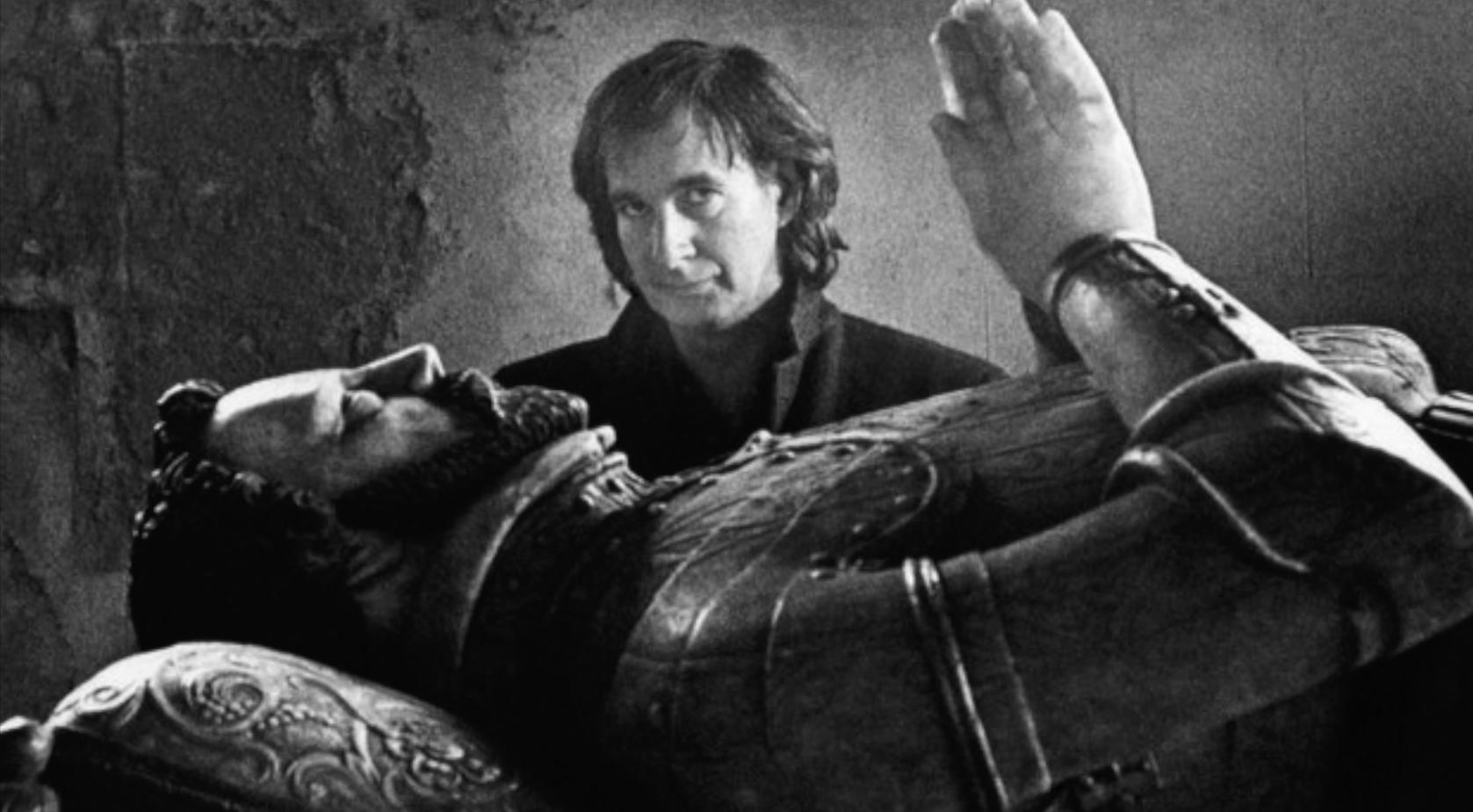
Documentary, by Jason Figgis, United States, 2019.
This documentary retraces the life and work of Simon Marsden, widely regarded as one of the foremost photographers of the supernatural. Premiered at the British Film Institute in London, the film offers a fascinating journey into his creative universe, appealing not only to photography enthusiasts but also to scholars, teachers, students, and anyone intrigued by the mysteries of the unseen. Through evocative imagery and first-hand accounts, it explores the artistic path of a photographer whose work has appeared in books, on U2 album covers, and in museum exhibitions around the world.
Although convinced of the existence of ghosts, Marsden never claimed to capture them directly with his camera. Instead, he used black-and-white infrared film to record the atmosphere and the invisible traces that, in his view, spirits left imprinted upon places. From the landscapes of Ireland to the vast expanses of Russia, passing through Venice and the American Southwest, he transformed historic buildings, ruins, and haunting locations into deeply evocative images capable of suggesting dark and unsettling stories. His photographs continue to captivate the imagination, demonstrating how the most powerful works of art can leave a lasting impression on those who behold them.
LANGUAGE: English
SUBTITLES: Spanish, French, German, Portuguese
The Scholar Who Knew Too Much About Comfort
You have spent your entire adult life inside the same set of buildings, eating at the same tables, walking the same quadrangles, and you have never once questioned whether this was freedom or a very elegant cage — and then one December evening, someone begins to read aloud in the candlelit common room, and the story makes the walls feel thinner than they did an hour ago.
Montague Rhodes James was born in 1862 and spent the better part of sixty years inside the most fortified institutions English civilization had ever built for the protection of the educated mind. He was a fellow, then Provost of King’s College Cambridge, then Provost of Eton. He catalogued medieval manuscripts across the libraries of Europe, producing a body of paleographic work so meticulous and exhaustive that it remains a primary scholarly resource more than a century later. He could read and date a twelfth-century vellum by its hand alone. He understood, at a level almost no one alive could match, the physical texture of the past — not as metaphor, but as object: the binding, the ink, the marginalia, the wormhole through three hundred years of paper.
What matters here is not that James was a learned man in a comfortable institution. What matters is that his comfort was total, structural, and earned. He did not inherit it passively. He built himself so thoroughly into the architecture of English scholarly life that there was no separation between him and the institution — and this is precisely the condition from which horror becomes possible as a diagnostic rather than an escape. A man terrified of his own life writes horror to externalize that terror. A man fully at peace with his life writes horror to discover where the peace is lying to him.
The French sociologist Pierre Bourdieu, developing the concept of habitus in his 1972 Outline of a Theory of Practice, described the way social structures are not merely external constraints but become literally embodied — posture, reflex, taste, the unconscious choreography of who speaks first in a room. James had one of the most thoroughly cultivated habituses in late Victorian England, and it gave him something rare: a forensic sensitivity to the exact texture of normalcy. He knew what a well-appointed study was supposed to feel like, which is why he knew precisely which note, introduced at precisely which moment, would make it feel wrong.
His ghost stories were written to be performed, not published — composed for reading aloud on Christmas Eve at King’s College to an audience of students and colleagues who shared his world entirely. This is not a minor biographical detail. It means the horror was calibrated for the initiated, for people who recognized every object in the room being described because they lived inside versions of those rooms daily. A hotelroom in a provincial English town. A cathedral library on a winter afternoon. A study lined with inherited books. The terror was not imported from some alien register of experience — it was mapped with absolute precision onto the lived coordinates of his audience’s existence.
James never married, had no children, and expressed, by all accounts, no particular private anguish about either fact. The standard biographical move at this point is to go looking for the wound — the repression, the sublimation, the hidden cost of the institutional life. But that reading smuggles in the assumption that horror must be produced by damage, that only the suffering man has access to the dark. What James demonstrates instead is something more unsettling: that the man who has fully accepted the terms of civilization, who has read its contracts carefully and signed them with both hands, is positioned more precisely than anyone to notice the clauses nobody mentioned.

The Victorian Residue No One Admitted to Keeping
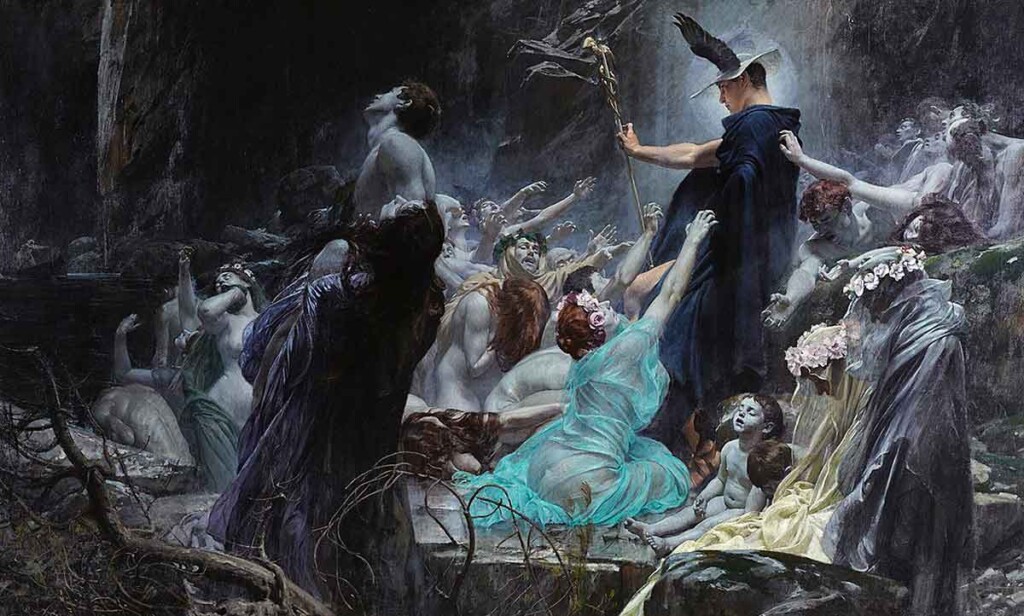
You are sitting in a well-lit room in 1904, surrounded by the institutional confidence of a civilization that has measured the atom, mapped the continent, and scheduled the trains. The British Empire administers roughly a quarter of the earth’s land surface. Germ theory has replaced divine punishment as the explanation for cholera. The gaslight has given way to the electric bulb. Everything is, in principle, explicable — and Montague Rhodes James, Provost of King’s College Cambridge, sits down to write a story about a man who unfolds an old piece of linen and finds something in his hotel room that should not be there.
The standard reading of this moment is that James was offering escape — a Victorian parlor game lingering into Edwardian comfort, nostalgia dressed as fright. That reading is too easy, and it protects us from what is actually happening in those pages. Max Weber, writing in 1917 for the lecture series that would become Wissenschaft als Beruf, described the condition of modernity as Entzauberung — the disenchantment of the world — the systematic elimination of magical thinking from every domain where rational calculation could reach. Weber was not celebrating this. He understood it as a kind of cost, a subtraction from experience that left the modern subject technically competent and spiritually hollow, living inside what he called the iron cage of bureaucratic reason. What Weber diagnosed in sociology, James was already performing in fiction a decade earlier, except James understood something Weber was still formulating: you cannot disenchant a world without producing, as a byproduct, the shadow of everything you have suppressed.
The Victorian project of rationalism did not simply replace supernatural belief — it archived it. Folklore commissions collected legends the way museums collected artifacts, both gestures being acts of controlled preservation that remove the living thing from circulation while appearing to honor it. The Society for Psychical Research was founded in 1882 with fellows who included Henry Sidgwick and William James — rigorous minds who assumed that applying empirical method to hauntings would dissolve them. What the Society actually produced, in thousands of pages of testimony, was a documented register of the residual, proof that the suppressed material did not vanish but simply changed address. James was not a member, but he read their proceedings, and the move he makes in his fiction is structurally identical to theirs, only inverted: where the Society tried to examine the irrational until it became rational, James embeds rational procedure inside irrational experience until the procedure itself becomes contaminated.
His scholars, antiquarians, and clergymen are not superstitious men. They are careful men. The horror in his stories does not arrive because someone was reckless or credulous or weak — it arrives precisely because someone was methodical. A man follows an archival lead. A man translates a manuscript correctly. A man does his professional duty with exactitude, and the exactitude opens the door. This is not Gothic carelessness punished; it is Enlightenment competence punished, which is an entirely different and far more disturbing structure. The Empire that had declared the irrational defeated was simultaneously running extraction economies on territories whose epistemologies it classified as primitive, archiving the sacred objects of conquered peoples in the British Museum three miles from the Royal Society. The confidence of 1904 rested on a foundation of suppressed material — suppressed belief, suppressed history, suppressed populations — and James’s stories function as pressure returning through the floorboards of exactly the kind of building that was supposed to be impervious to pressure.
Weber’s disenchantment was never total, because it could not be. The rational apparatus requires a remainder it cannot process, a residue that justifies the machinery of exclusion by persisting at the margins.
Cathnafola - A Paranormal Investigation
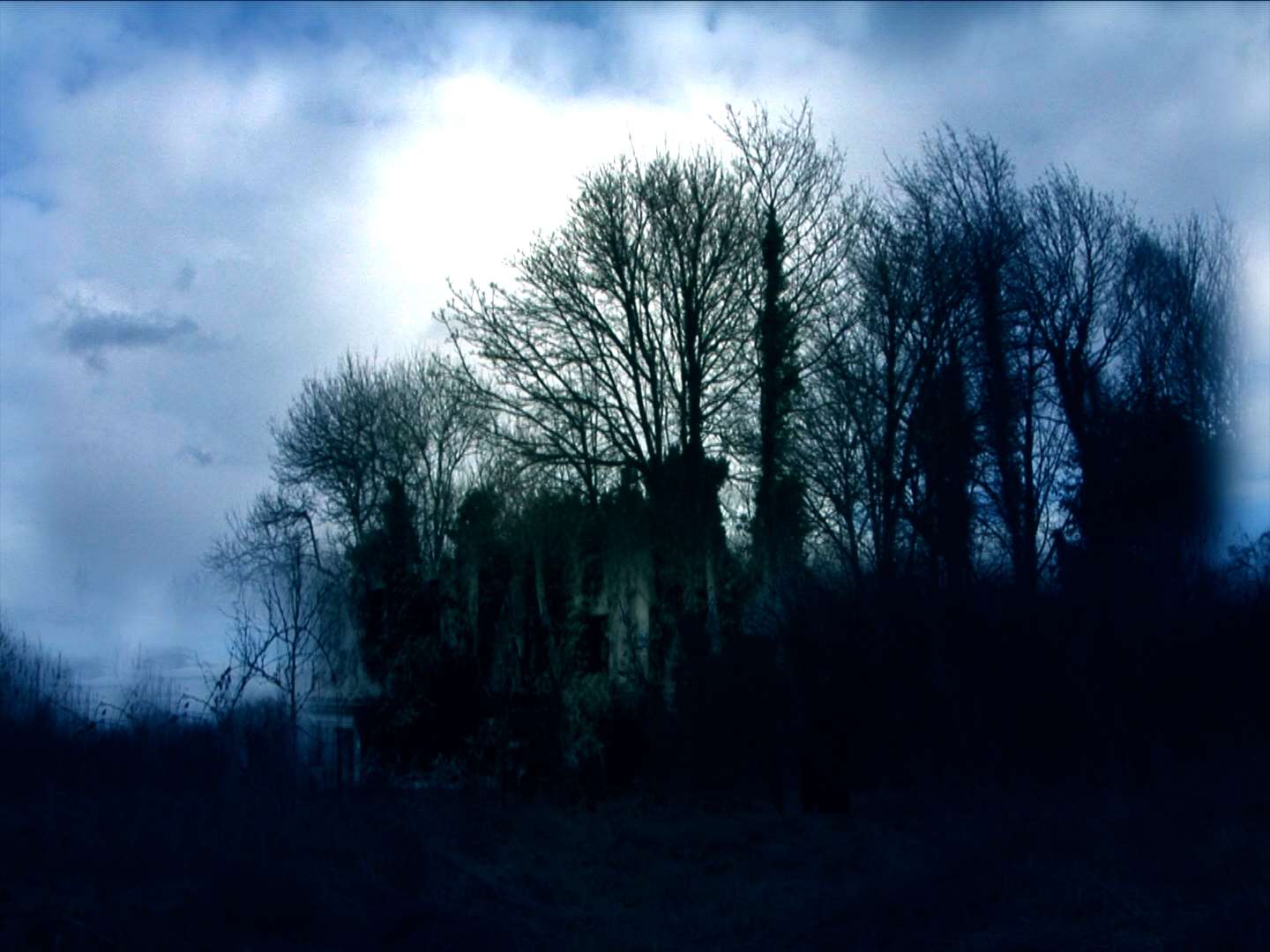
Documentary, horror, by Jason Figgis, USA, 2014.
In "Cathnafola", everything begins when renowned paranormal investigator Chris Halton of Haunted Earth UK receives footage filmed by three teenagers at the ruins of Cathnafola House in Ireland. Determined to unearth the truth behind the location’s bloody past, Halton embarks on a nighttime exploration of the infamous ruins—and soon uncovers terrifying and disturbing revelations.
LANGUAGE: English
SUBTITLES: Spanish, French, German, Portuguese
Objects as Accusers
You pick up the whistle because it is there, because it fits in your pocket, because you found it and finders have always told themselves a story about deserving what the ground gives up. That logic — so ordinary it barely registers as logic at all — is precisely what M.R. James spent a career dissecting with the patience of a man who knew the knife would eventually find the nerve.
In “Oh, Whistle, and I’ll Come to You, My Lad,” published in 1904 as part of Ghost Stories of an Antiquary, the object in question is not magical in any theatrical sense. It is old, corroded, Latin-inscribed, and above all it is lying on the ground waiting to be pocketed by a man who believes that curiosity is its own justification. Professor Parkins does not steal the whistle. He finds it. The distinction matters enormously to him, and James makes sure you understand that this self-exoneration is not incidental — it is the wound through which everything terrible enters. The terror that follows is not punishment in any moral fable sense; it is more unsettling than that. It is the object’s history asserting itself through the body of the man who thought he had simply picked up an interesting trinket.
Bill Brown, writing in Critical Inquiry in 2001, proposed that objects become visible as things — as genuinely present, resistant, demanding entities — only at the moment they stop functioning the way we expect. A hammer is invisible until it breaks; a chair is furniture until someone falls through it. What Brown called “thing theory” was an attempt to articulate the way the material world holds a kind of subjectivity that human use perpetually suppresses. James had understood this decades earlier without the theoretical vocabulary, which is perhaps why his version cuts deeper than the academic formulation. His objects do not merely stop functioning — they begin functioning differently, according to a logic that predates the person who now holds them.
The mezzotint in the 1904 story of the same name is a picture that changes. Between one viewing and the next, a figure crosses the lawn, enters the house, re-emerges. No one moves it. No one alters it. The collector who owns it never chose this; he purchased an engraving at a routine auction for a reasonable sum, and the transaction felt, as all such transactions do, complete. Ownership is presented throughout James’s fiction as a form of conclusion — you pay, you receive, the matter is settled. What the mezzotint demonstrates, frame by slow frame, is that the matter was never settled, that the object arrived carrying an unresolved event inside it like a charge, and that the exchange of money between two living people had no authority whatsoever over what the thing actually contained.
There is a violence embedded in provenance that polite culture has always needed to ignore. The whistle was buried for a reason. The doll’s house in “The Haunted Dolls’ House,” written in 1923, enacts its original horror every night in miniature — the tiny figures in the tiny rooms performing a tiny murder that happened once at full scale in a real house, in real bodies, for real stakes. The miniaturization does not diminish the event; it preserves it in a form that can be owned, catalogued, placed on a shelf. James understood that collecting is a form of containment, and that containment is the fantasy through which the educated classes manage their relationship to the violence that produced the things they love. The antiquarian — and James was himself a genuine one, a medievalist and manuscript scholar of serious standing — is not exempt from this; he may in fact be more implicated than the casual consumer, precisely because he knows the age of what he handles and chooses to call that knowledge appreciation rather than complicity.
The Antiquarian as Epistemological Trap
You open the cabinet with clean hands and a clear conscience, certain that understanding a thing is the same as controlling it, and that is the last certainty you will ever be permitted.
Montague Rhodes James constructed his scholar-protagonists with almost clinical precision: men of moderate temperament, impressive erudition, and an absolute faith that the archive is sanctuary. They hold fellowships, catalogue manuscripts, correspond with continental librarians, and approach the unknown with the quiet confidence of someone who has always been rewarded for paying attention. Their learning is not arrogance — it is something more dangerous. It is the genuine, earned conviction that knowledge forms a cordon around the self, that to name and classify a thing is to render it governable. James spent thirty years as a medievalist at King’s College Cambridge and later as Provost of Eton, producing authoritative catalogues of manuscript collections across England and Europe, and he understood with intimate precision what it felt like to believe that scholarly mastery was a form of moral protection. He gave that belief to his characters and then spent his entire fiction systematically breaking it apart.
Michel Foucault‘s 1969 work The Archaeology of Knowledge argues that knowledge systems do not simply describe existing realities — they produce them. The episteme, the underlying structure that determines what can be known and how, is not neutral ground but an active force that calls certain objects into legibility and, in doing so, grants them a kind of presence they did not previously possess. What Foucault identifies as the productive power of discourse is exactly what James renders as horror: the act of excavating a buried knowledge does not illuminate a pre-existing danger from a safe distance. It instantiates it. The ghost is not waiting in the dark regardless of whether you look. The ghost requires your looking in order to arrive.
This is the mechanical precision that separates James from the broader ghost story tradition. In most supernatural fiction, the haunting precedes the investigation — the house is already dangerous, the curse already active, and the protagonist stumbles into a disaster that has its own autonomous existence. In James, the disaster has no autonomous existence prior to the scholar’s intervention. Mr. Dunning in “Casting the Runes,” published in the 1911 collection More Ghost Stories, is targeted only because he wrote a negative academic review — because he exercised critical judgment, the exact faculty his training told him was his greatest asset. The investigation is not a response to the supernatural event. The investigation is the supernatural event.
What makes this structurally insidious rather than merely ironic is that James never allows his protagonists a point at which they could have chosen differently without ceasing to be who they are. The curiosity that drives them into catastrophe is not a flaw grafted onto an otherwise sensible character — it is the core of their identity, the thing that made them scholars in the first place. To have stopped inquiring would have required them to become someone else entirely, someone without the particular quality of attention that drew them to the ancient manuscript or the locked chest or the scratched inscription in the first place. James traps his characters not in a situation but in a self.
The epistemological violence here is quiet but absolute. These men are not destroyed by ignorance or recklessness or pride in the classical sense. They are destroyed by the very competence that defined them, by the disciplined, methodical, professionally validated practice of finding out. Every tool their education gave them — the ability to read dead languages, to date parchment by its grain, to recognize an obscure iconographic tradition — functions in James’s fiction as a key that opens something that should have remained sealed. The archive does not protect. The archive is the wound.
A vision curated by a filmmaker, not an algorithm
In this video I explain our vision
A Second Scene: The Courtesy That Kills

Picture a dinner party in 1903, a long table set with silverware that catches the candlelight, six people who have known each other for years arranged in the particular geometry of English social comfort. One of the guests has seen something in the upstairs corridor on the way back from washing his hands — something that stood at the end of the hall and turned toward him with a movement that was not quite movement, an orientation of attention that did not require a face. He returns to the table. Someone passes the claret. He accepts it. The conversation moves through the usual channels: a walking tour in Shropshire, the new appointment at the cathedral, whether the autumn has come early this year. He says nothing. He cannot say anything. Not because he is afraid of being disbelieved, though he is, but because the sentence he would need to form does not belong to the same language as the one currently being spoken at this table. To name what he saw would be to shatter not just the evening but the entire grammar of shared life that makes the evening possible.
This is the violence that M.R. James understood with a precision his ghost stories enact over and over, a violence that operates before the supernatural even enters the room. The terror is not simply that something exists which should not exist. The terror is that existing social language has no slot for it, no polite register into which it can be filed and thereby neutralized. Erving Goffman, writing in The Presentation of Self in Everyday Life in 1959, mapped the extraordinary labor that social actors perform to maintain what he called the definition of the situation, the collectively sustained fiction that the encounter is what all parties agree it to be. The machinery of tact, deference, and face-saving exists precisely to protect this agreement from contamination. A ghost is the ultimate contaminating element, not because it is frightening but because it is illegible within the terms the situation has already agreed to honor.
James’s protagonists are almost always men of learning, scholars, antiquarians, clergymen, men whose authority derives from their mastery of organized knowledge and whose social identity depends on being perceived as rational and composed. To report the apparition is to surrender both simultaneously. The language of polite English life in the late Victorian and Edwardian period did not lack words for the supernatural; it had an abundance of them, deployed cheerfully at séances and in drawing-room discussions of Frederic Myers and the Society for Psychical Research, founded in 1882. But there is a crucial difference between discussing the supernatural as an intellectual category and making a claim about one’s own immediate experience of it. The first is a social accomplishment, evidence of a curious and open mind. The second is a social emergency, an announcement that the speaker has stepped outside the agreed perimeter of the real.
What James grasped, and what his narrators perform without quite understanding they are performing it, is that horror does not require a confrontation with the monstrous. It requires only the discovery that the monstrous is unnameable in the available tongue. The scholar in “Oh, Whistle, and I’ll Come to You, My Lad,” published in Ghost Stories of an Antiquary in 1904, is not undone purely by what pursues him across the beach. He is undone by the gap between what he experiences and what his own professional identity as a rationalist will permit him to articulate. His terror loops back through his own epistemology. The ghost does not simply frighten him; it makes him illegible to himself.
And this illegibility is not a private failure. It is the product of a shared world that has been constructed, over centuries, to leave precisely that gap open and unaddressed, because closing it would require admitting what the structure was always designed to conceal.
Guilt Without a Crime, Punishment Without a Verdict
You pick up the whistle because it is there. That is the entirety of your offense. You are an antiquarian on a Suffolk beach, the light is going, and the object is half-buried and old and interesting, and you are a person who finds old things interesting. No contract is broken. No law is consulted. You blow it, almost absently, the way a person hums in an empty corridor, and then the nights begin, and the figure comes, and by the end you are a man diminished in some way that no physician would be able to name or treat. James’s scholar has done nothing wrong. This is not a technicality. It is the entire point.
The distribution of punishment in James is not inverse to guilt — it is simply orthogonal to it. The worst that can be said of most of his victims is that they are curious, that they handle what they find, that they sleep in rooms they have paid for, that they accept invitations. Professor Parkins blows a whistle. Mr. Wraxall reads a count’s diary too carefully and translates what he finds with too much diligence. A man stays in a hotel room that happens to be the wrong one. Another inherits a house and moves into it. The crimes, if they can be called that, are the ordinary gestures of educated, somewhat sedentary English life. Yet what descends upon these men has the structure and the weight of a verdict — something has decided, something has moved, something is coming, and appeal is not possible.
Franz Kafka published The Trial in 1925, the year after his death, and what he understood that his contemporaries mostly failed to see was that the horror of modern institutional logic was not its cruelty but its completeness. Josef K. is arrested without being told what he has done, tried by a court that will not disclose its location or its statutes, and executed by men who seem almost apologetic about the whole procedure. The guilt in Kafka is not absent — it is presupposed, structural, baked into the architecture of the encounter. To be addressed by the mechanism is already to be guilty, because the mechanism does not address the innocent. James arrived at the same structure twenty years earlier through entirely different materials. His supernatural apparatus — the relic dug from the sand, the Latin inscription decoded, the figure in the sheet — operates on the same logical template: your exposure to the system is already your implication in it. The question of what you actually did has been quietly set aside before the story begins.
What this reveals is something sociology has tried and largely failed to name cleanly: the way punishment in organized societies has historically detached itself from the individual act and begun to attach instead to position, presence, category. Michel Foucault‘s Discipline and Punish, published in 1975, documented the gradual transformation of punishment from spectacular public violence directed at specific offenses into a diffuse, ambient surveillance that disciplines the subject permanently, independently of what the subject actually does on any given day. James’s ghosts are not medieval in this respect. They are thoroughly modern. They do not punish the man who stole the candle from the altar. They punish the man who entered the room where the altar used to be, decades later, for reasons of architectural curiosity, on a Tuesday afternoon.
The terror this produces in the reader is not vicarious fear of supernatural violence. It is something closer to recognition — the sick, familiar feeling of being implicated in a system whose rules you cannot read, whose jurisdiction you never consented to, whose sentence arrives before any accusation has been formally made. You have felt this. Not on a Suffolk beach. In an office, in a family, in a bureaucracy that processes you with the smooth, impersonal efficiency of something that has been waiting for you specifically, for a very long time, and is neither surprised nor interested that you consider yourself innocent.
The Everyday as an Unratified Contract
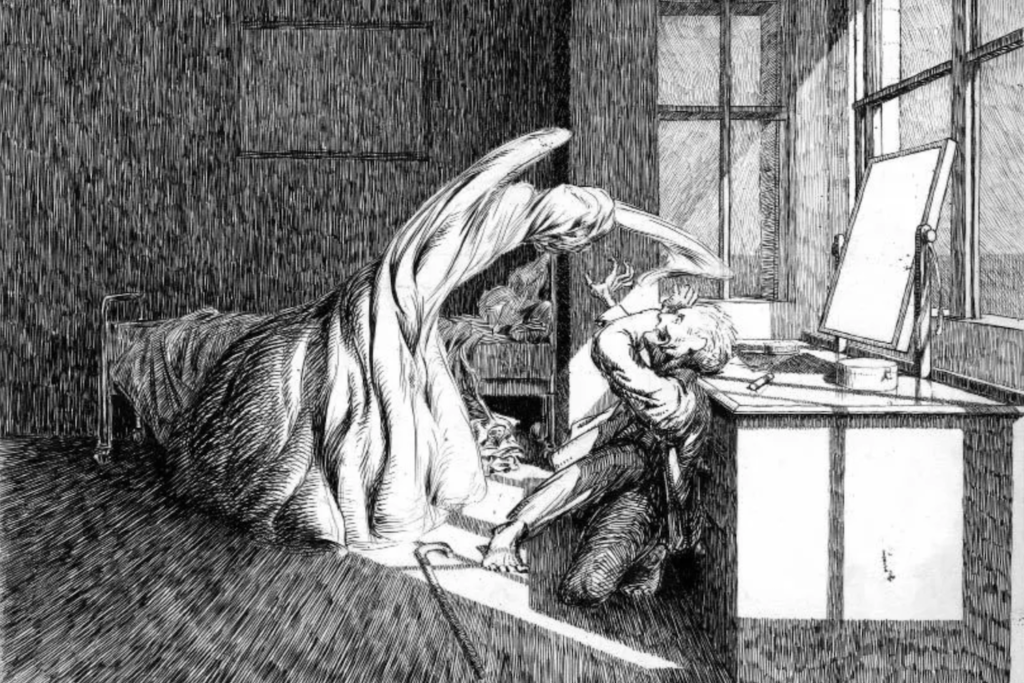
You are sitting at your desk, the lamp throwing its familiar amber circle, a cup of tea cooling at your elbow, and you realize — not with alarm but with something quieter and more corrosive — that you have never actually checked what agreed to leave you alone in this room.
Erving Goffman spent much of 1959 arguing, in the careful sociological language of The Presentation of Self in Everyday Life, that social reality is not a thing that exists but a performance that all present parties must continuously sustain. Interaction depends not on honesty but on collective pretense: everyone in the room agrees, tacitly, to behave as though the surface is the substance, to treat the lamp as merely a lamp, the desk as merely a desk, the other person as merely the person they are presenting. The social order is not a contract in any legal sense because it has never been signed, never been witnessed, never been ratified by the counterparty on the other side of the arrangement. It holds together only because everyone keeps performing it.
What M.R. James understood, in the bone-deep way that precedes articulation, is that the counterparty — whatever presses against the underside of domesticity — has never agreed to any of this. It has not consented to remain invisible during daylight hours. It has not signed the clause that says it will hold still while you move through your morning routine, that it will respect the territorial markings of your furniture, that it will pretend, as you pretend, that the room is simply a room. The horror in a James story is not supernatural intrusion so much as it is the collapse of a performance that was always unilateral. One side stops pretending, and the set dressing — the books, the firelight, the scholarly order of things — does not disappear; it simply stops being sufficient camouflage.
The genius of that effect lies precisely in what is not removed. James never strips the room bare. The whistle in “Oh, Whistle, and I’ll Come to You, My Lad” does not dissolve the bedsheets — it occupies them. The thing that comes for Parkins borrows the domestic linen as its body, which means the domestic object is not protection but material. Every comfort you have arranged around yourself turns out to be available to the thing that has never agreed to stay out. Goffman would call this a breakdown of the frame, the moment when the implicit agreement governing an encounter is visibly, irrevocably violated and everyone present suddenly sees the scaffolding that was always holding the scene up. James’s reader experiences this not intellectually but physically, because the frame being broken is the frame of the readable, familiar world.
There is a particular kind of dread reserved for the moment when a routine object — a pillow, a curtain, a pair of spectacles lying on a bedside table — is described with slightly too much attention. James knew this calibration precisely. Routine depends on not looking too carefully. Schedule, warmth, the placement of furniture: these are mechanisms of inattention, ways of moving through a space without ever fully perceiving it. The moment perception sharpens, the contract is already under strain, because the contract was written in the currency of comfortable blindness. Every James protagonist who lingers, who looks again, who picks up the object they should have left undisturbed, is not making a mistake of curiosity so much as they are committing the social error of withdrawing from the collective performance, of pulling back the curtain on the agreement and finding that no signature was ever there.
What remains when the performance collapses is not chaos but clarity — a terrible, useless clarity about the nature of everything that had been keeping you warm.
👻 Between Dread and the Mundane: Terror in Literature
M.R. James built his ghost stories on a simple but devastating principle: the uncanny lurks inside the familiar, transforming libraries, country churches, and quiet academics into stages for genuine horror. To fully appreciate his art, it helps to explore the broader landscape of supernatural literature, aesthetic theory of fear, and the haunted imagination of the Victorian and Edwardian eras.
Arthur Machen: Life and The Great God Pan
Arthur Machen was one of the great architects of literary dread in the late Victorian period, and his work shares with M.R. James a profound conviction that the worst horrors are those that breach the surface of ordinary life. His novella ‘The Great God Pan‘ introduced a kind of cosmic terror rooted in ancient, indifferent forces that prefigures much of twentieth-century weird fiction. Understanding Machen’s vision of the supernatural helps illuminate the tradition within which James both worked and subtly diverged.
GO TO THE SELECTION: Arthur Machen: Life and The Great God Pan
H.P. Lovecraft: Life and Works
H.P. Lovecraft, though American and writing in a later generation, was deeply influenced by the British ghost story tradition that James helped define, and both authors share an obsession with forbidden knowledge and the terror of the unknown. Lovecraft pushed the antiquarian dread of James toward cosmic nihilism, replacing English churchyards with unfathomable galactic voids. Comparing the two reveals how a shared aesthetic of erudite, slow-burning horror can yield radically different philosophical conclusions.
GO TO THE SELECTION: H.P. Lovecraft: Life and Works
Edmund Burke and the Sublime: Terror as Aesthetic Experience
Edmund Burke’s foundational treatise on the sublime established that terror, when experienced at a safe aesthetic distance, produces a powerful and even pleasurable emotional response—a paradox that lies at the very heart of the ghost story as a genre. Burke identified obscurity, vastness, and the suggestion of danger as key triggers of sublime experience, all qualities M.R. James exploited with masterful precision in his tales. Reading Burke alongside James reveals how deeply the English ghost story tradition is embedded in Enlightenment aesthetic philosophy.
GO TO THE SELECTION: Edmund Burke and the Sublime: Terror as Aesthetic Experience
The Literary Fantastic: Todorov and the Theory of the Fantastic
Tzvetan Todorov‘s theory of the literary fantastic defines the genre by its essential hesitation between a natural and a supernatural explanation for uncanny events—a tension M.R. James exploits with remarkable skill, never quite dispelling the mystery. Todorov’s framework allows us to understand why James’s stories feel so unsettling long after they are finished: the ghost is never fully confirmed, the rational explanation never fully satisfying. This theoretical lens transforms the reading of James from a pleasurable scare into a meditation on the limits of knowledge and perception.
GO TO THE SELECTION: The Literary Fantastic: Todorov and the Theory of the Fantastic
Discover the Cinema of Fear and Wonder on Indiecinema
If M.R. James’s quiet, creeping dread has stirred something in you, Indiecinema is the place to follow that feeling further. Our streaming platform gathers independent and auteur films that explore the supernatural, the uncanny, and the terror hidden inside everyday life—the cinematic heirs to James’s literary tradition. Join us and let the darkness in.
👉 EXPLORE THE CATALOG: Watch Indie Films in Streaming
A vision curated by a filmmaker, not an algorithm
In this video I explain our vision

