
The Lamp Lit Under Occupation
You are holding a page that should not move you, and yet something behind your sternum has shifted in a way you will spend the rest of your life trying to describe. The year is somewhere in the 1840s. The text is not scripture, not a colonial administrative document, not a translation produced by the East India Company’s servants to better govern you. It is written in your language — Bengali — and it is speaking to you as though the person who wrote it had sat beside you and watched the particular quality of your silence. This has not happened before. Not like this.

What is easy to forget, looking backward through the archive, is that there was nothing inevitable about Bengali literature finding this register of address. A vernacular tradition existed, certainly — the Vaishnava padavali, the Mangalkavya cycles, the vast oral current that moved through village performance and seasonal ritual. But the nineteenth century did something structurally different. It created a written secular literature in Bengali at precisely the moment when the language itself had become a site of administrative and epistemological contest. The British colonial apparatus had decided, with the institutional confidence that only a bureaucracy can muster, what counted as knowledge, what counted as education, and in which language both were permissible. Thomas Babington Macaulay’s 1835 Minute on Indian Education was not merely a policy document. It was a declaration about whose interior life deserved a grammar.
The Bengali intellectuals who responded to this were not, in any simple sense, nationalists. The category had not yet crystallized in the way that later decades would require. What they were was something more uncomfortable: people who understood that the ground of subjectivity itself was being reorganized beneath their feet, and who chose to think in public, in Bengali, about what that reorganization cost. Rammohan Roy, who died in Bristol in 1833 before the decade of greatest ferment arrived, had already demonstrated that vernacular argument could carry philosophical weight — that Bengali was capable of sustaining a critique of both Hindu orthodoxy and colonial condescension simultaneously. His work did not inaugurate a tradition so much as establish a precedent for inhabiting contradiction without resolving it prematurely.
What the colonial encounter produced, paradoxically, was a hyper-literacy. Fort William College, established in 1800 to train British civil servants in Indian languages, became an inadvertent engine of prose standardization. The grammars and dictionaries commissioned for colonial administrative purposes created a codified Bengali that had not previously existed in quite that form. The Serampore Mission press, beginning its operations in 1800, introduced movable type for Bengali script at a moment when the capacity to reproduce and distribute text transformed what writing could do socially. By the 1820s and 1830s, newspapers and journals were circulating among a Bengali readership in Calcutta that was small in number but extraordinary in its appetite for argument. The Sambad Kaumudi, the Samachar Darpan, the Tattvabodhini Patrika — these were not polite cultural supplements. They were instruments of a self that was learning, under surveillance, to articulate its own condition.
Surveillance is not a metaphor here. The colonial administration monitored Bengali periodical literature with the anxious attention of any power that understands that thought, once distributed, cannot be reliably contained. The Press Regulations of 1823 were imposed specifically to control what could be printed. Writers knew this. The knowledge shaped not just what they said but how they said it — the indirection, the irony, the willingness to embed a devastating observation inside a formal structure that appeared, from the outside, entirely orthodox. A literature born inside this pressure did not emerge naive about the relationship between language and power.
The lamp was lit, in other words, not in a room of freedom, but in a room where someone was watching to see whether you would light it at all.
Thirsty
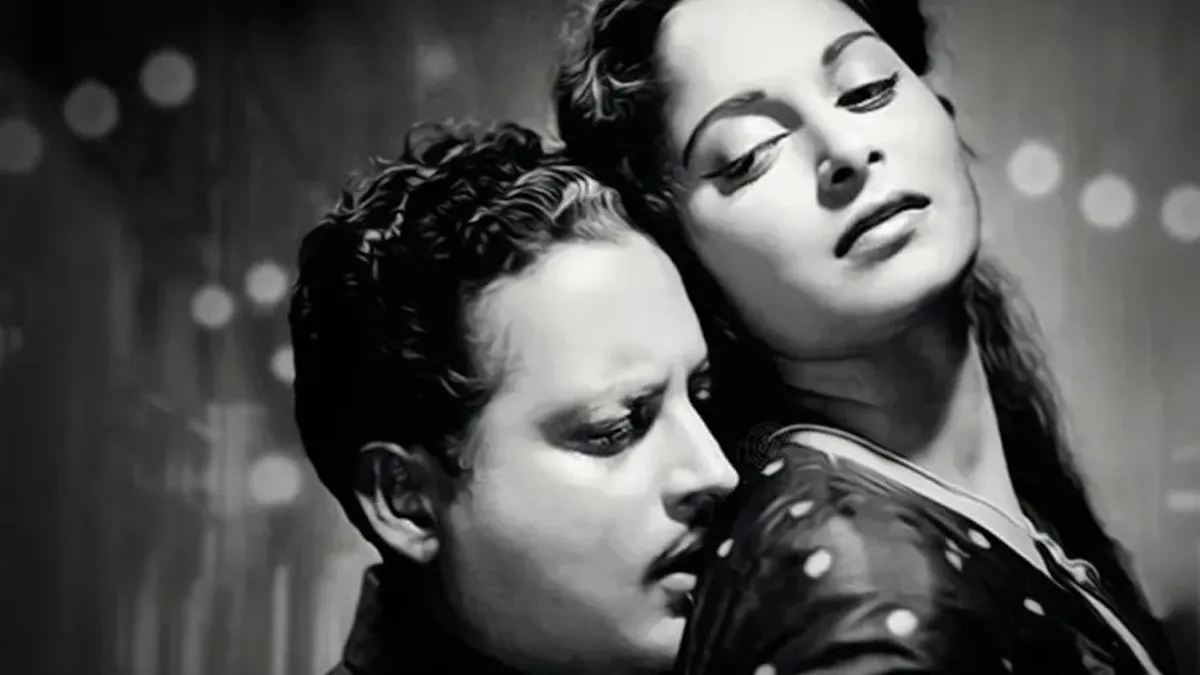
Drama, musical, by Guru Dutt, India, 1957
Thirsty is the heartbreaking story of Vijay, a young poet living in Calcutta who dreams of giving voice to the suffering and injustice of the world through his verses. Idealistic and sensitive, Vijay clashes with a society that despises his art because it is not profitable and does not cater to the tastes of the public. His brothers consider him a failure, the woman he loves leaves him for a marriage of convenience, and his poems are ignored by publishers. Only Gulabo, a prostitute with a pure heart, recognizes the beauty and truth of his words. When a misunderstanding leads everyone to believe Vijay is dead, his name and poetry suddenly become famous, exposing the hypocrisy of those who had previously rejected him.
Watching Thirsty means immersing oneself in a work that goes beyond melodrama, blending poetry, music, and imagery into a profound reflection on the human soul and the value of art. Guru Dutt, director and protagonist, creates one of the most intense and poetic films in world cinema, where black-and-white cinematography, expressive framing, and evocative lyrics produce an atmosphere of poignant melancholy. It is a film about the misunderstanding of the artist, pure love, and society’s hypocrisy, but also a universal critique of materialism and opportunism. Even today, Thirsty moves and provokes thought because it sincerely tells the story of the need to remain true to oneself in a world that measures people’s worth solely by their success.
LANGUAGE: Hindi
SUBTITLES: English, Spanish, French, German, Portuguese
What the Missionaries Accidentally Unleashed
You are handed a grammar book and told it will make you legible to your masters, and somewhere in the act of learning to be read, you learn to read back.
Fort William College opened in Calcutta in 1800 not as an act of cultural generosity but as an administrative emergency. The East India Company had watched enough of its young officers stumble through Bengal making catastrophic errors of translation, misreading land deeds, bungling judicial proceedings, humiliating themselves before the very population they were meant to govern. The College was a correction mechanism, a finishing school for empire, designed to produce functionally literate colonial administrators who could transact business without constant embarrassment. The Bengali prose it commissioned — dictated, funded, and distributed by the colonial apparatus — was instrumental, transactional, a tool of extraction dressed in the language of education.
William Carey arrived in Bengal in 1793 under the banner of the Baptist Missionary Society, and by 1800 he was already deep in the obsessive, almost pathological project of reducing Bengali to grammatical order. His Grammar of the Bengali Language, published at Serampore in 1801, was the first systematic attempt to codify what had until then been a living, sprawling, regionally fractured vernacular. Carey believed he was building a highway to the soul, a cleared road along which scripture could travel without distortion. What he actually built was a road. The direction of travel was not his to determine.
The Serampore Mission Press, running from 1800 onward, produced texts at a volume Bengal had never encountered — religious tracts, grammatical manuals, translations of scripture, and eventually, because the press existed and the type was set and the infrastructure was humming, texts that had nothing to do with conversion at all. The material conditions of literary production had been installed by people who imagined they were controlling the content. They were not. A press is a press. Once you teach a society what printed prose looks like, what a standardized sentence is capable of doing, what it means to address a reading public rather than a listening congregation, you have changed something that cannot be changed back.
What emerged in the decades following was not gratitude and not rebellion but something stranger and more durable: a self-consciousness. Bengali intellectuals encountered, through the very apparatus of colonialism, the concept of their own language as a bounded, rule-governed, historically deep object of study. Mrityunjay Vidyalankar, one of the pandits employed at Fort William to produce prose texts, wrote Pratapaditya Charitra in 1801, a historical narrative in Bengali that was commissioned as a language exercise for British officers. It was also, whether its commissioners understood this or not, an act of historical memory — a Bengali telling a story about a Bengali king to an audience that would eventually include Bengalis who had never been asked to see themselves as the subjects of their own history.
The irony is not that colonialism gave Bengal its literature. The irony is tighter and more painful than that. Bengal had vast literary traditions — the Mangalkavya cycles, the Vaishnava padavali, a millennium of manuscript culture. What colonial institutions provided was a specific technology of standardization and a specific market logic: the idea that prose could address a general public rather than a ritual community, that a text could travel beyond the occasion of its making. When Rammohan Roy published his Vedanta-related Bengali tracts in the 1810s and eventually his Persian-language attack on British press censorship in 1823, he was operating with tools the colonial system had sharpened. The argument he made for a free press — that without it, Bengal would remain in administered ignorance — was published through channels the Company had itself helped construct.
There is a particular species of miscalculation that empires commit repeatedly, which is the belief that infrastructure is neutral.

Ram Mohan Roy and the Violence of Reform

You are sitting with a text that does not ask for your approval. It states. It insists. It moves through its own argument the way a surgeon moves through a body — not carelessly, but without sentiment for what must be cut. This is how Ram Mohan Roy wrote in 1820, and the sensation for his Bengali readers was precisely that: not illumination, but incision.
The Precepts of Jesus, published that year, stripped the Christian gospels of their theology and retained only the ethical skeleton. No resurrection, no divinity, no institutional church — just the moral instructions, laid bare, offered to a Bengali readership as portable rational tools rather than sacred inheritance. The Serampore missionaries were furious, and their fury revealed something Roy understood perfectly: the most destabilizing act is not rejection but reduction. He did not attack Christianity. He extracted from it what he needed and discarded the rest with the calm efficiency of a man who has decided that tradition is raw material, not monument.
What makes Roy genuinely difficult to absorb — even now, even within the hagiography that has smoothed him into a national founding figure — is that this same extractive logic operated on his own inheritance with identical ruthlessness. His campaign against sati between 1818 and its legal abolition in 1829 is usually narrated as humanitarian intervention, a man of feeling confronting barbarism. But the prose he deployed in that campaign, in pamphlets and in the pages of the Sambad Kaumudi which he founded in 1821, was not the prose of a man pleading. It was the prose of a man prosecuting. He cited Sanskrit jurisprudential texts against the very custodians of those texts, weaponizing Brahminic learning against Brahminic authority — a move that required an almost cold willingness to use the father’s tools to dismantle the father’s house.
The Sambad Kaumudi itself deserves to be understood as a formal intervention, not merely a journalistic one. Bengali periodical prose in 1821 still largely operated within registers inherited from court correspondence and devotional literature — it deferred, it elaborated, it ornamented. Roy’s newspaper prose did none of these things. It addressed. It argued. It assumed a reader who was a citizen before such a political category had any institutional reality in Bengal. Michel Foucault‘s observation in Discipline and Punish that the production of new subjects requires new discursive technologies applies here with uncomfortable precision: Roy was not simply changing what Bengalis thought but manufacturing the kind of subject who could think in that way — atomized, rational, responsible for their own conclusions.
This is where the violence of his project becomes legible in ways that celebration tends to obscure. The reformed subject Roy was producing was, structurally, a subject whose ties to inherited community, to caste obligation, to the devotional epistemology of bhakti, had been partially severed. Reforming sati did not only save women from pyres. It repositioned the widow as an individual legal subject rather than a ritual participant in her husband’s cosmic fate — and that repositioning had costs that were not distributed evenly. The women who survived were returned to a social world that had not yet built the institutions to receive them as anything other than burdens. Roy’s prose moved faster than the society it addressed.
The Brahmo Samaj, which Roy founded in 1828, one year before his departure for England and two years before his death in Bristol in 1833, institutionalized this speed differential. It created a congregation organized around monotheism and rational inquiry rather than iconography and inherited ritual — and in doing so, it created a social space that was simultaneously radical and narrow, available primarily to upper-caste Bengali men educated enough to sustain the abstraction it demanded. The reformer’s blade had cleared ground, but the cleared ground was not evenly open to all who had been displaced.
The Printing Press as Social Earthquake
You pick up a pamphlet someone has left on a bench near the Strand in Calcutta, sometime in the 1840s, and the words printed there are in your mother tongue, addressed to no one in particular, which means they are addressed to you.
This is a genuinely strange experience, stranger than we are capable of feeling now, because we have never known its opposite. For centuries, knowledge in Bengal moved through bodies — through the reciting mouth of the pundit, the listening ear of the student, the hand of the copyist who introduced small errors and small corrections in equal measure, each manuscript slightly different from the last because each was also a performance, a conversation between the scribe and the text. Transmission was always also interpretation. The chain of knowledge was a chain of relationships, warm, hierarchical, and alive with the friction of personalities. A text did not exist apart from the person who gave it to you.
What the printing press dismantled was not ignorance. It dismantled the social architecture that had made knowledge inseparable from obligation. Printed Bengali prose — and Gangakishore Bhattacharya’s first Bengali newspaper, the Bengali Gazette of 1818, marks one early rupture in this fabric — addressed a reader who had no prior relationship to the writer. No debt of discipleship, no ritual of transmission, no guarantee that the receiver would interpret within sanctioned boundaries. Walter Ong, in Orality and Literacy published in 1982, observed that print creates a sense of closure and authority in a text that oral culture never permits, because a spoken utterance can always be challenged in the immediate presence of its speaker. Print is speech that has left the room. It cannot be interrupted.
The epistemological consequences of this are not merely academic. By 1857, Calcutta sustained more than thirty Bengali periodicals — Sambad Kaumudi, Tattvabodhinī Patrika, Somprakash among them — and this number means that a literate Bengali could encounter, within a single week, arguments he had never heard voiced aloud, positions that no one in his physical community held, challenges to customs whose legitimacy had rested precisely on their being unwritten. The unwritten has an enormous social power: it cannot be quoted back at you. Print ended that immunity. Suddenly orthodoxy was quotable, and therefore refutable.
What gets called the Bengal Renaissance is often narrated as intellectual awakening, as if ideas simply arrived, as if enlightenment descended. The less romantic truth is that mass textual production created a new form of social pressure: the pressure of the anonymous public gaze. Michel Foucault‘s argument in Discipline and Punish, published in 1975, about visibility as a mechanism of control takes on a particular dimension here. To be printed was to become legible to strangers who had no loyalty to you, no reason to be kind, no customary restraint. Reformers used this. Pandits used it. Polemicists used it. The periodical press turned private conviction into public position, and public position into a kind of permanent record that the manuscript culture, with its controlled circulation and its copyist’s latitude, had never produced.
The vertigo this produced was not only felt by conservatives defending tradition. It was felt in the body of the reform movement itself. Reformers who wrote in Bengali periodicals found that their arguments, once printed, acquired constituencies they had not intended — readers in Dhaka and Murshidabad and Chittagong who had no access to the polite drawing rooms of Jorasanko, who received the printed argument as a permission rather than a debate, and who acted on it in ways that embarrassed the genteel reformer who had launched the idea into print as a careful provocation for educated men. The press did not simply transmit ideas. It detonated them into a social field the writer could not see and could not control, and what detonated in that field was sometimes unrecognizable to the hand that had struck the match.
Michael Madhusudan Dutt's Sovereign Failure
You leave Calcutta in 1848 convinced that London will recognize what Bengal cannot yet name, carrying a manuscript and a borrowed accent, wearing the Christianity you converted to like a coat that almost fits.
Michael Madhusudan Dutt did not merely write differently from his predecessors — he destroyed the operating system and built another from scratch, and the tragedy is not that he failed but that he succeeded completely in a room no one had yet entered. In 1861, when Meghnad Badh Kavya appeared, Bengali literary culture was still organized around the gravitational pull of Sanskrit prosody, around a meter called payar that moved in rhyming couplets like a man walking with both feet tied together. Dutt cut the rope. He introduced blank verse — amitrakshar chhanda, the unrhymed line borrowed from Milton’s epic architecture — and in doing so he handed Bengali poetry a musculature it had not known it lacked. The form alone was a provocation. But the content was the deeper wound he inflicted on every comfortable assumption his readers carried.
Ravana, in the Valmiki tradition that had organized Hindu moral imagination for two millennia, is the obstacle, the obscene, the thing that must be destroyed so that dharmic order can be restored. Dutt looked at this figure and saw something that the original poem had deliberately refused to see: a king defending his civilization against an invader, a father watching his heroic son die, a man whose grief is structurally indistinguishable from the grief the epic asks you to feel for Ram. Meghnad — Ravana’s son, the true center of the poem — falls not because he is wicked but because the gods have already decided the outcome, and Dutt renders this divine favoritism with an irony so precise it becomes accusation. Lakshmana kills Meghnad while he prays, unarmed, in a sacred space. The poem does not flinch from what this means. Dutt, writing in 1861, four years after the Sepoy uprising had been drowned in imperial reprisal, was encoding into epic form a question about who gets to be the hero of history and by whose authority that assignment is made.
The cognitive distance required to receive this — to sit inside a tradition and simultaneously watch it from outside, to feel loyalty to Ravana without abandoning the emotional architecture the tradition had built — was a distance his immediate readership had not been trained to travel. Ishwar Chandra Vidyasagar recognized the poem’s magnitude almost immediately, and his advocacy kept Dutt from complete invisibility, but recognition from one giant does not constitute a culture’s readiness. What gets called “ahead of its time” is almost always a precise diagnosis of a social failure: the culture was not behind, it was organized around different priorities, and the new work was asking it to reorganize faster than institutions, habits, and economic structures permit.
Dutt spent his final years in Calcutta in a state of material collapse that has the quality of something staged for instruction, except no one was learning. He had burned through whatever earnings his legal career in Madras and Versailles had generated — he had actually lived in France for a period in the 1860s, writing to Vidyasagar begging for money with a directness that strips away every literary dignity. The letters survive. They are devastating not because of their poverty but because of their clarity: he knew exactly what he had made, he knew exactly what it was worth, and he knew that this knowledge would not feed him. He died in 1873, two days after his wife, both of them in the same Calcutta hospital, destitute. He was forty-nine.
What the literary histories tend to do with this is convert it into martyrdom, which is a way of admiring the result while avoiding the structural question the life actually poses — which is whether a culture that cannot sustain the people who renovate its imagination deserves to call their deaths tragic rather than merely convenient.
A vision curated by a filmmaker, not an algorithm
In this video I explain our vision
Bankimchandra and the Fiction of the Nation

You are handed a novel and told it will teach you how to love your country. You do not question this. You open it, and by the third chapter something has shifted in your chest — not thought, not argument, but a feeling you cannot name yet, something between grief and fury and devotion, and it belongs, you discover, to a people you are now part of.
Bankimchandra Chattopadhyay understood something about the architecture of collective emotion that no political pamphlet of his era could achieve: that belonging must be felt in the body before it can be articulated in a manifesto. When Anandamath appeared in 1882, Bengal had no unified political nation to speak of, no institutional vehicle for the energies it was about to release. What it had, instead, was a readership — literate, middle-class, largely Hindu, shaped by the collision of Sanskrit learning and colonial education — and Bankim gave that readership an emotional curriculum. The novel did not describe nationalism. It performed it, trained the nervous system to respond in specific ways to specific symbols, and the training held for generations.
The central mechanism was theological displacement. The motherland was not represented as a geographic or administrative fact but as a goddess — Bharat Mata, Durga, Kali fused into one composite figure of simultaneous nurturing and terrible power. The famous hymn embedded in the novel, Vande Mataram, condensed this fusion into eleven Sanskrit lines that could be memorized, chanted, weaponized. Rabindranath Tagore, who would later write the song that became India’s national anthem, recognized the grammar Bankim had invented and understood both its power and its danger — the danger being precisely that the emotional intensity of devotion to a maternal deity could not, by its internal logic, be universalist. It required an Other, a pollutant, something that had violated the sacred body of the mother. In Anandamath that role was assigned to Muslim rulers, a historical framing drawn selectively from the late Mughal period, and the choice was not incidental. It encoded a communal fault line directly into the emotional foundation of Bengali national feeling.
What makes this worth examining with unsparing attention is that Bankim was not a crude propagandist. He was a novelist of genuine sophistication, trained in the realist tradition, a Deputy Magistrate under British administration who read Comte and Spencer and translated his sociological anxieties into fiction. His earlier novels, particularly Bishabriksha in 1873 and Krishnakanter Will in 1878, had explored the tensions of Hindu domestic life, the position of women, the cruelty concealed within respectable households — work that cuts with psychological precision. The man who wrote those books then turned the same narrative skill toward manufacturing collective identity, and the combination proved irresistible precisely because it arrived dressed in literary seriousness. Readers were not being harangued. They were being moved.
The figure of the sannyasi warrior in Anandamath — the ascetic who renounces private life to consecrate himself to the nation-as-mother — established a template for heroic masculinity that would echo through Bengali and eventually pan-Indian political culture well into the twentieth century. Sacrifice became not merely admirable but erotically charged, coded as the highest form of masculine fulfillment. Aurobindo Ghose read Bankim before he became a revolutionary; the Swadeshi movement activists of 1905 chanted Vande Mataram in the streets of Calcutta. The emotion the novel had manufactured had by then been running in Bengali veins for two decades, looking for an event to attach itself to.
This is what literature can do that philosophy cannot: it does not persuade, it habituates. By the time a reader has wept for Bankim’s characters, argued with no one, refuted nothing, they have already been shaped by a world they entered voluntarily, as entertainment, as pleasure — and the shape persists long after the book is closed.
The Woman Reader They Forgot to Suppress
You have been told, more times than you can count, that the nineteenth-century Bengali renaissance was a revolution of consciousness — that it cracked open a civilization and let light pour through. What no one mentions is that the light had a door, and the door had a lock, and the lock was keyed specifically to the hand of the educated Bengali man.
Rashsundari Devi was born around 1809 into a household where the idea of a woman reading was not merely discouraged but treated as a cosmological transgression. She had no teacher, no permission, no language for what she wanted. So she stole pages from her son’s primers and hid them inside the kitchen, pressing torn fragments of the alphabet against the wall when no one was watching, sounding out letters in the gaps between cooking and serving and surviving. She taught herself to read and write over years of this clandestine arithmetic, and eventually she wrote a book. Not a poem composed in dutiful praise of a husband. Not a devotional tract that could be folded into the existing furniture of feminine piety. She wrote her own life — its texture, its confinement, its grief, its hunger for something she could not even name when the hunger began.
Amar Jiban, published in 1876, is the first autobiography written in Bengali by anyone. Not the first by a woman. The first by any human being in that language. The men who were busy theorizing the awakening, debating reform in journals, writing novels about the condition of Hindu society, did not produce this form first. A woman who had to hide her literacy inside a kitchen wall produced it first. The standard historiography of the Bengal renaissance treats this fact as a footnote, if it treats it at all, because the standard historiography was itself written by people who inherited the assumption that the awakening had certain legitimate authors and Rashsundari was not among them.
There is something structurally revealing in the way reform movements tend to carry their own blind spots as load-bearing walls. Ishwar Chandra Vidyasagar spent extraordinary energy on widow remarriage legislation, and the Widow Remarriage Act of 1856 was a genuine rupture in legal history. Yet the framework animating that campaign was still one in which women were the objects of reform rather than its agents — beings whose suffering needed to be corrected by enlightened men who had read the right Sanskrit sources and understood what Hindu tradition really meant. The reformer and the orthodox brahmin were fighting over the same piece of ground while the woman in the kitchen was building something neither of them had thought to build.
What Rashsundari actually wrote is not a protest document. That is perhaps the most disorienting thing about it. She does not position herself against the world that constrained her. She describes it from the inside with a precision that makes the constraint visible without ever editorializing about the constraint. She writes about the weight of domestic time, about what it means to want something unnamed, about the body moving through its prescribed circuits while something else inside it moves differently. Michel de Certeau, writing in The Practice of Everyday Life in 1980, would later theorize exactly this kind of behavior — the way people who cannot openly resist a system develop micro-tactics of appropriation within it, using the master’s infrastructure against the master’s intentions without ever confronting that infrastructure directly. Rashsundari was practicing this seven decades before de Certeau named it, in a kitchen in Bengal, with stolen alphabet pages.
The awakening, it turns out, was not a single event with a coherent set of authors. It was happening in multiple registers simultaneously, and some of those registers were invisible to the people most loudly announcing that consciousness was finally arriving in Bengal.
Rabindranath’s Shadow Falls Backward

You are reading this sentence because someone, at some point, decided that the story had a hero.
That decision — quiet, institutional, dressed in the language of merit — is how a century disappears. When the Swedish Academy awarded Rabindranath Tagore the Nobel Prize in Literature in 1913, the citation praised his “profoundly sensitive, fresh and beautiful verse,” but what the prize actually accomplished, in the decades of scholarship and pedagogy that followed, was the construction of a gravitational center so powerful that everything orbiting it lost its own light. The Bengali nineteenth century, which had been a genuinely fractured, argumentative, often self-contradicting literary explosion, was reorganized into a single origin story. Rammohun Roy became a precursor. Michael Madhusudan Dutt became a rehearsal. Bankimchandra Chattopadhyay became a stepping stone. The sheer intellectual violence of that compression is rarely named for what it is.
The philosopher of history Hayden White argued in Metahistory, published in 1973, that historical narratives are not discovered but emplotted — that the shape of a story, its arc toward resolution or tragedy or irony, is imposed on events rather than extracted from them. The Nobel Prize performed exactly this kind of emplotment on Bengali literary history. It supplied a terminal point of triumph, and from that terminal point, every preceding decade was reverse-engineered into a prologue. The logic is seductive precisely because it feels like recognition: surely the century that produced Tagore must have been building toward him. But this is teleology masquerading as tribute, and what it buries is the possibility that the century was building toward several things simultaneously, many of which were abandoned, suppressed, or simply outcompeted.
Consider what the teleological frame cannot accommodate. It cannot hold Dutt’s spectacular, anguished failure — his conversion to Christianity, his destitution in Versailles, his death in 1873 with his European ambitions in ruins — as anything other than a cautionary detour. It cannot hold the women writers of the period, figures like Swarnakumari Devi, who edited the literary journal Bharati from 1884 and published fiction that interrogated zenana confinement from inside the experience of it, as anything other than footnotes to a male canon. It cannot hold the vernacular religious poetry that continued to circulate outside print culture entirely, unmeasurable and therefore invisible to any archive that prizes the codified text. The Nobel framework does not merely elevate one writer; it installs a particular definition of what literature is — cosmopolitan, translatable, legible to European taste — and retroactively applies that definition to a century that was mostly doing something else.
Pierre Bourdieu‘s analysis of the literary field, developed across Distinction in 1979 and The Rules of Art in 1992, identified the way symbolic capital accumulates not neutrally but according to the already-existing hierarchies of the field. Tagore’s Nobel did not simply reward a great writer; it rewarded a writer who had already been translated into English by his own hand, who had already been championed by W.B. Yeats, who already moved through the networks of imperial cultural exchange with a fluency that Bankimchandra — writing in Bengali with a deliberate refusal of English accommodation — never sought. The prize validated a specific posture toward the West, and then that posture was read backward as the inevitable posture of Bengali literary maturity.
What this means for anyone who reads the nineteenth century now is that the canonical texts arrive pre-interpreted, their difficulty sanded down, their contradictions resolved in advance by the knowledge of where the story ends. Dutt’s rage at the limits of Sanskrit prosody, Bankimchandra’s ferocious ambivalence about colonial modernity, Vidyasagar’s battle to reform a Brahminical textual tradition from within — these were not movements toward a single shore but separate acts of rupture, each one opening a future that was then foreclosed by history taking a different turn, and no prize awarded in Stockholm, however luminous the recipient, can restore what was abandoned at each of those forks.
🌸 Voices That Awoke a Sleeping Continent
Bengali literature of the nineteenth century did not emerge in isolation — it was part of a vast current of spiritual, poetic, and social awakening that swept across South Asia. These related articles trace the deeper roots and broader echoes of that renaissance, from mystical poetry to revolutionary verse.
Rabindranath Tagore: Life and Works
Rabindranath Tagore stands as the luminous culmination of the very Bengali literary tradition that the nineteenth century labored to build. His life and works absorb the social reformism, spiritual longing, and linguistic innovation of his predecessors, transforming them into a universal humanist vision. Understanding Tagore means understanding where an entire century of Bengali awakening ultimately arrived.
GO TO THE SELECTION: Rabindranath Tagore: Life and Works
Tagore’s Gitanjali: Analysis
Gitanjali, Tagore’s celebrated collection of devotional songs, is perhaps the most internationally recognized fruit of the Bengali literary renaissance. Its verses carry the weight of a tradition that had spent a century rediscovering the sacred in the vernacular, fusing Vaishnavite devotion with a modern sensibility open to the world. Reading Gitanjali is an encounter with a literature that had finally found its own sovereign voice.
GO TO THE SELECTION: Tagore’s Gitanjali: Analysis
Nazrul Islam: The Poet Who Defied an Empire With Verses
Nazrul Islam, the ‘Rebel Poet’ of Bengal, represents the incandescent continuation of the awakening that began in the nineteenth century. Where the earlier generation had fought for cultural dignity, Nazrul wielded verse as a direct weapon against colonial oppression and social injustice, merging Islamic mysticism, Hindu mythology, and revolutionary fire. His defiance shows how Bengali literature transformed from cultural renaissance into political resistance.
GO TO THE SELECTION: Nazrul Islam: The Poet Who Defied an Empire With Verses
Poetry as Revolt: Voices That Power Did Not Want to Hear
Poetry as revolt is not merely a modern phenomenon — its roots in South Asia stretch back precisely to the nineteenth-century Bengali writers who dared to use the vernacular as a challenge to colonial and Brahminical authority. This article explores how literary voice and political dissent have always been intertwined across the subcontinent, offering essential context for understanding why the Bengali awakening was also a deeply subversive act. The pen, in these traditions, was never innocent.
GO TO THE SELECTION: Poetry as Revolt: Voices That Power Did Not Want to Hear
Discover the Cinema of Awakening on Indiecinema
If the voices of Bengali literature have stirred something in you, Indiecinema is the place to go deeper. Our streaming platform gathers independent and world cinema that carries the same spirit of cultural awakening, poetic resistance, and human dignity. Join us and let the screen become another page of discovery.
👉 EXPLORE THE CATALOG: Watch Indie Films in Streaming
A vision curated by a filmmaker, not an algorithm
In this video I explain our vision

