The Voice Before the Silence
There is a man at the kitchen table who will not go to bed. It is past two in the morning. The bottle in front of him is three-quarters empty and his eyes are wet and bright, the way eyes get when something between grief and joy has dissolved the membrane that normally keeps a person contained. He is reciting something — not performing it, not showing off for whoever remains slumped in the chair across from him — reciting it the way other men breathe, because stopping would mean confronting the silence that lives just underneath the words. You have met this man. You may have been this man. And if you have sat across from him long enough, you know that what feels like excess is actually a form of terror made beautiful by the velocity at which it moves.

Dylan Thomas was this man. He was this man in the pubs of Soho, in the cramped flats of Swansea, in the living rooms of New York admirers who had invited a legend and received instead something rawer and harder to categorize — a presence that seemed to generate its own weather, its own pressure system, arriving with noise and warmth and a voice that people who heard it once never stopped describing for the rest of their lives. That voice. Everyone who encountered it reaches for the same words: musical, incantatory, oceanic. A BBC producer who recorded him in the 1940s said it was like hearing the English language remember what it was originally for. This is not a metaphor. This is a technical observation about what happens when a human instrument is tuned beyond the normal range of expression.
He was born in Swansea in 1914, the son of a grammar school English teacher who read Shakespeare aloud to him before he could understand the words, and perhaps that is where the whole story begins — not in meaning, but in sound. Before the semantic content, before the argument or the image or the idea, there is the physical fact of language as vibration, as breath shaped by muscle and bone into something that enters another body through the ear. Thomas never entirely left that pre-verbal relationship with words. He kept it even as he learned to deploy meaning with extraordinary precision. The result was poetry that operates simultaneously on two levels — the level of sense and the level of pure sonic event — and the tension between those two levels is what makes a poem like “The Force That Through the Green Fuse Drives the Flower,” written when he was seventeen years old, feel less like a text to be read than an experience to be survived.
This is the philosophical problem that Thomas poses and that no biography has entirely resolved: what does it mean to live so loudly that the noise becomes the self? Most people maintain a distinction between their interior life and its expression. There is the self and then there is what the self produces, and the gap between them is where privacy lives, where the capacity for reflection lives, where the possibility of choosing who you are rather than simply being it lives. Thomas collapsed that gap, or perhaps he was born without it. The philosopher Charles Taylor, writing in Sources of the Self about the modern construction of identity, argues that the autonomous self depends on a kind of inner distance from its own drives. Thomas had no such distance. He was not a man who wrote poetry. He was a condition that poetry was the symptom of.
The drunk man at the kitchen table will eventually sleep. The bottle will be cleared away, the night will pass, and in the morning there will be ordinary daylight and ordinary silence and the hangover’s flat accounting of costs. But for the hours when he is reciting into the dark, something real is happening. Something that cannot be recovered in sobriety or explained in the light.
The Lost Poet
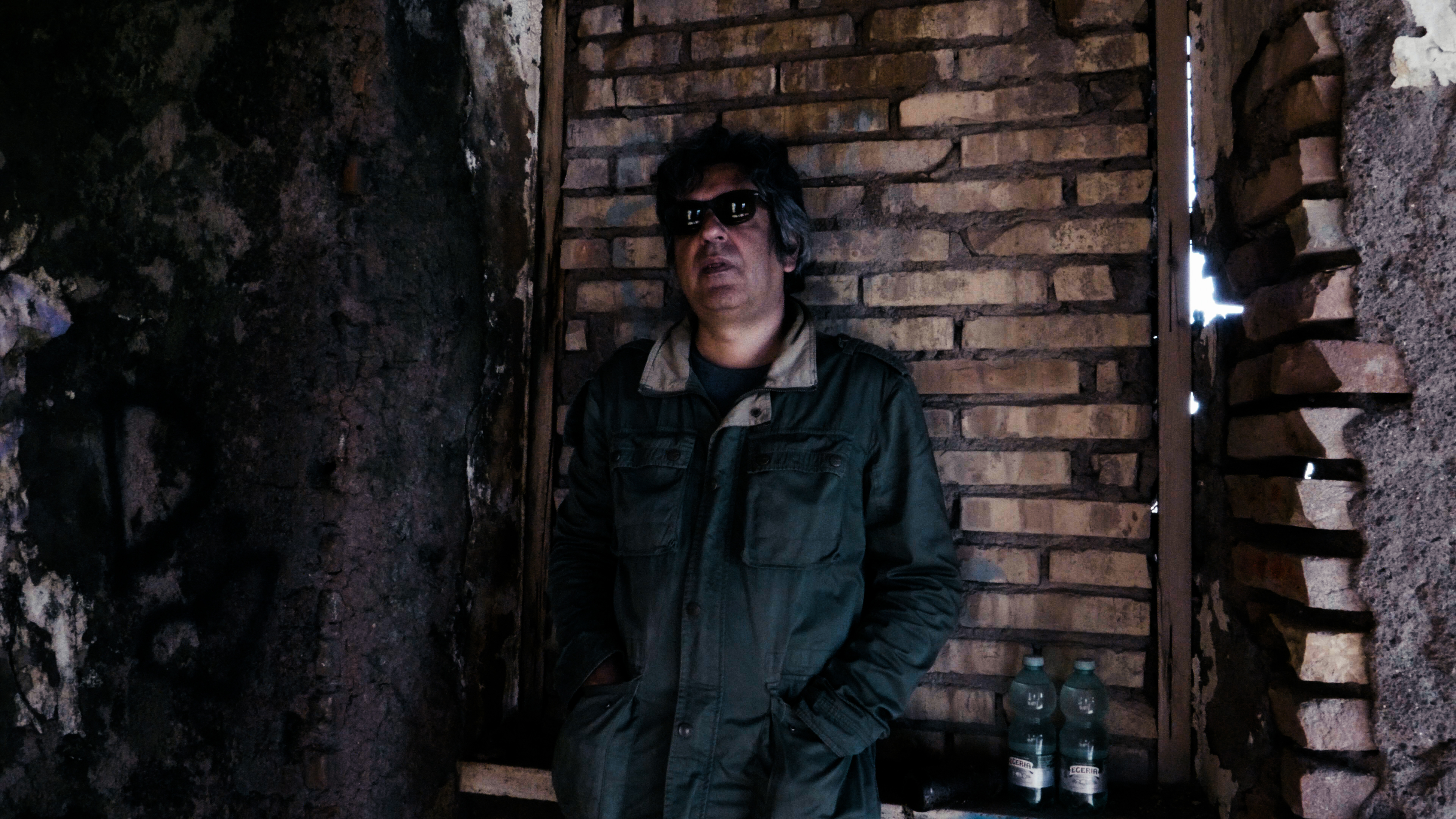
Drama, by Fabio Del Greco, Italy, 2024.
Dante Mezzadri wants to see an old friend, nicknamed the Iguana, whom he has lost sight of for many years, and who has managed to turn their shared youthful passion for poetry into a job, becoming a famous writer and poet. The man escapes from his bourgeois life and his wife to live homeless on the Roman coast, printing and trying to sell his poetry collections. At night he sleeps in a park of old carnival floats, inside a papier-mâché tank, and waits for the opportunity to meet his old friend, who however never shows up for appointments in the places they frequented when they were young, now in ruins. Dante's poetry books do not interest anyone and to support himself he is forced to "change product": he starts selling the infamous "cannibal pill" on behalf of young drug dealers, a new drug that sells like hot cakes and causes sensory and consumerist ecstasy. However, he realizes that this powerful drug is very dangerous for those who take it, he comes into conflict with his ethical conscience and throws all the pills into the sea. However, the dealers want to collect their money.
Shot over a period of 2 years, the film is a reflection on the cultural and artistic rubble of the society in which the protagonist lives, in an increasingly mechanized, consumerist and arid world. Dante Mezzadri is yet another human being who has renounced his inspiration and his creativity, but unlike many he is not willing to give his life to a system that distances him from his true identity. The physical world around him, however, seems constructed in such a way that it seems impossible to escape from this "invisible cage". The enthusiasm of the people he meets is ignited only by sensory gratification, by unreal visions of personal affirmation and success, by "metaverses" that offer an escape into an illusory and destructive reality. The poet's house on the coast, where he met with his friends as a young man, is just a pile of abandoned rubble. What happened to all those who wanted to become poets and ended up becoming something else? Are there internal forces with which that house can be "rebuilt"?
LANGUAGE: Italian
SUBTITLES: English, Spanish, French, German, Portuguese
Swansea and the Grammar of a Wound
There is a city that shaped him before he knew he needed shaping. Swansea, 1914, a port town on the southern lip of Wales, perpetually damp, perpetually caught between two identities it could never fully inhabit at once. The English dismissed it as provincial and vaguely foreign. The Welsh heard in its streets an accent too anglicised to be trusted. It was a place that existed in the grammatical gap between two languages, and Dylan Thomas was born directly into that gap.
His father, D.J. Thomas, taught English literature at the local grammar school with the ferocious intensity of a man compensating for something — for Wales, perhaps, for being Welsh in a world that rewarded you in direct proportion to how little of Wales you carried. He read Shakespeare aloud to his son before the boy could understand the words, which is precisely the point. The sounds arrived before the meanings. Thomas absorbed English as a kind of music, a foreign tongue made native through sheer repetition of its rhythms, and this gave him a relationship to language that native speakers almost never achieve. He heard it. He heard it the way you only can when some part of you knows it was not entirely yours to begin with.
Zygmunt Bauman, writing in Liquid Modernity in 2000, argued that the most destabilising condition of modern identity is not poverty or exclusion but the impossibility of stable belonging. The man who cannot fix himself to one territory, one tradition, one coherent narrative of self, is perpetually in motion, and that motion is both wound and gift. Thomas had no stable ground. He was too Welsh for England, too English for Wales, too working-class for the literary establishment he would one day dazzle, too flamboyant and self-destructive for the respectable Welsh nonconformist culture that surrounded his childhood. He belonged nowhere with complete conviction, and so he learned to speak from everywhere with complete conviction. The wound and the voice were the same wound.
Then the bombs came. In February 1941, the Luftwaffe hit Swansea for three consecutive nights and reduced the town centre to a landscape of ash and collapsed façade. Two hundred and thirty people died. Streets Thomas had walked as a boy, the market, the pubs, the terraced slopes leading down toward the water, were levelled. He was in London during the raids, writing radio scripts and drinking, watching a different city burn. But the news of Swansea’s destruction reached him in the way that childhood places always reach you when they are destroyed: not as information but as amputation.
Four years later, in 1945, he wrote Fern Hill. The critical reflex has always been to call it nostalgic, which is perhaps the laziest reading available. The poem is not an act of looking back. It is an act of building back. He reconstructs a Welsh rural childhood that was never entirely his in the first place, a farm belonging to his aunt near Carmarthen, a landscape of fields and apple trees and the particular green light of summer mornings, and he builds it with such ferocious verbal intensity that the reconstruction becomes more real than the original. This is not nostalgia. Nostalgia is passive. It sits and mourns. What Thomas does in Fern Hill is closer to what the historian Svetlana Boym called restorative nostalgia in The Future of Nostalgia, published in 2001 — the impulse not to mourn the lost home but to rebuild it in language with a fidelity so absolute it becomes a new and more permanent form of possession.
He rebuilt Swansea with vowels. He could not rebuild it with stone.
And perhaps that is the structural truth of everything he ever wrote: the man from the city that was never quite anywhere used language to construct the only territory that would hold him.

The Craft Before the Chaos
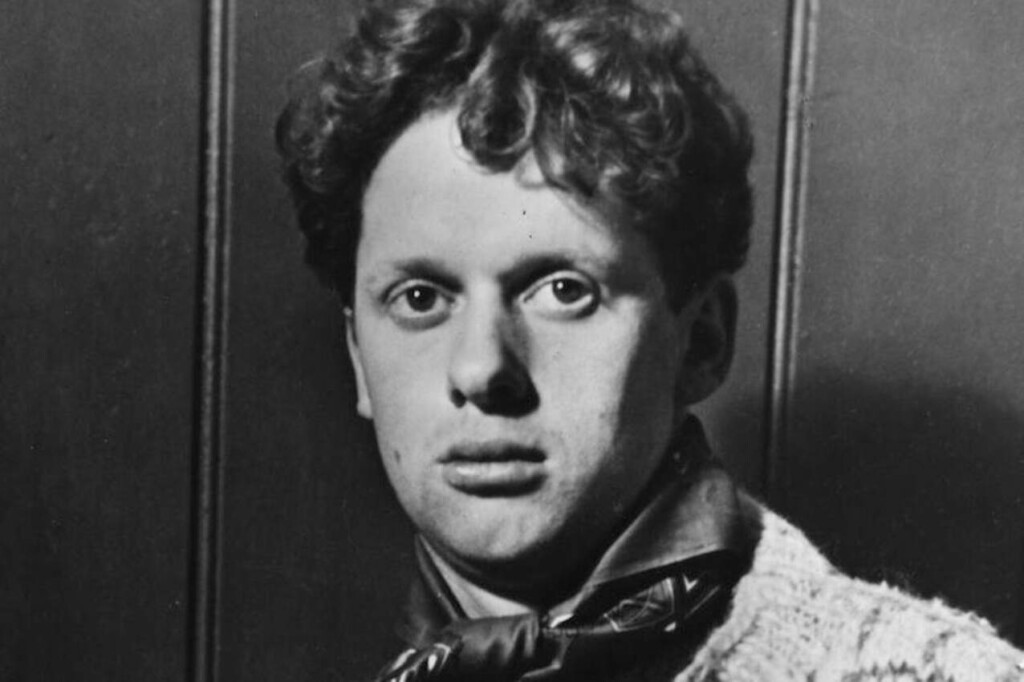
There is a specific kind of loneliness that belongs only to the craftsman who cannot stop. Not the romantic loneliness of the misunderstood genius staring at horizons, but the small, airless loneliness of a man bent over a table at two in the morning, crossing out a word he wrote an hour ago, writing it back, crossing it out again. The lamp throwing its circle of yellow light. The woman asleep in the next room, or perhaps not asleep, perhaps listening to the scratch and silence, the scratch and silence, knowing better than to speak. The distance between that table and that bed is not measured in feet. It is measured in something that has no unit yet invented.
This is where the myth of Dylan Thomas as pure volcanic eruption, as bardic accident, as the man who simply opened his mouth and poetry fell out, begins to collapse under the weight of the actual evidence. His notebooks, which he kept obsessively from adolescence, contain not the spontaneous outpourings of an inspired primitive but the forensic record of a mind at war with language. Single stanzas revised across dozens of drafts. Individual lines reconceived so many times that the original intention becomes archaeological, buried under successive layers of attack and retreat. He said himself, and he meant it without romance, that a poem might take a full year to finish. Not a year of intermittent attention. A year of returning, daily, to the same knot of syllables and pulling at it until something gave.
When 18 Poems appeared in December 1934, Thomas was nineteen years old. What happened next in the critical world is almost always misremembered. The standard narrative reaches for enchantment, for the story of a child prodigy welcomed with open arms into the English literary tradition. The truth is considerably stranger. The critical establishment was not enchanted. It was destabilized. Edith Sitwell, hardly a conservative reader, wrote of the poems with a mixture of admiration and visible unease, as though she had encountered something she lacked the existing vocabulary to fully categorize. Geoffrey Grigson, who had published Thomas in his journal New Verse and ought to have been prepared, found himself writing responses that circled the work without quite landing on it. The poems refused to behave. They were formally dense, obsessively attentive to sound in ways that felt almost pre-rational, and yet they were not nostalgic. They did not reach backward toward Georgian pastoral. They reached toward something that had no name in 1934.
What unsettled people was precisely what the myth later erased. The poems were too deliberate. The imagery was too compressed, too load-bearing. These were not the products of divine madness. They were the products of a very young man who had read Gerard Manley Hopkins until the pages softened, who understood how syntax could be torqued under pressure without breaking, who believed that a poem’s sound was not decoration but argument. The body of the language doing the thinking that the mind alone cannot do.
And yet the myth was more convenient, for everyone. For critics who needed to explain an idiom they could not fully account for. For Thomas himself, perhaps, who understood that the persona of the wild Welshman who drank and roared and stumbled into genius was far easier to sell in London literary circles than the truth of the dim room, the crossed-out word, the year spent on twelve lines that still did not satisfy him. The persona was a kind of camouflage. And camouflage, as anyone who has worn it knows, eventually becomes a second skin you cannot find the seam of.
The woman in the next room turns over in the dark. The scratch of the pencil stops. Then begins again.
Alcohol as Mythology and as Murder
There is a particular kind of drinking that has nothing to do with pleasure. You have seen it, or you have done it yourself — the way a man refills his glass not because he wants more but because the room, without the drink, becomes unbearable in its precision. The edges of things are too sharp. The people are too legible. The silence between words carries too much information. So he drinks, and the room reassembles itself into something softer, something he can inhabit without feeling like a wound exposed to open air. This is not celebration. This is not even escape. It is closer to what Walter Benjamin described when he wrote about the storyteller standing at the threshold between experience and death — the figure who has seen too much and whose authority comes precisely from that proximity to annihilation. The drink does not move him away from that threshold. It makes the standing there endurable.
Benjamin’s essay on the storyteller, published in 1936, argued that the art of storytelling was dying because modern experience had become incommunicable — that the First World War had returned men from the front not richer in communicable experience but poorer, that something in the structure of contemporary life had severed the transmission of wisdom through narrative. What he perhaps could not have predicted is the figure who responds to that severance not by going silent but by screaming louder, by filling the gap with more language, more performance, more noise — and by drinking to sustain the volume. Dylan Thomas was that figure. His drinking was not the fuel for his poetry. It was the cost of his presence in a world where presence itself had become a performance, and where the performance was the only thing standing between him and the silence he most feared and perhaps most needed.
The mythology constructed around his death is almost perfectly designed to obscure what actually happened. The story you were told — that he drank eighteen straight whiskies at the White Horse Tavern on Hudson Street, walked back to the Chelsea Hotel, and collapsed into legend — is the story that serves the myth of the doomed genius, the Rimbaud trajectory, the beautiful self-destruction that confirms art’s proximity to flame. It is a useful story. It makes the death meaningful, which is to say it makes the death literary. But the hospital records from St. Vincent’s, where he was taken on November 4, 1953, tell something considerably less poetic. The admitting physician, Milton Feltenstein, had earlier that day injected Thomas with half a grain of morphine sulfate — a dose dangerously inappropriate for a man in his condition, a man who had not eaten properly, who was in respiratory distress, whose body was already negotiating with more than whisky. Thomas fell into a coma. He died on November 9, aged thirty-nine. The cause was recorded as a severe insult to the brain, pneumonia, a fatty liver — the accumulated damage of years — but the immediate precipitant was, in the careful reading of later medical analysis, as much negligence as mythology. Feltenstein was never formally censured. The eighteen whiskies became the official story because it was the story everyone needed.
This is what Benjamin means when he speaks of the storyteller and death as inseparable. Not that great artists die young and beautifully, which is a lie dressed as a truth. But that the proximity to annihilation is the condition of transmission — that the story can only be told by someone who has lived close enough to the edge to know what the edge feels like from the inside. Thomas lived there. But he did not choose the edge. The edge was chosen for him by a culture that found his self-destruction more legible, more marketable, more consoling than his survival would ever have been.
Do Not Go Gentle: The Poem as Act of War
There is a particular moment that breaks something in you quietly, without announcement. You are watching your father try to read a letter, holding it closer and then farther, squinting against a light that no longer cooperates with him, and you understand — not intellectually, but in the stomach — that the man who once seemed to contain the whole world in his certainty is now being slowly erased by it. The letter trembles slightly in his hands. He does not ask for help. That is the worst part.
Dylan Thomas wrote the poem in 1947, watching his father David John Thomas — a schoolteacher, a proud man who had read Shakespeare to his son before the boy could walk, a man who had wanted to be a poet himself and settled for shaping one — go blind in old age. What emerged from that watching was not elegy. It was not consolation. It was fury dressed in the most disciplined formal structure Thomas ever submitted to, which is itself a kind of statement: that some emotions are too violent for free verse, that grief at its most extreme requires walls to throw itself against.
Simone de Beauvoir, writing in The Coming of Age in 1970, identified something that the culture around her was working very hard to deny: that aging is not a natural softening into acceptance but a form of dispossession, a stripping away of the powers by which a person has defined themselves, and that the social expectation of graceful decline is itself a violence. She was describing what society demands of the old — that they become smaller, quieter, less insistent on their own significance — and she named that demand for what it was: a convenience for everyone except the person being diminished. Thomas, writing twenty-three years earlier in a form rather than an argument, arrived at the same indictment.
The villanelle is not an easy form to love. Nineteen lines, two rhymes only, two refrains that return with the insistence of something that refuses to stay buried. Dylan Thomas did not choose it because it was elegant. He chose it because obsession requires repetition, because the mind that cannot accept a truth circles it over and over, approaching from different angles, testing it each time for a weakness that is never there. Rage, do not go gentle, rage against the dying of the light — the line returns not as refrain but as demand, as the same argument made again because the first time it was not heard, and the second time it was not heard, and the argument does not stop simply because it is losing.
What the poem enumerates in its central stanzas is a catalogue of different ways men have lived — the wise, the good, the wild, the grave, the gay — and in each case the argument is the same: they had not finished. They had not said everything, had not done everything, had not been everything they were capable of being, and so they should not yield. This is not a philosophical position about the nature of death. It is a son telling his father that he is not yet allowed to become less. It is a refusal to permit diminishment, which is precisely what de Beauvoir identified as the most transgressive act available to the aging: the refusal to cooperate with your own erasure.
There is a scene — a man in his seventies sitting in a chair while his adult son crouches beside him, trying to explain something the father can no longer quite follow, and the father’s face carries that particular expression of someone who knows he is being explained to where once he did the explaining — that belongs to every family that has ever existed. Thomas transformed that scene into a command. Not a plea. A command addressed directly to his father, repeated until the poem ended, and then once more.
A vision curated by a filmmaker, not an algorithm
In this video I explain our vision
America as Mirror and Abyss

The stage lights hit you before the words do. You are standing in front of four hundred people at the 92nd Street Y, or at Berkeley, or at some university in the Midwest whose name you already cannot remember, and the applause begins before you have opened your mouth. They are not applauding you. They are applauding the idea of you, which is a different and far more dangerous thing. The Welsh thunder, the bardic drunk, the man who writes poems the way a storm breaks — not chosen but erupted. They need you to be primitive so they can feel that poetry is still alive, and that its aliveness has nothing to do with the careful, ironic work they themselves produce in academic offices. You are their antidote. And antidotes are consumed, not listened to.
Thomas made four reading tours of America between 1950 and 1953, and the audiences that filled those halls were not wrong, exactly, about what they felt in his presence. His voice was genuinely extraordinary — recorded readings still carry a physical authority that modern listeners describe as almost bodily. But what they built around that voice was a fiction, and the fiction had a function. Guy Debord, writing in 1967 in The Society of the Spectacle, described the mechanism with cold precision: in a society organized around image and performance, the living person is gradually replaced by their representation, and then the representation is what gets consumed, celebrated, and finally destroyed. Thomas was not a man on those American stages. He was an image the culture required — the Dionysian outsider, the counterweight to T.S. Eliot’s cultivated difficulty, proof that poetry could still be raw and Welsh and roaring and drunk on its own sound.
There is a scene — a man performing for a crowd that watches him the way a crowd watches a fire, with pleasure and with a readiness to be warmed that has nothing to do with caring whether the fire survives. He knows it. You can see it in his face between the lines, in the fractional pause before the applause swallows him again. He tells himself the applause is recognition. But recognition would require them to see him. What they are doing is something closer to projection, and projection is a form of loneliness even when it looks like love.
This is what America offered Thomas, and it was catastrophic. Not because the audiences were cruel — most were genuinely moved — but because the structure of the encounter made it impossible to be a person rather than a symbol. He drank more on those tours, not less. The drinking was partly the schedule, partly the social performance expected of the wild Welshman, but it was also, one suspects, a response to the particular vertigo of being seen by thousands and recognized by none. Hannah Arendt, in The Human Condition published in 1958, draws a distinction between being visible in public and actually existing in public — the first is spectacle, the second requires genuine plurality, genuine encounter. Thomas had the first in overwhelming abundance. He had almost none of the second.
What he gave them was the voice, the performance, the work — and the work was real, no spectacle there. The poems were the same poems they had always been, carrying their earned weight. But what it cost him was the ability to believe that the poems were enough, that he was enough, that the man standing at the lectern had any continuous existence independent of what the crowd’s hunger made of him. The applause, arriving before he had spoken and continuing after the words had dissolved, functioned as a kind of erasure. Not hostile. Absolute. The way a standing ovation can leave a person more alone than silence, because at least in silence there is still a shape to the space where you are standing.
Caitlin and the Architecture of Mutual Destruction
There is a particular kind of fight that happens in kitchens at three in the morning, when every surface has been cleared of everything except the two people who cannot leave. You have seen it, perhaps lived it: the voices drop below shouting into something worse, something surgical, and neither person moves toward the door because moving toward the door would mean becoming someone who does not need this, and neither of them is that person yet. The glasses are full. The glasses are empty. The argument is not about what it is about. It never is, at that hour, in that room.
Dylan and Caitlin Macnamara married in July 1937 in Penzance, Cornwall, with almost nothing between them except appetite and a mutual recognition so fierce it was indistinguishable from violence. She was a dancer, Irish-French, wild-bodied, trained under the choreographer Margaret Morris, with a talent that her contemporaries recognized as something formidable and unresolved. He was already the author of Eighteen Poems and Twenty-Five Poems, already wearing the mask of the doomed bard so comfortably that the mask had begun to fuse with the skin beneath. Two people who required the same oxygen walked into the same room and decided to share it.
Simone Weil, in her essay “The Love of God and Affliction” written in 1942, drew a distinction that most people find uncomfortable precisely because it is accurate. Affliction, she wrote — malheur in the original French — is not suffering. Suffering passes. Affliction is when suffering has penetrated so deeply into the identity of a person that to be relieved of it would require the annihilation of the self as currently constituted. The afflicted person cannot simply choose to stop. The condition has become the architecture of the self. Weil was writing about the soul and its relationship to God, but the structure she described is recognizable in marriages where destruction has become the shared grammar, the only language both people speak fluently.
Caitlin drank. Dylan drank more. She took lovers; he took lovers. She threw things; he disappeared into pubs for days. But beneath the operatic wreckage of the public record, something more precise was happening: Caitlin was a serious artist whose seriousness was continuously subordinated to the mythology of her husband. Every interview asked about Dylan. Every introduction named her as his wife before naming her as herself. Her dancing, her writing, her particular fury and intelligence — these became, in the cultural narrative, mere symptoms of being married to a genius, evidence of the specific madness that proximity to greatness produces in women. She understood this. She raged against it with her body, her infidelities, her bottle, and her fists. The rage was entirely rational. It was also entirely useless, because the trap had been constructed at a level below conscious choice, at the level of what Weil would call the gravity of social existence — the force that pulls every person toward the position the world has already assigned them.
And Dylan needed her anger. Not in any simple psychological sense, not because he was a man who required punishment, but because her refusal to be domesticated, her insistence on her own chaos, was the only proof available that chaos was still livable, that the burning was not only his. When she left, temporarily, repeatedly, the poems often came. When she was present, the drinking escalated. This was not cause and effect. It was two people organized around the same wound, each using the other to avoid looking at it directly.
The three-in-the-morning kitchen is not a place people go by accident. It is the room you arrive in when you have been, for years, slowly choosing it over every other room available to you. By the time you understand this, the house has been built entirely around it.
The Words That Outlive the Body
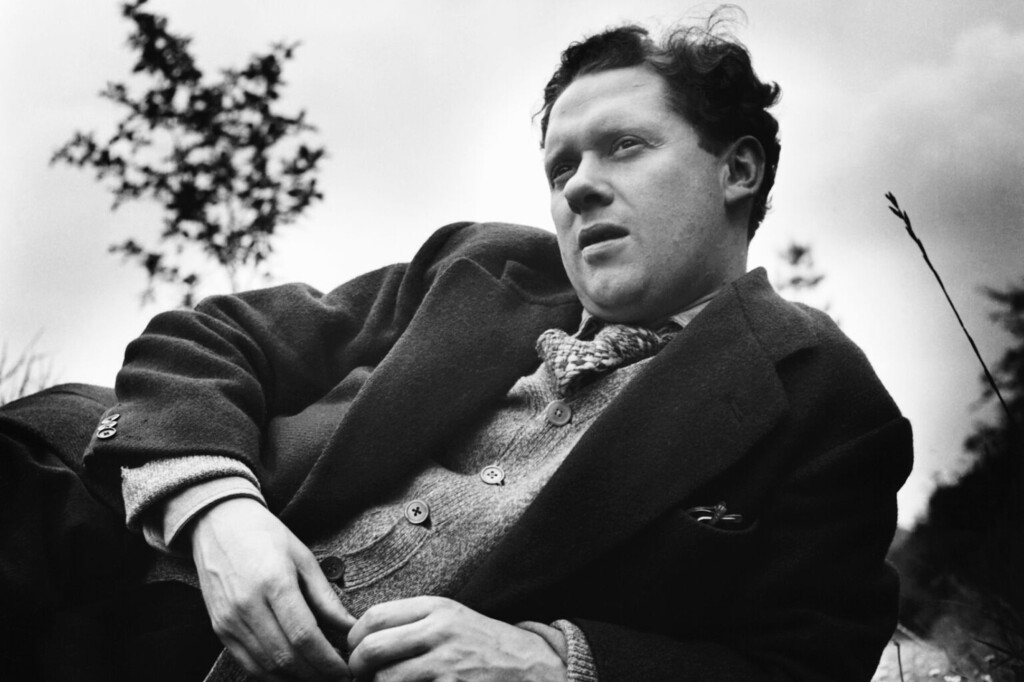
There is a moment that happens to certain people alone in a room at night — not often, maybe once or twice in a life — when a voice comes through a speaker and you do not move. You were about to stand up, about to reach for something, about to do the ordinary thing that fills the space between one hour and the next, and then something in the sound stops you. Not the meaning of the words yet, not the argument or the story, but the texture of the voice itself, the way it carries inside it the full weight of a person who once breathed and no longer does. You sit there in the dark with your hands in your lap and you do not move because moving would break it, because the spell is exactly as fragile as it feels, and you already know, somewhere beneath the thinking part of you, that this is one of those moments you will not be able to explain later to anyone who was not in the room.
That is what Under Milk Wood does. It was broadcast on BBC Radio in January 1954, months after Thomas died on a New York pavement at thirty-nine, and the voices it released into the air — Captain Cat dreaming of his drowned sailors, Polly Garter singing to her dead lover, the whole impossible village of Llareggub waking into its own strange tenderness — landed in living rooms across Britain with the force of something that had always been true and had simply been waiting for the right vessel. People who heard it described a physical sensation, something close to being found out, as if the play knew things about them they had not yet admitted to themselves.
Roland Barthes, writing in Camera Lucida in 1980, identified what he called the punctum — the detail in a photograph that wounds you, that reaches out of the frame and pricks you personally, not because it is beautiful or historically significant but because it finds the specific raw place in you that no one else might even notice. It is not the studium, the general cultural meaning you can discuss with others; it is the thing that ambushes you alone. Barthes was writing about images, about the arrested moment of photography, but the punctum is not exclusive to the visual. Language can do it too, and Thomas’s language does it with a consistency that defies rational accounting. A phrase will rise off the page — “the force that through the green fuse drives the flower” — and something in you answers before you have processed the grammar, before you have decided whether you agree or understand. The wound comes first. The meaning, if it ever comes at all, comes after.
What is harder to hold is the fact of who made it. A man who drank to stop feeling, who destroyed every room he entered, who wept in bars and borrowed money from strangers and could not stay faithful to the people he loved most, who in the end could not manage the basic project of staying alive — this man assembled, out of the chaos of himself, something that makes other people feel less alone in their own chaos. There is a version of this story in which that is beautiful, in which the suffering becomes retroactively purposeful, in which the wreckage is transformed into meaning and we can close the book with something that resembles peace. But there is another version, equally plausible, in which that consolation is itself the trap — the story we tell about ruined artists so we do not have to ask what it would have cost us, collectively, to catch them before they fell, and whether the poems we treasured were worth the price that only one person paid.
🌊 Voices from the Edge: Poetry, Madness, and Vision
Dylan Thomas stands among those rare artists whose life and work cannot be separated — his Welsh voice, his bardic intensity, and his tragic arc connect him to a broader tradition of writers and thinkers who pushed language and the self to their limits. These related articles trace the currents of existential philosophy, visionary writing, and the literature of identity that flow beneath and around Thomas’s world.
Virginia Woolf: Life and Works
Virginia Woolf‘s life and works illuminate the modernist struggle to forge a literary language capable of capturing the fluid, interior rhythms of consciousness — a project that deeply resonates with Dylan Thomas’s own sonic and imagistic approach to poetry. Both writers drew on a heightened sensitivity to time, mortality, and the music of language. Exploring Woolf’s legacy offers essential context for understanding the broader experimental tradition in which Thomas was rooted.
GO TO THE SELECTION: Virginia Woolf: Life and Works
Albert Camus: Life and Philosophical Thought
Albert Camus‘s philosophical thought centers on the absurd condition of human beings confronting a silent universe — a tension that echoes powerfully in Thomas’s insistence on singing against the dying of the light. Camus and Thomas were near-contemporaries who shared a post-war urgency, a love of embodied life, and a refusal to accept meaningless resignation. Reading Camus alongside Thomas deepens our understanding of mid-twentieth-century humanism at its most impassioned.
GO TO THE SELECTION: Albert Camus: Life and Philosophical Thought
Antonin Artaud’s Theater of Cruelty
Antonin Artaud‘s Theater of Cruelty sought to shatter comfortable aesthetic conventions and restore raw, visceral force to artistic expression — an ambition that finds a striking parallel in Dylan Thomas’s belief in poetry as incantation and physical presence. Both Artaud and Thomas were consumed by the relationship between the body, breath, and the spoken word. Their parallel trajectories reveal a shared avant-garde hunger to make art a matter of life and death.
GO TO THE SELECTION: Antonin Artaud’s Theater of Cruelty
Johann Wolfgang von Goethe: Life and Works
Johann Wolfgang von Goethe‘s life and works represent the archetype of the poet-seer who channels nature, myth, and personal transformation into a total artistic vision — a model that Dylan Thomas absorbed and inflected through his Welsh landscape and Nonconformist religious inheritance. Goethe’s sense of the poet as a mediator between the visible and invisible world resonates deeply with Thomas’s own bardic self-understanding. This article provides a rich comparative lens for appreciating Thomas’s place in the European lyric tradition.
GO TO THE SELECTION: Johann Wolfgang von Goethe: Life and Works
Discover the Cinema of Words and Visions on Indiecinema
If Dylan Thomas’s world of poetry, myth, and passionate intensity has moved you, Indiecinema streaming is the place to continue your journey. Our curated catalog brings together independent and art-house films that share that same commitment to authentic storytelling, lyrical vision, and the courage to see the world differently. Join us and let independent cinema speak directly to your imagination.
👉 EXPLORE THE CATALOG: Watch Indie Films in Streaming
A vision curated by a filmmaker, not an algorithm
In this video I explain our vision