
The Engineer Who Stopped Sleeping
You are fifty-six years old, you have spent three decades building machines that drain mines and calculating the weight of the earth’s crust, and tonight, again, you cannot tell whether you are asleep. The room in Amsterdam or London or Stockholm — it barely matters anymore, you have moved between them so many times the geography has stopped anchoring you — fills with something that is not quite light and not quite sound, and you find yourself writing it down because the scientist in you insists on recording what the human in you cannot categorize. You reach for your journal and the pen moves before you have decided to pick it up.

Emanuel Swedenborg in 1744 was not a mystic. He was the most decorated natural philosopher in the Swedish empire, a man who had published on metallurgy, anatomy, cosmology, and hydraulics, who had supervised the transport of five warships overland across the Scandinavian peninsula during the siege of Fredrikshald in 1718 — an engineering feat of such audacity that it still unsettles military historians. He had corresponded with Leibniz. He had proposed, in 1734, a nebular hypothesis for the formation of the solar system that Kant and Laplace would independently arrive at decades later and receive full credit for. He was, by any honest accounting, one of the most formidably credentialed minds on the continent. And then something broke open.
The journal he began keeping in 1743 and 1744, published posthumously under the title Drömbok, or Journal of Dreams, is one of the strangest documents in the history of European thought precisely because it refuses the comfort of either madness or enlightenment as explanatory frames. It is written in the careful, observational grammar of a man trained to measure and record. He notes the physical sensations — the trembling, the sense of being rolled across the floor by an invisible force, the sound that he describes as a rushing wind — with the same scrupulous attention he had applied to measuring the specific gravity of iron ore. He does not celebrate what is happening to him. He is, unmistakably, frightened by it.
What makes the rupture of 1744 so philosophically uncomfortable is that it cannot be dismissed as the arrival of irrationality into a rational life. Swedenborg had spent years, in his 1734 Principia Rerum Naturalium, attempting to derive the structure of matter from pure geometric and mechanical first principles — a project that required him to take seriously the idea that reality possessed layers not immediately available to the senses. He had already, in other words, been intellectually living in a universe with more rooms than ordinary perception could enter. The visions did not contradict his prior work so much as they walked through a door he had spent his career building without knowing it.
The crisis the journal records is not a breakdown in the clinical sense. It is a dissolution of the boundary between two cognitive states that most people never examine because they never have occasion to. Sleep and waking are not, for most human beings, philosophically interesting — they are simply alternating conditions of availability. But Swedenborg begins to notice, with increasing precision, that the states are bleeding into each other, that insights arrive with the texture of revelation rather than deduction, that the figures he encounters in his hypnagogic hours carry a consistency and purposiveness that random neural noise does not explain. He records a conversation with Christ. He records it the way a surveyor records the angle of a slope.
This is the detail that should stop you: not the content of the vision, but the methodology applied to it. A man who had calculated the mineral yield of Swedish copper mines now applied the same epistemological discipline to an encounter he believed was supernatural — and found the encounter more convincing than many of the certainties his era called science.
Cathnafola - A Paranormal Investigation
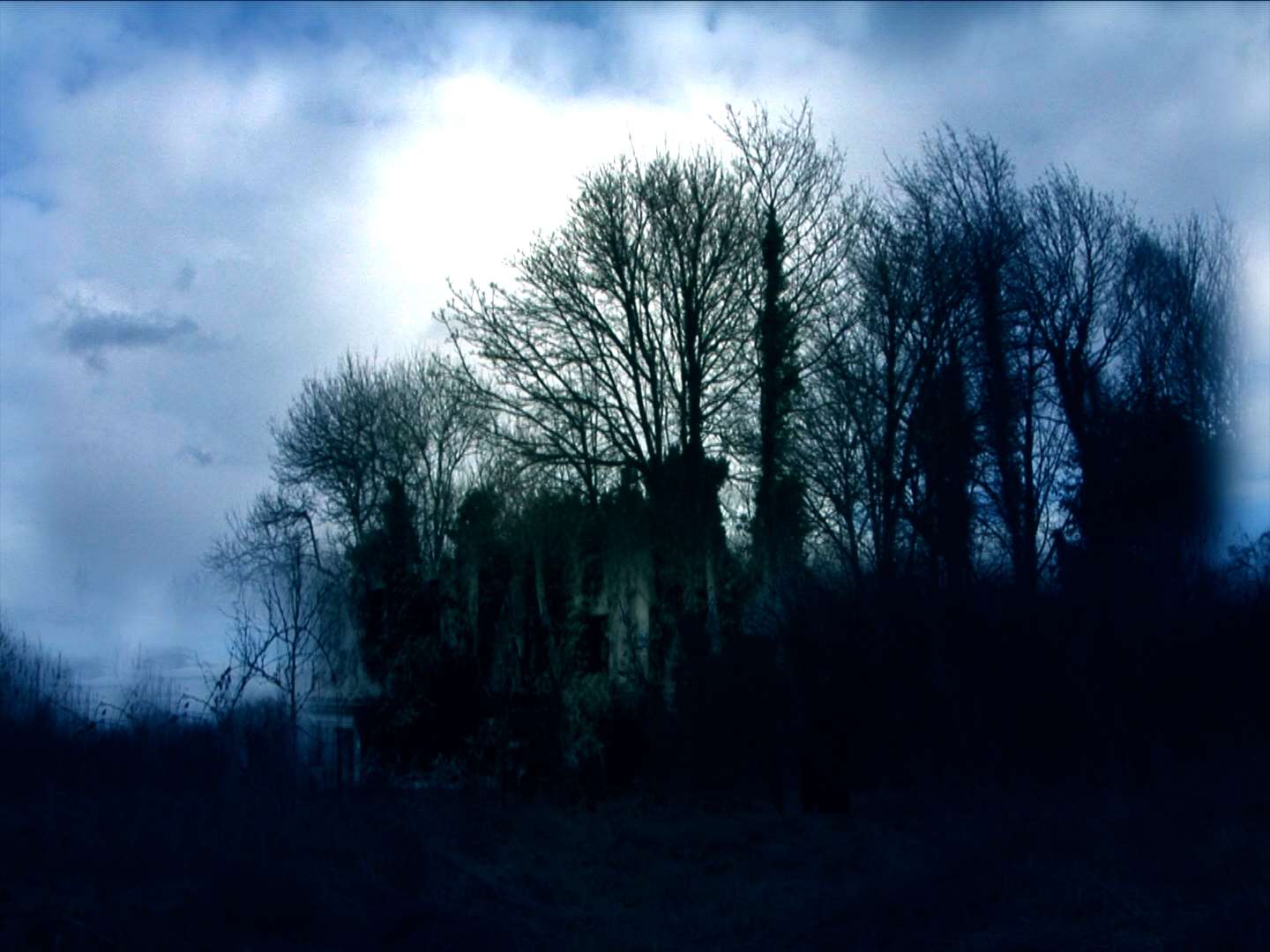
Documentary, horror, by Jason Figgis, USA, 2014.
In "Cathnafola", everything begins when renowned paranormal investigator Chris Halton of Haunted Earth UK receives footage filmed by three teenagers at the ruins of Cathnafola House in Ireland. Determined to unearth the truth behind the location’s bloody past, Halton embarks on a nighttime exploration of the infamous ruins—and soon uncovers terrifying and disturbing revelations.
LANGUAGE: English
SUBTITLES: Spanish, French, German, Portuguese
Thirty Years of Measuring the World
You are handed a set of copper ore samples and told to determine their yield. You weigh them, assay them, record the numbers in a ledger that will inform the economic decisions of a kingdom. This is not metaphor. This is what Emanuel Swedenborg did, repeatedly, for the Swedish Board of Mines — the Bergskollegium — for over three decades beginning in 1716, traveling through the interior of a country whose wealth lived underground, converting raw earth into columns of figures that would keep a northern empire solvent.
The remarkable fact about Swedenborg before the visions is not that he was intelligent. Eighteenth-century Europe was briefly crowded with intelligent men who could move across disciplines the way water moves across a tilted surface. The remarkable fact is how systematically he refused to stop. In 1716, the same year he joined the Bergskollegium as an assessor extraordinary, he was already corresponding with Christopher Polhem, Sweden’s foremost engineer, on problems of mechanics and hydraulic technology. His periodical Daedalus Hyperboreus, launched that same year, was the first scientific journal published in Swedish — not in Latin, not in French, but in the language of the craftsmen and miners who would actually use what it contained. This was not the gesture of a popularizer. It was the gesture of a man who understood that knowledge sealed inside scholarly Latin was knowledge functioning as social barrier rather than instrument.
Between 1721 and 1734 he published works on iron and copper smelting, on the mathematical principles of natural philosophy, on the motion of elements. His Opera Philosophica et Mineralia of 1734, a three-volume monument dedicated in part to understanding the structure of iron and the geometry of atoms, was read seriously by European scholars who had no particular interest in Swedish metallurgy — because the ambition running beneath the technical surface was nothing less than a unified account of matter itself. He was trying to locate the point where physics became cosmology, where the behavior of molecules in a blast furnace opened onto the behavior of the universe as a whole.
Immanuel Kant would later, in 1766, dismiss Swedenborg’s mystical writings in Dreams of a Spirit-Seer with a kind of contemptuous wit — yet Kant himself had absorbed and was quietly indebted to the earlier cosmological Swedenborg, whose nebular hypothesis of solar system formation anticipated by years the framework Kant would develop in his own Universal Natural History and Theory of the Heavens of 1755. The irony is architectural: the same mind Kant would mock as deluded had already seeded some of the ground Kant stood on.
The anatomical work pushed even further into territory that demanded both precision and a willingness to confront the limits of precision. Swedenborg’s Oeconomia Regni Animalis, published in two volumes in 1740 and 1741, was a serious attempt to locate the soul — not theologically, but physiologically, through the study of the cerebral cortex, the blood, and the motion of the cerebrospinal fluid. He was working on questions that neuroscience would not have adequate tools to address for another century and a half, but he was working on them empirically, through dissection records and comparative anatomy, through the published findings of Marcello Malpighi and Anton van Leeuwenhoek, through a methodology that accepted failure as information.
What this thirty-year record actually reveals is a man who had made a profound and unspoken wager with reality: that the visible world, examined with sufficient rigor, would eventually yield everything. That measurement was not merely a technique but a theology of the tangible. He was not simply a scientist in the Enlightenment mold — he was a man who had pushed the Enlightenment’s central promise further than almost anyone else dared, right to the edge where matter becomes insufficient to explain what the measuring instrument — the human mind — is actually doing when it measures.

The Crisis the Enlightenment Cannot Hold
You are sitting with a man who has spent forty years building instruments, measuring angles, calculating the weight of air, and you watch the moment his hands begin to shake — not from illness, not from age, but because something he cannot name has begun pressing against the inside of his skull from a direction that geometry does not recognize.
Emmanuel Swedenborg arrived at his crisis in 1744 not as a mystic searching for revelation but as one of Europe’s most accomplished scientific minds, a man who had corresponded with the engineers of certainty themselves, who had applied Cartesian mechanism to human anatomy with the same confidence that Descartes had applied it to the motion of planets. His Oeconomia Regni Animalis, published in 1740 and 1741, was a sincere attempt to locate the soul inside the body through empirical dissection — to find, somewhere between the cerebral cortex and the ventricular fluid, the precise anatomical seat of consciousness. He was not being naïve. He was being rigorously faithful to the philosophical contract that the seventeenth century had signed on behalf of all educated Europeans: that the real is measurable, that the knowable is mappable, and that the mind of God, if it exists at all, operates through laws indistinguishable from mathematics.
What collapsed in him was not a man. What collapsed was a method mistaken for a self.
The Enlightenment’s deepest psychological function was never purely epistemological. It offered something more intimate than a system of knowledge — it offered an identity, a way of being human that felt permanently modern, permanently safe from superstition, permanently above the embarrassment of the pre-rational. When Newton published his Principia Mathematica in 1687, he did not merely explain gravity; he gave educated Europeans a mirror in which they could finally see themselves as dignified, as having graduated from the childhood of civilization. Rationalism became not just a method but a class marker, a moral posture, an existential shelter. To doubt it was not to revise a hypothesis — it was to fall.
Swedenborg’s crisis journals, the Drömbok or Dream Diary kept between 1743 and 1744, reveal a man not peacefully receiving divine communication but violently thrown against the walls of his own cognitive architecture. He records trembling, heat, visions that arrive without invitation, voices that speak before sleep with a specificity that feels less like dream logic and more like interruption. What makes these entries philosophically disturbing is not their content but their structure: they are written by someone still trying to apply taxonomic precision to phenomena that actively resist being classified. He annotates his own dissolution. He tries to record the angel the way he once recorded the membrane of a lung.
William James, writing in The Varieties of Religious Experience in 1902, identified what he called “noetic quality” in mystical states — the insistence of those who undergo them that they have received genuine knowledge, not merely sensation. He was careful not to adjudicate the metaphysical truth of such knowledge, but he was precise about its phenomenology: it arrives with a certainty that outstrips the evidence available to ordinary cognition, and it cannot be argued away because it was never argued into existence. Swedenborg’s experience fits this structure with uncomfortable precision, which is exactly why it cannot be safely filed under pathology or safely filed under theology.
The rationalist tradition, when confronted with cases like his, has always reached for the same two exits: either the subject was ill, or the subject was deceiving others and possibly himself. Both exits serve the same function — they preserve the integrity of the framework by exiling the evidence. What they cannot explain is why the exile feels so necessary, why the anxiety of the rationalist confronting genuine anomaly so closely resembles the anxiety of the believer confronting genuine doubt, as if both are defending not a truth but a territory whose borders they have never actually inspected.
What the Visions Actually Said
You are sitting across from someone who insists they have visited the afterlife not once but thousands of times, and they are not describing clouds or light or the faces of dead relatives. They are describing jurisdictions. Administrative zones. The precise geometry of how goodness, when it hardens into habit, becomes indistinguishable from the landscape a soul inhabits.
The Spiritual Diary, which Swedenborg maintained in Latin across roughly twenty-seven years of visionary experience and which runs to thousands of entries, reads less like a mystic’s rapture and more like a surveyor’s field notes. Spirits cluster by affinity. Communities of the afterlife self-organize according to the dominant love that shaped a person in life, so that what you most truly wanted — not what you professed to want, but the desire running beneath every decision — determines not where you are sent but where you inevitably arrive. There is no tribunal in this cosmology in the conventional sense. The judgment is structural. You simply, at death, become exactly what you always were, and the environment around you becomes that thing made visible.
This is the doctrine of correspondences, and it is where Swedenborg’s thought touches something that would have been recognizable to the Cambridge Platonists and yet moves well past them into territory that made orthodox Lutheran theologians acutely uncomfortable. In Heaven and Hell, published in Amsterdam in 1758, he elaborated a principle holding that every natural phenomenon is the outward expression of a spiritual reality — not symbolically, not metaphorically, but as a matter of ontological structure. Heat in the spiritual world is love. Light is intelligence. Distance is the degree of difference between inner states. When two spirits move apart, it is not because space separates them but because their characters have diverged. The physical world you inhabit now is, by this logic, already a readable text if you know the grammar.
What disturbed the theologians was not the eccentricity of this claim but its relentless coherence. A vision that produces images can be dismissed. A system that produces laws cannot be so easily contained. Swedenborg’s architecture left no room for arbitrary divine intervention in the afterlife, no possibility of last-minute conversion, no mechanism by which institutional sacrament could override the accumulated direction of a lived life. The church, in any confessional form, does not appear at the gates of his heaven because the gates are not gates — they are states of being that either match yours or do not. Salvation by faith alone, the cornerstone of Lutheran theology since the Augsburg Confession of 1530, is quietly dissolved in a cosmology where what you believe matters infinitely less than what you have become in the act of believing it.
The word he returned to was usus — usefulness, function, the actual labor a thing performs in relation to other things. Angels in his account are not beings of pure contemplation. They work. They serve. Their joy is indistinguishable from their utility, not as a moral reward but as a metaphysical condition: in the spiritual world, what you are is expressed in what you do, without remainder, without performance. A person who performed goodness in life while cultivating contempt as their private state arrives not in heaven but in a community whose surface resembles heaven while its interior is exactly that contempt, now encountered without the mediating comforts of social life.
The Spiritual Diary records one such encounter in clinical detail — a spirit of apparently elevated bearing whose transformation upon full exposure to spiritual light reveals something shriveled and repelled by the company it had sought. There is no punishment administered. The recoil is automatic, constitutional. Swedenborg was not inventing a horror but describing, with the precision of someone who had spent forty years as a mining assessor and anatomist, how a structure that has been built wrong will eventually express its wrongness under sufficient pressure.
The Church He Never Founded and the Sect That Used His Name
You are sitting in a pew that a dead man never built, singing hymns to a theology he never systematized, inside a denomination named after a city he described as a spiritual state rather than an organizational structure. The New Jerusalem Church was formally constituted in London in 1787, eleven years after Emanuel Swedenborg died in a rented room on Bath Street, and the founding members were convinced they were honoring him. They were doing something far stranger than that.
Swedenborg spent the last two decades of his life producing works like “Arcana Coelestia,” an eight-volume exegesis of Genesis and Exodus published between 1749 and 1756, and “Heaven and Hell” in 1758, and at no point did he instruct anyone to build anything institutional around his revelations. He attended services of the Church of Sweden until his death. He had conversations with angels, not committees. When a small group of readers in Lancashire began gathering in 1782 to study his writings — the Preachers Robert Hindmarsh and James Glen among the early architects of what would become an organized body — they were performing an act of creative misreading so total that it transformed a private mystical cosmology into a confessional identity with membership rolls, ordained clergy, and eventually transatlantic congregations.
This pattern has a sociological name, though the name is less important than the mechanism underneath it. Max Weber, in “Economy and Society,” described how charismatic authority — the raw, disruptive force of the visionary — undergoes what he called routinization after the figure’s death. The living prophet disturbs existing structures; the dead prophet becomes a new structure. Followers cannot sustain the intensity of pure revelation indefinitely, so they translate it into offices, liturgies, and doctrines that can be administered without the original fire. The institution is not a betrayal of the prophet; it is what happens when ordinary human psychology encounters something it cannot hold in its hands.
What makes the Swedenborgian case particularly sharp is that the man left explicit evidence of his resistance to exactly this outcome. He wrote in his journal of spiritual experiences, the “Spiritual Diary,” that the true church exists within the individual conscience recognizing divine truth, not in external assembly or clerical hierarchy. He distrusted priestly intermediation with the directness of someone who believed he could walk into the spiritual world himself on any given afternoon. The New Jerusalem Church took this anti-institutional mystic and gave him vestments, hymnals, and a governance structure — which suggests that the institution was never really about Swedenborg at all. It was about the people who needed Swedenborg to mean something that could be scheduled on a Sunday morning.
By 1817, the General Convention of the New Jerusalem in the United States had been established, and Swedenborgian congregations were spreading through New England and the mid-Atlantic states with the same organizational efficiency as Methodist circuits. Helen Keller, whose theological commitments are rarely discussed with any precision, declared herself a Swedenborgian and wrote a 1927 essay, “My Religion,” defending his vision of spiritual correspondence as personally transformative. But notice what Keller was doing: she was claiming a private, interior experience of his ideas, not a denominational allegiance. She was reading him the way he wrote — as an individual confronting something vast — while the institution that bore his name was doing the opposite, converting private confrontation into collective ritual.
The social function of prophetic authority, stripped of reverence, is containment. The vision that cannot be argued with, the consciousness that claims direct access to divine reality, is genuinely threatening to every existing arrangement of power and meaning. Founding a church around such a figure is the most elegant neutralization available: it takes the explosive and makes it load-bearing, turns the crack in the wall into a decorative arch, ensures that the disruption circulates only within a frame that the institution controls. What Swedenborg actually saw in his visions — if the question of what he saw is even separable from the question of why he needed to see it — becomes secondary to the question of who gets to interpret seeing.
A vision curated by a filmmaker, not an algorithm
In this video I explain our vision
Kant's Contempt and Its Cost

You buy the book in secret, read it three times, fill the margins with notes you later pretend you never wrote, and then publish a pamphlet calling the author a fool. This is not a confession of weakness — it is, in the economy of intellectual reputation, an act of self-preservation so precise it deserves its own taxonomy.
In 1766, Immanuel Kant published Träume eines Geistersehers, erläutert durch Träume der Metaphysik — Dreams of a Spirit-Seer, Elucidated by Dreams of Metaphysics — a text that mocked Emanuel Swedenborg with the particular viciousness reserved for thinkers who frighten us. The mockery was elaborate: Kant called Swedenborg a “visionary among visionaries,” dismissed his eight-volume Arcana Caelestia as containing nothing but “absurdities,” and performed throughout the text a theatrical exasperation designed to signal that the whole inquiry was beneath him. The performance was almost convincing. What Kant could not fully conceal was that he had spent months acquiring, reading, and annotating Swedenborg’s work — that he had written personal letters requesting detailed accounts of Swedenborg’s clairvoyant episodes, including the famous Stockholm fire incident of 1759, in which Swedenborg reportedly described a conflagration happening 300 miles away in real time. A man who finds something genuinely absurd does not chase it across three languages and two years of correspondence.
What Kant was doing in 1766 was boundary work, and the sociologist Thomas Gieryn named this activity with clinical precision in his 1983 paper in the American Sociological Review: the active construction of demarcation lines between legitimate science and what must be expelled from it, performed not by neutral criteria but by interested parties protecting institutional terrain. Kant had staked his entire philosophical future on the possibility of a rigorous metaphysics — one that would survive the Humean demolition of causality by locating the conditions of experience inside the structure of the mind itself. Swedenborg represented the catastrophic alternative: a metaphysics that did not discipline itself, that took its own perceptions at face value, that refused to treat the invisible as permanently inaccessible. If Swedenborg was right in any meaningful sense, the entire critical architecture Kant was preparing to build would rest on an arbitrary exclusion. The contempt in Dreams of a Spirit-Seer was therefore not a conclusion but a precondition — something Kant needed to establish before he could proceed with his own project.
What makes this philosophically uncomfortable rather than merely historically interesting is that Kant’s critique of Swedenborg is structurally circular. He dismissed spirit-seeing as impossible because spirits cannot be objects of possible experience, then spent his next decade elaborating a philosophy whose central move was defining possible experience in precisely the way needed to make spirit-seeing impossible. The argument assumes what it claims to demonstrate. And yet this is the text that generations of philosophy students have been taught to read as an early sign of Kantian maturity — proof that the great man was learning to separate rigorous thought from mystical noise. The pedagogical tradition absorbed the conclusion while discarding the anxiety that produced it.
There is a cost to this kind of intellectual boundary enforcement that the history of ideas tends not to calculate honestly. When a thinker of Kant’s magnitude publicly ridicules an inquiry, that ridicule calcifies into institutional permission — junior scholars understand without being told that certain questions will not be taken seriously, that certain evidence will not be weighed, that certain experiences reported by ordinary people across centuries and cultures constitute, by definition, data points for pathology rather than for knowledge. The entire category of anomalous cognition — veridical hallucinations, crisis apparitions, the documented cases that later filled the 1886 Phantasms of the Living compiled by Edmund Gurney and Frederic Myers across 1,300 pages of first-hand testimony — was made methodologically radioactive not by refutation but by the social force of contempt distributed from positions of authority.
Swedenborg himself was indifferent to all of it, which may be the most unsettling detail of the entire episode.
The Readers He Was Never Supposed to Have
You are sitting with a book that seems to have been written specifically for you, by someone who could not possibly have known you existed, and the feeling is not warmth — it is vertigo.
William Blake read Emanuel Swedenborg with the fury of a man who recognizes a great predecessor and cannot forgive him for stopping too soon. He annotated Heaven and Hell in 1789 with marginal notes that oscillate between ferocious agreement and outright denunciation, scrawling “Good” and “False” on facing pages as though conducting a violent argument with a ghost. What Blake took from those pages and then detonated across The Marriage of Heaven and Hell was not the theology but the architecture: the idea that interior states are literal landscapes, that the psyche has geography, that what a man believes with sufficient force becomes the world he actually inhabits. Blake simply refused the moral hierarchy Swedenborg had installed inside that architecture, inverted it, and called the result prophecy. The scaffolding was borrowed; the edifice was unrecognizable.
Honoré de Balzac encountered Swedenborg differently — not as a sparring partner but as a kind of surveyor. When he published Séraphîta in 1835, he embedded Swedenborg’s doctrine of correspondences so completely into the novel’s structure that the book cannot be read as fiction in any conventional sense: it is closer to a demonstration, a proof that human love, taken far enough, dissolves the distinction between the material and the spiritual into something Balzac called “celestial.” Séraphîta herself — or himself, the pronoun is precisely the point — is a being who has completed the Swedenborgian ascent and exists simultaneously as man to one character and woman to another, a figure of accomplished androgyny that would have been incomprehensible without the 1758 treatise Heaven and Hell as its conceptual substrate. Balzac wrote the novel in a state of almost pathological intensity, finishing sections in single sittings, convinced he was transmitting something rather than inventing it.
Ralph Waldo Emerson‘s relationship to Swedenborg was more ambivalent and therefore more structurally important. In Representative Men, published in 1850, Emerson assigned Swedenborg the role of “the mystic” — which sounds like a demotion until you read what Emerson actually does with it. He credits Swedenborg with having mapped the law of correspondence between nature and mind more thoroughly than any other mind in recorded history, while simultaneously indicting him for having made that map into a prison, for having closed a living intuition inside a dogmatic system. What Emerson extracted from that ambivalence and fed directly into American Transcendentalism was the conviction that the natural world is not self-explanatory, that every fact is a cipher pointing beyond itself — a conviction that becomes the load-bearing beam beneath essays like “Nature” and “The Over-Soul,” structures that would collapse without it.
August Strindberg did not read Swedenborg out of philosophical curiosity. He read him during the period he himself named the Inferno crisis, roughly 1894 to 1897, after a psychological breakdown in Paris left him convinced that invisible agencies were persecuting him. The memoir he published in 1897 under the title Inferno uses Swedenborg’s concept of “vastation” — the spiritual devastation that precedes illumination — to narrate what a psychiatrist of the period would have diagnosed as acute paranoid psychosis. Strindberg’s genius was to take that framework seriously without claiming it as comfort: the vastation does not resolve into peace in Inferno, it simply becomes legible, acquires a kind of terrible dignity. He transformed Swedenborg’s most frightening doctrine — that suffering is not accidental but instructive, that the infernal states are real and personally addressed — into a literary form that anticipated expressionism by a decade.
What links these four projects is not discipleship but a structural dependency that none of its beneficiaries was fully willing to acknowledge, because to acknowledge it would have meant admitting that the most disreputable corner of eighteenth-century thought had quietly become the foundation of the most vital imaginative projects of the nineteenth century.
Perception as a Political Problem

You are sitting in a meeting, nodding at the right moments, and somewhere behind your eyes a thought moves through you that has nothing to do with the room — a certainty about something you cannot source, a recognition that arrives without evidence, a grief or a joy that belongs to no event you could name to a colleague. You file it away. You return to the agenda. This is not weakness or distraction. This is citizenship.
The management of interior life as a civic obligation is older than modernity but modernity perfected it. When John Locke argued in 1690 that legitimate knowledge derives from sensory experience organized by reason, he was not merely writing epistemology. He was drafting a social contract about what counts as real, and therefore what counts as speakable, and therefore who counts as sane. The invisible architecture of that contract still holds the walls of every professional conversation, every courtroom, every diagnostic manual. DSM-5, running to 947 pages, is among other things a very long answer to the question Swedenborg’s life refused to stop asking: where does valid perception end and pathology begin, and who has the authority to draw that line.
What is striking is not that the line exists but that its position has shifted with remarkable convenience across centuries, tracking power rather than truth. In 1758, the year Swedenborg published Concerning Heaven and Its Wonders, the interior visions of European mystics were being reclassified from theology into medicine, a process Michel Foucault traced in his 1961 work with forensic precision — the moment when the Church ceded interpretive authority over the irrational to the physician, and the physician’s first act was to make the irrational a symptom rather than a signal. What had been revelation became hallucination not because the experience changed but because the institution managing it changed hands.
The philosopher Charles Taylor, in his 2007 work A Secular Age, identifies what he calls the “buffered self” as the dominant psychological structure of Western modernity — a self experienced as sealed, protected from external spiritual intrusion, operating behind a kind of membrane that filters the world into manageable information. This self did not emerge naturally. It was constructed through centuries of institutional pressure, educational discipline, and the slow discrediting of every experiential claim that could not be verified by a third party. The buffered self is comfortable. It is also, Taylor suggests with careful understatement, a historically anomalous way for a human being to inhabit consciousness.
What consensus reality protects, then, is not truth — it is coordination. Markets function, courts deliver verdicts, elections produce governments, armies follow orders, because enough people agree, moment to moment, to treat the shared perceptual field as the only field. The terror underneath this agreement is not that someone like Swedenborg might be wrong. The terror is the older and more serious one: that the threshold between inner and outer might be genuinely porous, that perception might be participatory rather than passive, and that if this were taken seriously as a possibility rather than quarantined as a symptom, the epistemological foundations on which modern institutions rest would require a renegotiation that no institution currently has the vocabulary to conduct.
This is why Swedenborg remains more unsettling than wrong. A man who is simply wrong can be corrected and forgotten. A man who spent eighty-four years as a mathematician, engineer, anatomist, and legislator before reporting, with the same methodical precision he applied to the mechanics of the cerebral cortex, that he had walked through the architecture of the afterlife — that man does not resolve into a cautionary tale. He sits at the edge of the map where the cartographers marked, with honest terror, that the known world stops, and he keeps pointing at what he claimed to have seen just beyond it, with the steady hand of someone who was never, in any domain of his long life, given to invention.
🔮 Visions, Mysticism & the Inner Infinite
Emmanuel Swedenborg’s life and visions open a doorway into one of the most extraordinary mystical traditions in Western history. His journeys between heaven, hell, and the spiritual realms echo through centuries of esoteric thought, philosophical inquiry, and the search for transcendence. These related articles invite you to explore the wider landscape of visionary experience, mystical philosophy, and the hidden dimensions of human consciousness.
Meister Eckhart: Life and Mystical Philosophy
Meister Eckhart stands as one of the towering figures of medieval mysticism, whose radical vision of union with the divine drew the wrath of Church authorities even as it inspired generations of seekers. Like Swedenborg, Eckhart believed that direct inner experience of God was not only possible but was the very purpose of human existence. His sermons and treatises remain astonishing in their philosophical depth and their insistence on the soul’s capacity to touch the Absolute.
GO TO THE SELECTION: Meister Eckhart: Life and Mystical Philosophy
Helena Blavatsky and Theosophy: the Woman Who Revolutionized Esoteric Thought
Helena Blavatsky and the Theosophical Society she founded drew heavily on the visionary tradition that Swedenborg had helped to establish, weaving together Eastern philosophy, Western esotericism, and claims of direct spiritual perception. Her monumental works proposed a secret doctrine underlying all religions, a claim that resonated deeply with Swedenborg’s own assertion that the spiritual world is layered and accessible to the prepared mind. Theosophy became one of the most influential currents in modern esoteric thought, shaping everything from the New Age movement to twentieth-century art.
GO TO THE SELECTION: Helena Blavatsky and Theosophy: the Woman Who Revolutionized Esoteric Thought
Medieval Mysticism: History and Main Figures
Medieval mysticism produced an astonishing variety of visionary experiences and theological innovations that prefigure many of Swedenborg’s own claims about the structure of the spiritual universe. From Hildegard of Bingen‘s luminous visions to the apophatic theology of the Cloud of Unknowing, these traditions share a conviction that the human soul can penetrate beyond ordinary perception into realms of divine reality. Understanding this rich heritage is essential for placing Swedenborg within the long history of Western mystical thought.
GO TO THE SELECTION: Medieval Mysticism: History and Main Figures
Rudolf Steiner and Anthroposophy: A Guide to Modern Esoteric Thought
Rudolf Steiner and his anthroposophical system represent perhaps the most systematic attempt in the modern era to develop Swedenborg’s project of mapping the spiritual worlds through disciplined inner vision. Steiner claimed direct clairvoyant access to Akashic records and the supersensible realms, constructing an elaborate cosmology that encompassed art, education, medicine, and agriculture. His work remains a fascinating and controversial attempt to reconcile rigorous intellectual method with the radical claims of mystical experience.
GO TO THE SELECTION: Rudolf Steiner and Anthroposophy: A Guide to Modern Esoteric Thought
Discover Visionary Cinema on Indiecinema
If Swedenborg’s extraordinary life has stirred your curiosity about the hidden dimensions of human experience, Indiecinema is the streaming platform where cinema becomes a form of visionary exploration. Discover independent and documentary films that dare to ask the deepest questions about consciousness, spirit, and the nature of reality — stories you won’t find anywhere else. Join Indiecinema and let the journey inward begin.
👉 EXPLORE THE CATALOG: Watch Indie Films in Streaming
A vision curated by a filmmaker, not an algorithm
In this video I explain our vision

