
The Darkroom and the Dead
You sit in a chair that has been arranged with deliberate care, its back straight, its position calculated to catch the light from the studio window at the precise angle that will make the figure behind you appear to emerge from the air itself. The photographer asks you not to move. You have paid two dollars and fifty cents for this, which in 1872 is the price of a laborer’s full day, and you have brought the one photograph you own of your son, dead eight months from typhoid, because you were told it helps. Helps what, exactly, was never explained, and you did not ask, because the question would have required you to be skeptical, and skepticism is a luxury available only to people who have not lost anyone.

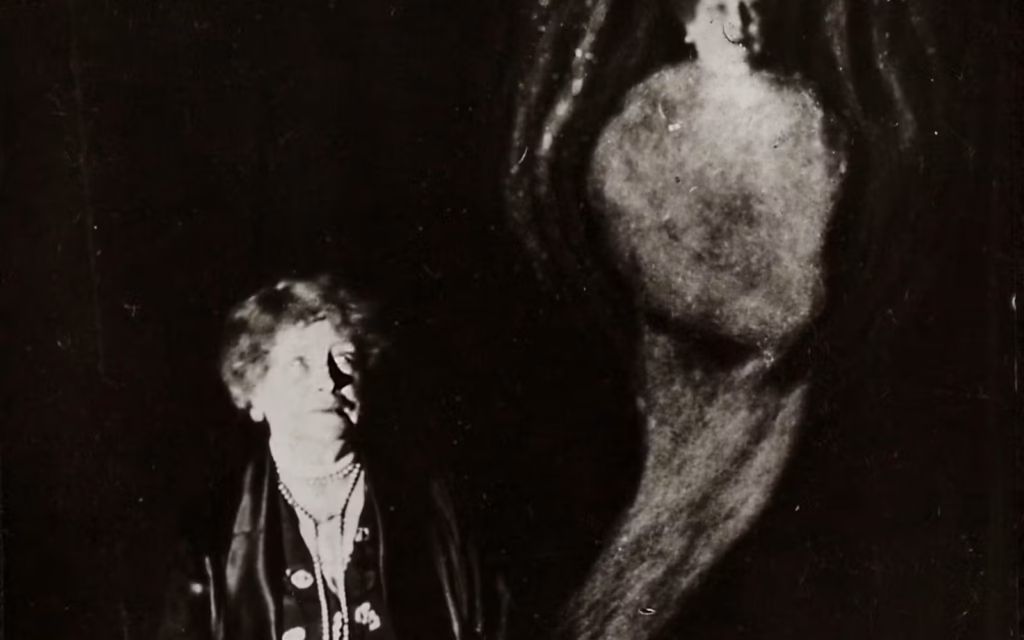
What happened in those studios — dozens of them operating across Boston, New York, and London between the 1860s and the early 1900s — was not primarily a crime. It was a transaction of a very specific emotional economy, one that the twentieth century would later condescend to as mass delusion while quietly running the same economy through different machinery. William Mumler, the engraver-turned-photographer who produced the first widely circulated spirit photographs in Boston around 1861, was eventually tried for fraud in 1869 and acquitted, partly because the prosecution could not prove that the grieving people who bought his images had not received something of genuine value. The judge understood something that the cultural historians who came after him sometimes missed: that value is not always material, and that the gap between comfort and deception is not as clean as rationalism would prefer.
The nineteenth century had constructed an unusually brutal relationship with death. Infant mortality in industrializing Britain ran at roughly 150 deaths per 1,000 live births as late as 1880. The American Civil War produced 620,000 military deaths between 1861 and 1865, leaving behind a population of survivors whose grief had no institutionalized outlet except religion, and whose faith was simultaneously being pressured by the geological findings of Charles Lyell and the biological arguments published in 1859 by Darwin. When the scaffolding of eternal life begins to crack, people do not become stoics. They become customers.
Photography itself arrived into this wound with terrible timing and extraordinary power. Roland Barthes, writing in Camera Lucida in 1980, identified something that the Victorians experienced before they had language for it: that every photograph is already a kind of death certificate, a proof that the moment shown no longer exists, that the person captured in silver halide is simultaneously present and irrevocably gone. The medium was haunted before anyone pointed a camera at a ghost. It produced absence in the act of recording presence, and the culture sensed this immediately, which is why memorial photography — photographing the dead in their coffins, arranging them to appear merely sleeping — became one of the most common uses of the technology in its first decades. Spirit photography was not a perversion of the medium. It was the medium’s most honest extension.
What Mumler and his successors understood, whether consciously or not, was that the human nervous system does not grieve in the abstract. It grieves toward an image, a face, a spatial location where the person used to be. The mourner in the studio was not stupid and was not, in most cases, fully deceived. She was purchasing a ritual object, something that gave grief a place to land, a surface against which the loss could press itself and briefly take shape. The double exposure on the photographic plate — the ghostly figure hovering behind the living sitter, slightly translucent, slightly wrong in scale — was doing the same psychological work that candles do at altars, that photographs do at roadside memorials, that the entire material culture of mourning has always done: it was making the invisible legible enough to be survived.
Simon Marsden’s Haunted Life In Pictures
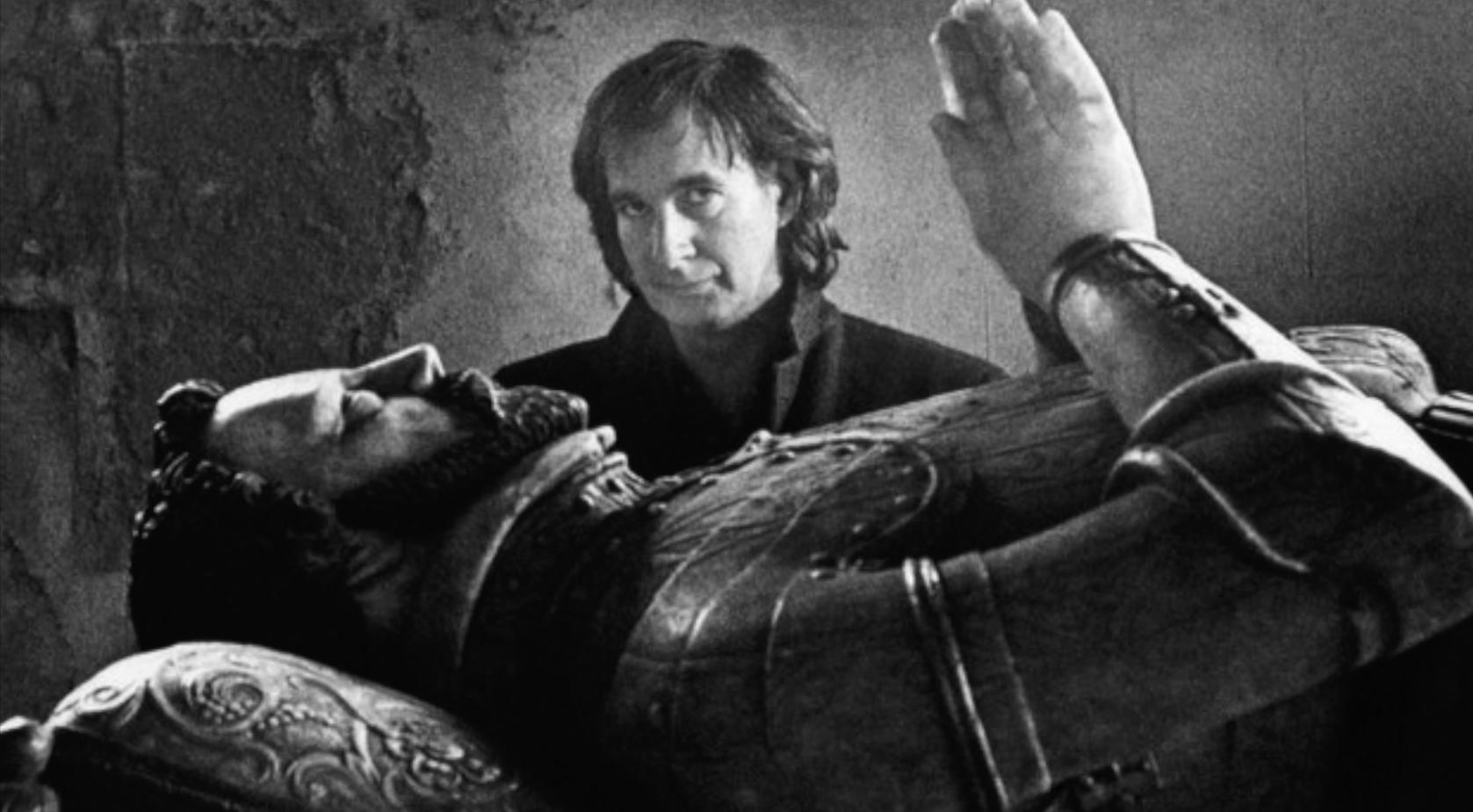
Documentary, by Jason Figgis, United States, 2019.
This documentary retraces the life and work of Simon Marsden, widely regarded as one of the foremost photographers of the supernatural. Premiered at the British Film Institute in London, the film offers a fascinating journey into his creative universe, appealing not only to photography enthusiasts but also to scholars, teachers, students, and anyone intrigued by the mysteries of the unseen. Through evocative imagery and first-hand accounts, it explores the artistic path of a photographer whose work has appeared in books, on U2 album covers, and in museum exhibitions around the world.
Although convinced of the existence of ghosts, Marsden never claimed to capture them directly with his camera. Instead, he used black-and-white infrared film to record the atmosphere and the invisible traces that, in his view, spirits left imprinted upon places. From the landscapes of Ireland to the vast expanses of Russia, passing through Venice and the American Southwest, he transformed historic buildings, ruins, and haunting locations into deeply evocative images capable of suggesting dark and unsettling stories. His photographs continue to captivate the imagination, demonstrating how the most powerful works of art can leave a lasting impression on those who behold them.
LANGUAGE: English
SUBTITLES: Spanish, French, German, Portuguese
William Mumler and the Invention of Visible Grief
You are sitting in a photographer’s studio in Boston in 1861, and the man behind the lens tells you that your dead mother is standing just behind your left shoulder. You do not spin around. You already knew it.
William Mumler had not planned to become the prophet of the bereaved. He was a jewelry engraver by trade, competent and unremarkable, experimenting with a camera the way curious men of his era did — as a hobbyist, not a visionary. The figure that appeared in one of his self-portraits, a translucent young woman hovering at the edge of the frame, was almost certainly a residual image left on an improperly cleaned glass plate. He knew enough about the chemistry to understand the accident. What he understood far better was the room the accident left open in the human heart, and he stepped through it without hesitation.
By the mid-1860s his Boston studio had become a destination for grief. The American Civil War had, between 1861 and 1865, produced approximately 620,000 military deaths, a number that does not begin to account for the civilian destruction radiating outward from each uniform. An entire generation had been handed loss without ceremony, without bodies to bury, without the consoling rituals that give death a shape the living can hold. Mumler’s photographs gave grief an object. The blurred, hovering figures in his images were almost certainly produced through double exposure or through the deliberate reuse of plates bearing earlier sitters — techniques requiring no supernatural cooperation whatsoever. But the bereaved woman clutching a carte-de-visite on which her dead son’s face appeared beside her own was not asking for a chemistry lesson. She was asking to be seen in her loss, and the photograph answered her.
What collapsed the enterprise was not skepticism but ambition. By 1869, Mumler had relocated to New York, raised his prices, and attracted the attention of people wealthy enough to make his prosecution worth someone’s political capital. The trial convened under Mayor Abraham Oakey Hall, a man whose own relationship to performance and constructed identity was intimate enough to lend the proceedings a peculiar irony. The prosecution called photographers who testified to the technical banality of Mumler’s methods. P.T. Barnum, master of profitable illusion himself, appeared as a witness against a man who had simply applied Barnum’s own principles to a clientele too desperate to enjoy being fooled. Mumler was ultimately acquitted — the evidence of deliberate fraud proved insufficient for conviction — but the trial had accomplished something the verdict could not undo.
What the 1869 proceedings actually staged was a dispute over custodianship. The courtroom argument was nominally about whether Mumler had taken money under false pretenses. The deeper argument was about whether the image of a dead person belonged to the market, to the law, to the grieving family, or to some provisional and ungovernable territory between them. Photography in 1869 had no settled doctrine governing the rights of the depicted dead. The legal imagination of the period had not yet caught up to the ontological violence that a photograph performs — the way it freezes a person into an object, makes them portable, reproducible, sellable. Mumler had simply discovered that this violence could be applied to absence as efficiently as to presence, and that people would pay handsomely to have their grief framed and hung on a wall.
Mary Todd Lincoln, photographed by Mumler sometime around 1872, sits in the image with the unmistakable posture of a woman who has run out of future. Behind her, hands resting on her shoulders, appears the dim form of Abraham Lincoln. Whether she believed the image was genuine is a question that mistakes the nature of belief entirely — as if what she needed in that studio was evidence rather than company, proof rather than the simple, annihilating mercy of being told that she was not alone in the frame.

The Camera as Philosophical Instrument
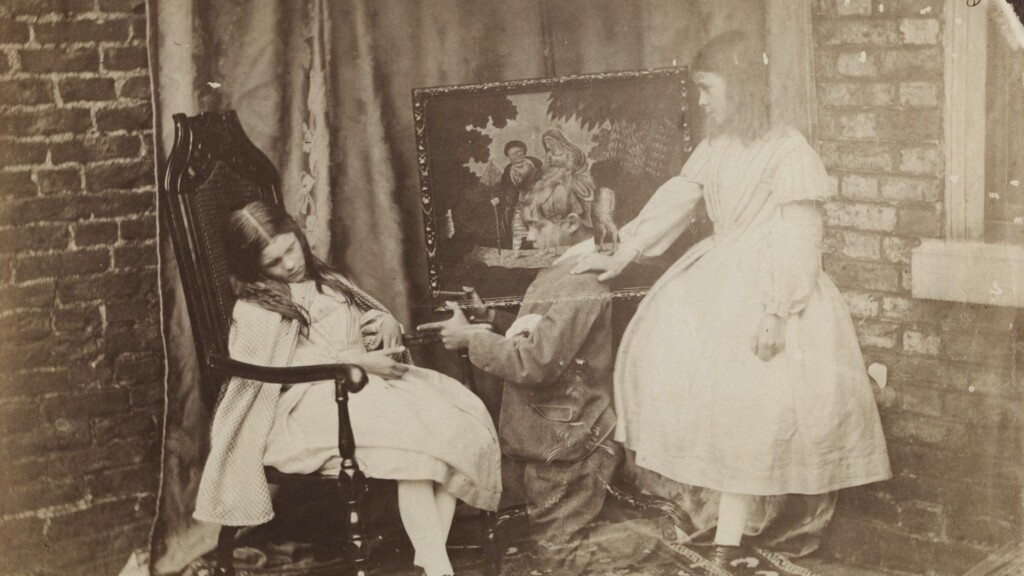
You hold a photograph of someone you loved, and something in it strikes you before you can name what. Not the composition, not the light. Something smaller, more precise — a gesture of the hand, the angle of a shoulder, the way the mouth is almost about to say something it never finished saying. The image does not console you. It opens a wound in exact proportion to its specificity.
Roland Barthes identified this phenomenon in Camera Lucida, published in 1980, the year after his mother died. He called it the punctum: the unintentional detail that pierces the viewer, that was never placed there by the photographer’s intention and cannot be fully described without disappearing under the description. The studium, by contrast, is the photograph’s legible cultural content — what it is about, what it documents, what it means in the sociological sense. But the punctum is what it does to you personally, what it lodges under the skin. Barthes was not writing mysticism. He was writing phenomenology, and the distinction matters because it reveals something structural about the medium itself rather than about individual emotional response.
Every photograph is taken in a moment that, by the time you look at it, has already ceased to exist. This is not a metaphor. The shutter clicks at a measurable interval, the light-sensitive surface records a state of the world that is immediately past, and every subsequent viewing of that image is a confrontation with what Barthes called the noeme of photography: this was. Not this is, not this happened once in a general sense, but this specific configuration of matter and light existed at a precise coordinate in time and will never recur. The photograph does not preserve life. It preserves proof that something was alive, which is a categorically different operation — and one that sits far closer to the logic of mourning than to the logic of memory.
What the Spiritualists of the 1860s and 1870s understood, perhaps without the vocabulary to articulate it, was that the camera had already introduced the dead into every image before any double exposure was attempted. William Mumler’s portraits of grieving widows holding photographs of their deceased husbands contained a formal truth embedded in the medium even when the ghost figures were fraudulent. The apparatus was already haunted. The question of whether the translucent figure appearing over someone’s shoulder was real or fabricated almost became secondary to the deeper fact that the medium as such had made the cohabitation of the living and the dead its native condition.
This is why Susan Sontag‘s argument in On Photography, published in 1977, reaches a similar destination from a different direction. Where Barthes approached photography through grief, Sontag approached it through power and consumption, arguing that to photograph something is to appropriate it, to fix it into an object that can be owned and circulated. But the violence she identified in the photographic act — the fact that it turns living presence into portable representation — has the same consequence: it produces a remainder. The subject of the photograph exists afterward in a form they cannot control, a residue that outlasts them and that belongs structurally to no particular time. The portrait taken of a living person already participates in the logic of the posthumous.
The philosophical stakes here are not trivial. If the camera’s mechanical objectivity — its chemical or digital indifference to what it records — was precisely what granted photography its authority as evidence, then that same indifferent objectivity is what made it a machine for generating absence. The lens does not lie, which is exactly why everything it captures is already receding from the present. The photograph proves the moment existed by confirming, with the same gesture, that the moment is gone, and in that confirmation it creates a space that the imagination — and in the nineteenth century, the theology — of grief was entirely prepared to fill.
Cathnafola - A Paranormal Investigation
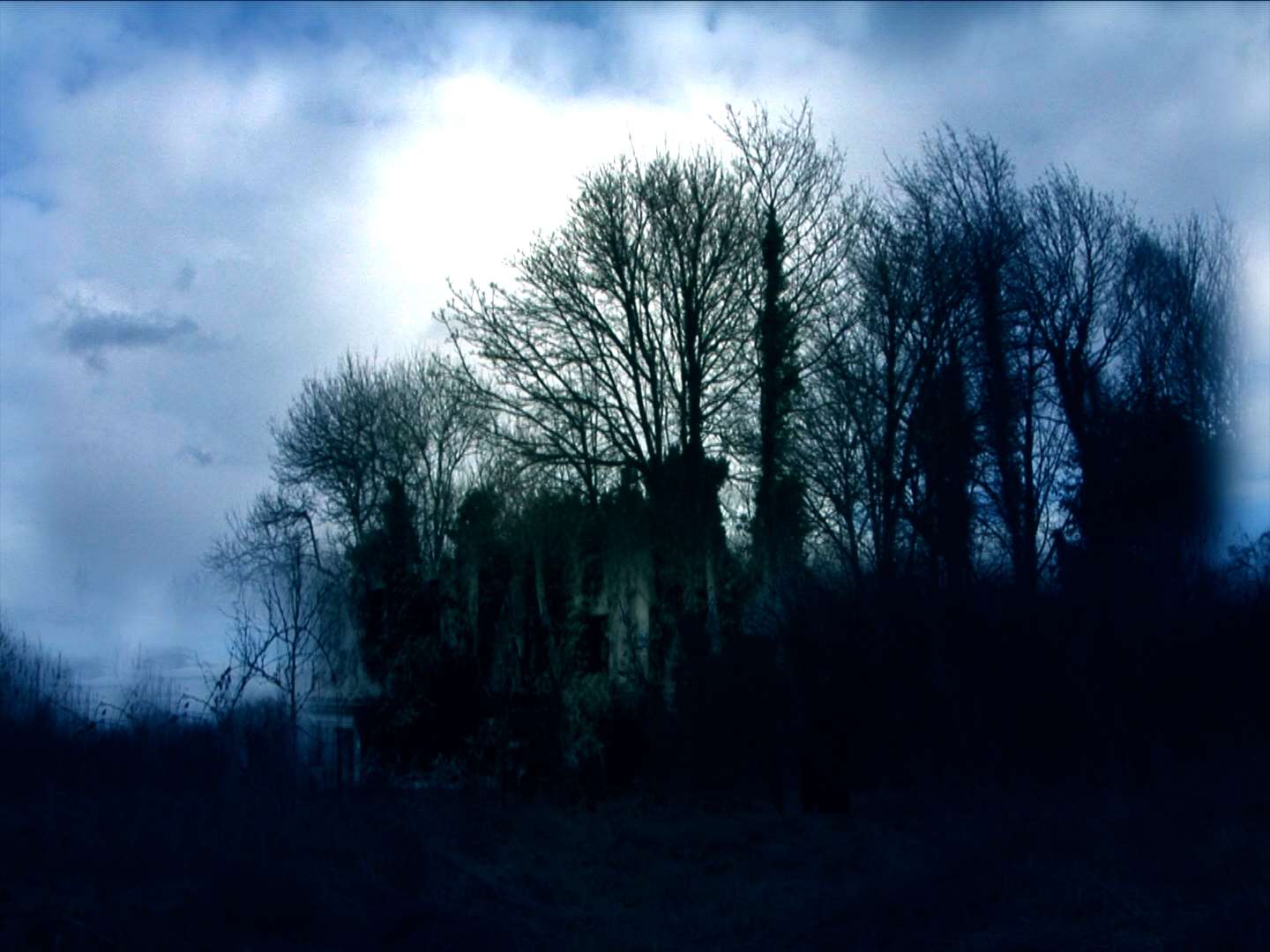
Documentary, horror, by Jason Figgis, USA, 2014.
In "Cathnafola", everything begins when renowned paranormal investigator Chris Halton of Haunted Earth UK receives footage filmed by three teenagers at the ruins of Cathnafola House in Ireland. Determined to unearth the truth behind the location’s bloody past, Halton embarks on a nighttime exploration of the infamous ruins—and soon uncovers terrifying and disturbing revelations.
LANGUAGE: English
SUBTITLES: Spanish, French, German, Portuguese
Grief Industrialized: The Victorian Death Machine
You have just received a letter informing you that your son died at Antietam. You do not have a photograph of him. You have a lock of hair braided into a brooch, a death mask your neighbor’s cousin made from a soldier two towns over, and a carte de visite of a stranger someone sold you at the market because the face was close enough. This is not a metaphor for grief. This is the literal inventory of mourning in 1862.
The American Civil War did not merely kill 620,000 men between 1861 and 1865. It produced a statistical catastrophe of bereavement so massive that it restructured the emotional economy of an entire civilization. Drew Gilpin Faust, in her 2008 study “This Republic of Suffering,” documented how the sheer arithmetic of death — bodies unidentified, burials improvised, notifications arriving weeks late or never — denied families the basic ritual scaffolding that allows grief to resolve into acceptance. When you cannot confirm a death, you cannot bury it psychologically. The wound stays open indefinitely, and an open wound will accept almost any instrument that promises to close it.
Into that wound, Victorian mourning culture had already inserted an elaborate industrial apparatus long before the first rifle fired at Fort Sumter. Post-mortem photography, which reached its commercial peak in the 1840s and 1850s, operated on the logic that the image could extend presence past the moment of biological cessation. Families posed dead infants with open or propped eyes, sometimes surrounded by living siblings, so that the photograph would contain the child among the living rather than among the absent. The daguerreotype plate functioned less as a documentary record than as a prosthetic memory, something the hand could hold when the mind could not hold the fact. Hair jewelry — rings, lockets, woven brooches containing strands from the deceased — served a related but distinct purpose: they kept the body’s material trace inside the intimacy of daily dress, against the skin, literally incorporated into the mourner’s physical self.
What is striking about this entire apparatus is not its morbidity but its rationality. Given the genuine epistemological problem these families faced — the problem of not knowing where someone is once they have ceased to be locatable — each of these technologies represents a pragmatic solution. The death mask gives the face a permanence the decaying body cannot sustain. The hair gives the body a fragment that does not decompose. The post-mortem photograph gives the family a scene they can revisit. Each technology is answering a real question about how to maintain relationship with someone who has become spatially and physically inaccessible. Spirit photography arrives as the logical culmination of this sequence, not as its aberration.
William Mumler began producing his spirit portraits in Boston in 1861 — the same year the war began — and his practice expanded precisely as the casualty lists did. The timing was not incidental. He was operating in a market that the war was actively enlarging with every engagement at Cold Harbor, every dysentery death in a Virginia field hospital, every soldier whose body was never recovered from the Wilderness. The bereaved who came to his studio were not, in the main, people whose critical faculties had been suspended by naivety. Many were educated, professionally accomplished, socially prominent. Mary Todd Lincoln, who lost her son Willie to typhoid fever in 1862 and her husband to an assassin’s bullet in 1865, visited Mumler’s studio and received a photograph purporting to show Abraham Lincoln’s spirit standing behind her, hands resting on her shoulders. She found it consoling. The question of whether the image was fraudulent is a genuinely separate question from the one her grief was actually asking, which was whether the structure of reality permitted any form of continued contact with those the living had catastrophically lost.
What the Victorian mourning industry reveals is that grief, when it reaches a certain scale, does not remain a private psychological event — it becomes a demand placed on technology itself.
The Séance Economy and the Medium’s Body
You arrive at the séance already knowing your role. You sit at the table, you place your hands flat against the wood, you wait. The room is designed to make you wait — the dim light, the circle of strangers, the woman at the center whose eyes have already rolled back before the session has properly begun. What you are watching is not theater, though it uses every theatrical mechanism available. What you are watching is an economy, with a very specific currency, and that currency is a woman’s body in distress.
When Kate and Margaret Fox began producing their mysterious knocking sounds in Hydesville, New York in 1848, they were twelve and fifteen years old. Within two years they were performing before audiences of hundreds in Rochester and New York City, charging admission, corresponding with journalists, and generating a movement that would eventually claim, by the 1880s, upward of eight million adherents in the United States and Britain alone. The Fox sisters had not discovered the supernatural. They had discovered something more durable: that a culture desperate for evidence of life after death would pay handsomely for a woman willing to suffer convincingly in its service. Margaret confessed the fraud in 1888, cracking her toe joints against the floor to demonstrate the mechanism, then retracted the confession a year later — not because the truth had changed, but because without the role of medium she had no income, no identity, and no social standing whatsoever.
This is the trap that Victorian feminism largely refused to examine: Spiritualism offered women a form of public authority that secular culture denied them entirely. A female medium could address a room of men, could contradict doctors, could accumulate followers, could publish, could travel — all because she claimed to be merely a passive vessel. The authority was real. The passivity was the price of admission. Sociologist Alex Owen documented in her 1989 study The Darkened Room how mediumship functioned as a professional structure for women who had no other access to public life, and how the séance room reproduced, with eerie precision, the same dynamics of the Victorian sickroom: the prone body, the male observers taking notes, the woman’s credibility rising in exact proportion to her apparent helplessness.
What the lens then entered was not a spiritual event but a labor negotiation conducted in ectoplasm. The photographs of mediums like Florence Cook or Eva C. — taken under supposedly controlled conditions by researchers including William Crookes — were evidentiary documents in a professional dispute. They were meant to prove that the suffering was real, that the loss of control was genuine, that the woman was not performing but being used by forces beyond her volition. Every blurred figure behind her, every gauzy apparition hovering at her shoulder, functioned as a credential. The camera was recruited not to capture death but to certify female suffering as legitimate — and therefore to make female authority acceptable to an audience that could not tolerate it any other way.
What went unexamined in almost every contemporary account was the obvious structural violence of requiring a woman to demonstrate incapacity in order to be taken seriously. The medium had to tremble. She had to lose consciousness, weep, exhaust herself. Hélène Smith, the Geneva medium studied obsessively by psychologist Théodore Flournoy and documented in his 1900 From India to the Planet Mars, spoke languages she had never learned, channeled Martian civilizations, drew maps of other worlds — and Flournoy’s entire analytical project rested on proving she was unconsciously fabricating it all, that her intellect was operating without her knowledge or consent. The conclusion that her extraordinary feats were products of her own mind was framed as debunking. It had not occurred to Flournoy, nor apparently to his readers, that a woman producing multilingual automatism and elaborate cosmologies might simply be extraordinarily intelligent — and that the only frame available for that intelligence required it to arrive from somewhere else entirely.
A vision curated by a filmmaker, not an algorithm
In this video I explain our vision
Conan Doyle’s Fairies and the Expert Who Refuses to See
You have watched a brilliant person defend something indefensible and felt, beneath your irritation, something closer to recognition. Not because you share their delusion, but because you have seen the particular quality of their certainty — the way it does not waver when evidence arrives, the way it absorbs contradiction the way deep water absorbs a stone, closing over it without a mark.
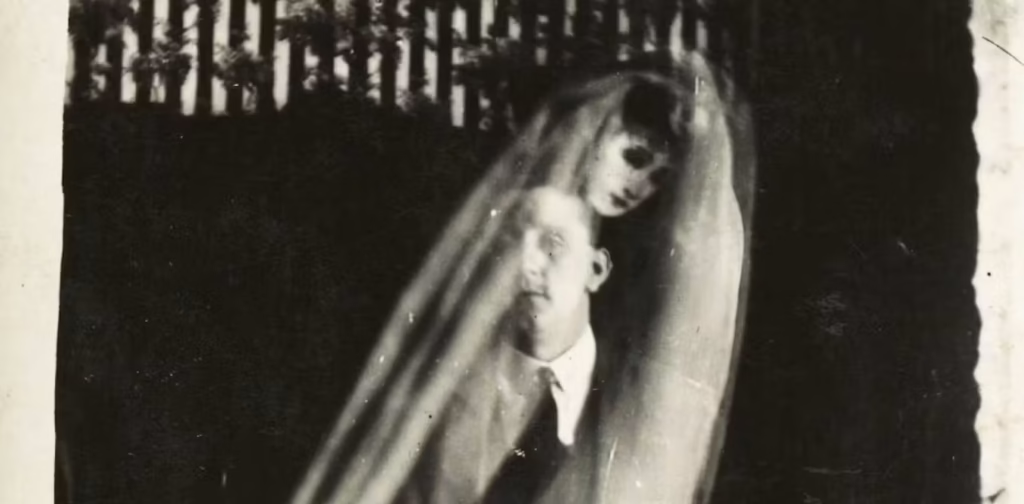
Arthur Conan Doyle was sixty-two years old when he staked his reputation on two girls and a garden in Yorkshire. Elsie Wright and her cousin Frances Griffiths had produced, in 1917, a series of photographs showing themselves in the company of small winged figures near a stream in Cottingley. The figures were, as would be confirmed decades later by both women, cardboard cutouts drawn from a children’s book and pinned to the grass with hatpins. Doyle did not merely believe the photographs were genuine. He constructed an entire theological and scientific architecture around them, culminating in his 1922 book The Coming of the Fairies, where he argued that the images constituted empirical proof of a non-material dimension interpenetrating the physical world. He consulted photographic experts. He analyzed light diffusion and exposure. He applied, with visible rigor, exactly the kind of systematic evidentiary reasoning that had made his fictional detective the emblem of pure rationality. The conclusion he reached was structurally indistinguishable from the conclusion a man reaches when he needs something to be true.
What makes this case irreducible to simple credulity is that Doyle was not an uneducated man grasping for magic. He was a trained physician, a methodical observer, a writer who had spent decades dramatizing the dangers of assumption and the supremacy of evidence. The character he had built — the gaunt, incisive figure who sees what others overlook — was in some sense a monument to everything Doyle himself aspired to be. And yet by 1917 he had lost his son Kingsley to the influenza pandemic following wounds sustained at the Somme. He had lost his brother, two brothers-in-law, two nephews. The deaths accumulated with the particular cruelty of that period, which killed in industrial quantities and returned nothing to the living except silence. Doyle had turned to Spiritualism not as a hobby but as a lifeline, and he had invested in it the way a man invests in the only remaining architecture that makes the structure of loss bearable.
The psychologist Leon Festinger, writing in A Theory of Cognitive Dissonance in 1957, demonstrated that the mind does not revise belief when confronted with disconfirming evidence — it generates new supporting beliefs to protect the original. But Festinger’s model still imagines a kind of passive resistance, a psychological immune response. What Doyle demonstrates is something more active and more disturbing: the intelligence itself becomes recruited. The expertise is not bypassed. It is conscripted. His photographic analysis was not sloppy. It was precise in its methods and catastrophically wrong in its premise, because the premise was not epistemological but existential. He was not asking whether the photographs were real. He was asking whether there was anything left worth living inside of.
The expert gaze is never neutral, and this is not an accusation but a structural fact about how perception operates. The historian of science Lorraine Daston, in her work on objectivity co-authored with Peter Galison and published in 2007, traces how scientific seeing is always trained seeing — shaped by institutions, by prior commitment, by the particular historical moment in which a practitioner formed their interpretive habits. To see something as evidence is already to have decided what you are looking for. Doyle looked at two cardboard fairies and saw proof of the afterlife because the afterlife was the only territory in which his dead were still reachable, and no amount of photographic expertise could survive contact with that kind of need.
The Photograph That Precedes the Photographer
You hold the photograph before it holds you. That is the inversion nobody names at the moment of the shutter — the image that will outlive you already exists in potential, waiting for the fraction of a second that locks you into it permanently. The living person pressing the button believes they are capturing something. What they are actually doing is producing a corpse in advance, a flat and motionless facsimile that will remain when the original has gone. This is not metaphor. It is the structural logic of what the medium does every single time it operates.
Susan Sontag argued in her 1977 collection of essays that the camera does not record an existing reality but manufactures a new one — a parallel world of images that behaves by entirely different rules than the world it supposedly documents. The photograph is not a window. It is a surface with its own ontological weight, its own claim to truth, its own way of replacing the thing it depicts. By the time her book was published, more photographs had been taken in the preceding decade than in all the previous history of the medium combined. That acceleration did not make images more faithful to reality. It made them more sovereign over it. The image of an event began to feel more real than the event itself, more stable, more authoritative, more permanent. The living moment, by contrast, started to feel provisional — something that needed photographic confirmation to have fully occurred.
What Sontag identified as distortion is actually something more precise: the photograph converts presence into evidence. A living person exists in time, breathes through duration, changes from one instant to the next. The camera arrests that process and produces something the person never was — a single frozen instant elevated into a representative truth. The photograph of a face is already a kind of lie about that face, because the face was never still, never flat, never reducible to one expression at one angle in one quality of light. To photograph someone is to kill a version of them and mount it. Families understand this instinctively, which is why they argue about which photographs are kept and which are discarded. The photograph that survives will become the dead person, in the end. The others will be forgotten.
This is why the spirit photograph is not a deviation from what photography normally does but its most honest statement. Every photograph already presents you with someone who is, in that fixed form, gone. The chemistry of the daguerreotype, the silver salts of the albumen print, the digital sensor — all of them convert a living presence into a relic in the same instant they capture it. The Victorian mourner who brought her dead child to a photographer to be posed one final time was not confusing photography with life. She understood the transaction more clearly than most: the photograph was always where the dead went. She was simply being literal about it.
When a blur appears on a plate that no living body can account for, the viewer’s instinct is to read it as evidence of something supernatural. But the blur is doing nothing different from what the sharp image does — it is collapsing a presence into a surface, compressing a being into light and chemistry. The only difference is that the supposedly supernatural image makes the violence visible. The clean portrait conceals it. Both arrest something that was moving. Both produce a presence by eliminating one. The spirit photograph merely fails to pretend that the thing being fixed was ever fully alive in the first place.
There is a specific kind of grief that photographs produce which has no name in any language — the feeling of looking at someone you loved in an image so sharp and present that the fact of their absence becomes, for a moment, incomprehensible, as if the photograph is arguing against the death it was always preparing.
What the Lens Has Always Known
You pull out your phone in a dimly lit room and take a picture of no one in particular, and when you zoom in on the background, something in the grain arranges itself into a face — a suggestion of eye sockets, a mouth half-open, the contour of a forehead that belongs to nobody present. You know it is noise. You zoom in closer anyway.
Digital photography did not eliminate the ghost; it gave it new address space. Every JPEG carries metadata — timestamps, geolocation coordinates, device signatures — and this informational skeleton is, in its own way, a trace of presence, a record that something was here at a specific longitude and latitude at a specific second. The file knows where you stood. It knows the angle of light. It preserves everything except what the nineteenth century most desperately wanted it to preserve, which was the fact that the person in front of the lens still, somehow, persists. The metadata is a ghost of a different order: not the dead haunting the living, but the living haunting themselves, leaving forensic evidence of existence that will outlast the body.
Long-exposure photography collapses time into a single frame in a way that Frederick Myers, who coined the term “telepathy” in 1882 and spent decades cataloguing cases for the Society for Psychical Research, would have recognized immediately as the visual grammar of his entire project. When a camera’s shutter stays open for thirty seconds on a busy street, the people who moved through the frame become translucent, half-present, layered over one another — not quite there, not quite absent. The image does not lie. It accurately represents what time looks like when you refuse to cut it into discrete moments. The figures are genuinely there and genuinely gone, which is precisely what grief insists on.
Pareidolia — the neurological tendency to extract meaningful patterns from random visual data, described in detail by cognitive scientists including Bruce Hood in his 2009 work The Science of Superstition — is not a malfunction. It is the visual cortex operating exactly as selected, hypervigilant for faces because faces were, for most of evolutionary history, the most consequential thing in the environment. The noise in a pixelated photograph is not haunted. But the brain scanning that noise is running ancient hardware, and ancient hardware was never designed to draw a clean line between signal and projection.
What has changed in the twenty-first century is not the impulse but the infrastructure that receives it. CCTV footage from empty parking garages gets uploaded to paranormal investigation forums where thousands of people analyze compression artifacts and reflections for evidence of apparition. Families now commission AI services to generate animated, speaking portraits of deceased relatives from a handful of old photographs — the face moves, the lips form words, the eyes track — and the companies offering this service reported a surge in demand that accelerated sharply after 2020, when mass death arrived faster than grief could organize itself. These are not fringe behaviors. They are grief finding the tools available in its historical moment, which is what grief has always done.
William Mumler charged New York and Boston’s bereaved middle class between one and ten dollars per spirit portrait during the 1860s, and he was tried for fraud in 1869 and acquitted because the prosecution could not prove the figures in his photographs were not real. The verdict was technically about evidence, but culturally it was about the impossibility of asking a jury of grieving people to unanimously agree that the dead are nowhere in the image, that the chemical residue means nothing, that the resemblance is coincidence, that the comfort derived from the picture does not constitute a form of truth that the law has no jurisdiction to revoke.
The AI portrait moves its lips, and somewhere a person watches it loop, and the question of whether what they are seeing is real has quietly become the wrong question to ask.
👁️ Veils Between Worlds: Spirits, Lenses & the Unseen
Spirit photography has always hovered at the crossroads of belief, grief, and the human longing to pierce the veil of death. To truly understand why the camera became a vessel for the invisible, we must explore the cultural and philosophical traditions that gave shape to apparitions, loss, and the sacred gaze. These related articles illuminate the deeper terrain from which spirit photography emerged.
Ghosts in Japanese Culture: History and Symbolism
Long before any camera shutter opened on a claimed apparition, Japanese culture had already developed one of the world’s most nuanced and elaborate relationships with the spirits of the dead. This article traces the history and symbolism of ghosts in Japan, revealing how the deceased were never simply absent but remained as presences demanding attention, ritual, and acknowledgment. Understanding this tradition reframes spirit photography not as a Western curiosity but as part of a universal human compulsion to render the invisible visible.
GO TO THE SELECTION: Ghosts in Japanese Culture: History and Symbolism
C.S. Lewis and the Death of His Wife: A Grief Observed
C.S. Lewis‘s raw, journal-like account of mourning his wife Joy offers a profound window into why the bereaved have always sought proof that the dead persist. His wrestling with grief, faith, and the desperate need for signs of continued presence mirrors the psychological hunger that drove Victorian families to séance rooms and spirit photographers’ studios. This article shows how grief itself becomes a kind of lens, bending reality toward what the heart most needs to see.
GO TO THE SELECTION: C.S. Lewis and the Death of His Wife: A Grief Observed
Helena Blavatsky and Theosophy: the Woman Who Revolutionized Esoteric Thought
Helena Blavatsky and the Theosophical movement provided much of the intellectual and spiritual scaffolding that made spirit photography culturally credible in the late nineteenth and early twentieth centuries. Theosophy’s insistence on subtle bodies, astral planes, and the survival of consciousness after death created a readership eager to believe that the camera could capture what the human eye could not. This article charts how Blavatsky’s thought permeated the occult milieu in which spirit photography thrived.
GO TO THE SELECTION: Helena Blavatsky and Theosophy: the Woman Who Revolutionized Esoteric Thought
Must-see Movies about the Afterlife
Cinema has long served as a secular séance, projecting luminous presences onto a darkened screen in a ritual not entirely unlike what spirit photographers promised their clients. This curated list of films about the afterlife explores how moving images have attempted to negotiate the boundary between the living and the dead, extending the tradition that spirit photography began. Each film in this selection becomes a meditation on what it means to seek the face of someone who is no longer there.
GO TO THE SELECTION: Must-see Movies about the Afterlife
Discover the Cinema That Dares to Look Beyond the Frame
If these themes have awakened your curiosity about the invisible worlds that art and cinema dare to explore, Indiecinema streaming is your destination. Our platform gathers independent films that venture into the uncanny, the spiritual, and the philosophically daring — stories that no mainstream algorithm would ever surface for you. Step through the lens and find what is waiting on the other side.
👉 EXPLORE THE CATALOG: Watch Indie Films in Streaming
A vision curated by a filmmaker, not an algorithm
In this video I explain our vision

