
The Cell Without Walls
You are somewhere in the middle of the game and you no longer remember when the room stopped existing. The window is still there, the light still falling at its particular afternoon angle, but these facts have become administrative, irrelevant to the only thing that is happening, which is the board. Your opponent, if there is one, has receded into the category of obstacle rather than person. The pieces are not symbols of anything anymore — they are the actual substance of thought, more real than your hands moving them, more real than the coffee that went cold two hours ago without you noticing. There is a specific quality to this dissolution that is not unpleasant, that is in fact dangerously close to relief: the world has been reduced to sixty-four squares and for once the reduction feels like clarity rather than loss.

Stefan Zweig understood this particular seduction with the precision of someone who had lived inside it, and when he published Schachnovelle in 1942 — his final work, completed in exile in Brazil mere months before he and his wife Lotte took their lives together in Petrópolis — he was not writing a story about chess. He was writing a clinical account of what happens when a mind, deprived of all other material, begins to consume itself as fuel. The novella was his last act of diagnosis, and the patient was not only his protagonist.
The character at the center of the story is a man held in solitary confinement by the Gestapo — not in a cell with walls and bars, but in a hotel room, deliberately ordinary, stripped of all objects, all books, all newspapers, all contact with any mind other than his own. The torture here is not physical. It is epistemological. The captors understood something that brute force never quite grasps: deprive a thinking person of all external reality and they will not rest in emptiness. They will manufacture a world. And if the only material they find is a stolen chess manual, they will inhabit it so completely that the game stops being a game and starts being the architecture of sanity itself — which means it also becomes the architecture of its collapse.
Zweig was writing in 1941 and 1942 from a specific kind of exile that most comfortable discussions of his life sanitize into the picturesque. He had lost Vienna, lost his library of four thousand manuscripts, lost the cultural Europe he had spent his life documenting. His autobiography, Die Welt von Gestern, written in the same final months, is an elegy for a civilization he watched dismantle itself with bureaucratic efficiency. What rarely gets examined is the way exile operates not only geographically but cognitively — the way a mind trained on the richness of Viennese intellectual life, on Freud and Hofmannsthal and the dense social fabric of the Ringstrasse era, finds itself suddenly with nothing to push against. No friction. No resistance. The thoughts that once sparked against the world begin to spark only against themselves.
This is the condition that chess in the novella does not solve but rather crystallizes. The game is not an escape from confinement — it is confinement made elegant, given rules, given the illusion of progress. Every move opens possibilities, yes, but only within an absolutely closed system. You cannot introduce new pieces. You cannot change the rules of how a knight moves. The grandeur of chess, the thing that makes it feel like freedom to a certain kind of mind, is identical to what makes it a trap: it is infinite complexity inside a finite container, and the mind that enters it looking for liberation will spend eternity rearranging the furniture of its own cage without ever once touching the door.
Arte
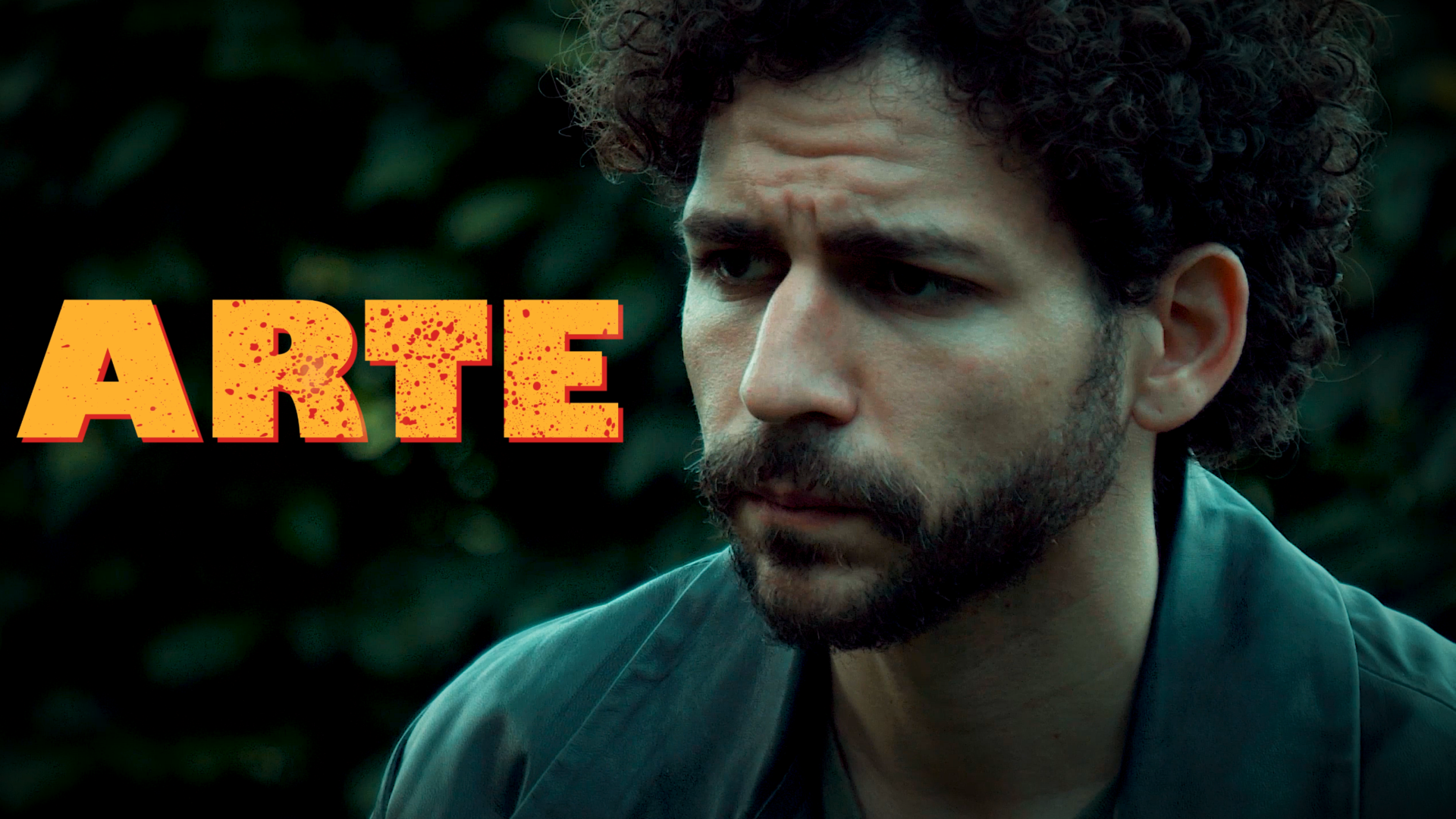
Drama, thriller, by Stefano Scala, Simone Arcidiacono, Italy, 2023.
In a secret and fascinating world, four people meet every week at the mysterious "The Circle" for a gripping game, knowing nothing about each other. However, fate has a different plan for them. As the game progresses, their lives begin to intertwine in unpredictable ways. The boundaries between the game and reality start to blur, revealing buried secrets and creating unthinkable connections. In the heart of "The Circle," the masks fall, and the players' lives will be forever changed.
LANGUAGE: Italian
SUBTITLES: English, Spanish, French, German Portuguese
Zweig’s Last Year and the Geography of Exile
You are sitting in a rented house in Petrópolis, a mountain town forty miles from Rio de Janeiro, and the air smells like wet earth and flowering trees you cannot name. The furniture belongs to someone else. The language spoken outside belongs to someone else. The war that destroyed everything you were belongs to a continent you will never see again, and the man you were in Vienna — the most translated German-language author alive, friend to Freud and Rodin and Toscanini, citizen of a civilization that believed in its own permanence — that man has been quietly ceasing to exist for several years already.
Stefan Zweig left Austria in 1934, two months after the Austrian Civil War made it unmistakable that the continent was reorganizing itself around violence. He was fifty-two years old, and he had spent three decades building one of the most extraordinary literary networks in European history, a correspondence that ran to tens of thousands of letters, a library of original manuscripts by Goethe, Mozart, and Beethoven that he had assembled with the devotion of a man who believed that touching the page a genius had touched was a form of communion. He settled first in Bath, England, in a Georgian townhouse that was comfortable and utterly foreign, then crossed to New York in 1940 as the German advance made Britain feel like a waiting room for catastrophe. New York was loud, enormous, indifferent, and generous in the way that only cities with no memory can be generous. He arrived in Petrópolis in the late summer of 1941 with his second wife, Lotte Altmann, twenty-seven years younger than him and chronically ill, and he told people the Brazilian light was beautiful. He finished his memoir there. He finished the novella that would become his last published work. On the twenty-second of February, 1942, he and Lotte took lethal doses of barbiturates and were found the following morning, lying side by side, composed, as if they had arranged themselves for a photograph.
What the biographical record tends to call displacement is something far more precise and far more brutal. Exile is not the removal of a person from a place. It is the removal of the system of references that makes a person intelligible to themselves. Zweig’s identity was not portable. It had been constructed inside a specific cultural ecosystem: the coffee houses of Vienna where intellectuals argued across disciplines, the publishing infrastructure of the German-speaking world, the shared literary inheritance of a European humanism that traced itself back through Erasmus and Montaigne and Goethe. When that ecosystem was destroyed, not metaphorically but literally — books burned in Berlin on the tenth of May, 1933, and his name was on the list — what remained was not Zweig in a different location. What remained was something that had Zweig’s memories and Zweig’s habits and Zweig’s handwriting, but no longer had the social and cultural mirror in which those things had ever made sense.
The sociologist Norbert Elias, himself a German-Jewish exile writing in the same decade, would describe this condition in terms of what he called the figurational dependencies of selfhood — the idea, developed across his 1939 work on the civilizing process, that the individual self is not a sovereign unit but a node in a network of mutual recognitions, and that severing those recognitions does not liberate the self but rather dissolves the medium through which it becomes visible to itself. Zweig did not lose his home. He lost the conditions under which being Stefan Zweig was a coherent activity. The rented house in Petrópolis was not a refuge. It was the place where the erosion completed itself quietly, in a language he was only beginning to learn, surrounded by the names of flowers he could not yet speak.

Schachnovelle as Diagnostic Document
You are sitting in a room that is not a cell. The walls are clean, the bed is made, the window admits light. Nothing has been taken from you except everything that made you a self — the newspaper, the book, the letter, the voice of another human being. The Gestapo officers who detained Dr. B. in a Vienna hotel room sometime in the late 1930s understood something that most torturers do not bother to learn: that the mind, deprived of external material, will turn on itself with a ferocity no interrogator can match.
Stefan Zweig published the novella in 1942, weeks before his suicide in Petrópolis, Brazil, and the text carries the specific weight of a man who had watched an entire civilization dismantle the conditions necessary for inner life. What he constructed in Dr. B.’s confinement is not a metaphor for oppression. It is a clinical diagram. The Gestapo’s technique — documented in various accounts of isolation detention used against Austrian intellectuals and political prisoners after the Anschluss of March 1938 — was to produce a particular kind of collapse by removing not comfort but cognition. No books, no papers, no human exchange, no task. The prisoner was left with the one instrument that cannot be confiscated: his own thinking apparatus. And that apparatus, Zweig understood, becomes lethal the moment it has nothing to metabolize except itself.
The chess manual that Dr. B. steals from a coat pocket is not a rescue. It is the form the self-destruction takes when it becomes structured. He memorizes one hundred and fifty grandmaster games and begins replaying them without a board, without pieces, inside the sealed theater of his skull. What first reads as ingenuity — a man making something out of nothing — reveals itself gradually as a doubling that the mind cannot survive. To replay a game mentally, you must occupy both sides simultaneously. You must think as White and then think as Black, each time trying to defeat the position you yourself constructed. Zweig names this Schizoidie, borrowing loosely from the psychiatric vocabulary available to him, but the mechanism he describes anticipates what the psychiatrist Stuart Grassian would document in 1983 in his landmark study of solitary confinement at Walpole State Prison in Massachusetts — a syndrome involving hypersensitivity, cognitive distortion, and a specific form of self-referential thought that feeds on itself in the absence of external interruption.
The horror Zweig engineers is precise: Dr. B. does not go mad because the conditions are unbearable. He goes mad because he adapts to them. He becomes masterful at the internal game. The two versions of himself — call them the attacking mind and the defending mind — grow more distinct, more adversarial, more convinced of their separate identities. The self does not break; it splits along a fault line that was always there, held together in ordinary life by the friction of the world. Remove the world, and the fault becomes a chasm. When Dr. B. is eventually released and finds himself on an ocean liner years later, playing the world chess champion Czentovic, what surfaces is not a recovered man but a haunted one — the split still active, the second self still capable of seizing control and playing at a speed that no sane game can accommodate.
Zweig locates the violence of the twentieth century not in its explosions but in its administrative precision. A hotel room. Clean sheets. A locked door. The state did not need to touch Dr. B. to destroy him. It only needed to leave him alone with the one thing modern liberal civilization had always promised was a refuge — the interior life — and let that refuge become a closed circuit with no exit.
When Thought Becomes the Torturer
You have done it before — sat with a problem you could not solve, turned it over like a stone that keeps revealing the same face, and felt the hours dissolve without your permission. The mind was not resting. It was running a loop, feeding on its own output, mistaking motion for progress. What you experienced in those hours was not thinking. It was thought thinking itself, the engine left running in an empty garage.
William James understood this in 1890 with a precision that still stings. In his Principles of Psychology, he described consciousness not as a sequence of discrete states but as a stream — continuous, unchosen, impossible to simply switch off. The metaphor sounds generous, almost pastoral. But James was documenting something far more threatening: that the mind’s continuity is not under the mind’s control. Attention does not rest between thoughts. It drifts, but it does not stop. And when a single object seizes it — a chess position, a grief, an unresolved humiliation — the stream does not flow around it. It circles. The water goes nowhere. The object grows.
Modern cognitive psychology has since given this circling its clinical name: rumination. The research of Susan Nolen-Hoeksema, developed through the 1990s and formalized in her 2008 work The Wrath of Rogues of Depression, demonstrated that repetitive self-focused thought does not process distress — it amplifies it. Subjects who were instructed to dwell on their feelings reported higher levels of hopelessness than those distracted with neutral tasks. The act of thinking about suffering, stripped of any external target or social context, functions as a magnification instrument. Every return to the same thought deepens the groove, makes the next return more likely, and raises the emotional intensity of the content. The mind becomes the wound’s most reliable reopener.
This is the trap Zweig constructed with surgical precision for the character he placed in solitary confinement, denied every material object, stripped of the ordinary friction of daily life that keeps consciousness from devouring itself. The cell is almost incidental. The real architecture of confinement is cognitive: a man who cannot stop thinking, given nothing to think about except the one thing he has found. The chess positions he reconstructs from memory are not an escape from the cell. They are the cell reproduced inside his skull, portable and inescapable, available every waking hour. What appears to be intellectual mastery — a man commanding armies of abstract pieces across an imagined board — is actually surrender to the only stimulus left. The mind, desperate for purchase, seizes what it can find and will not release it.
There is a particular cruelty in the fact that chess is the instrument here, because chess presents itself as the purest form of rational control. Every move is chosen. Every position is analyzable. The player sits opposite chaos and imposes order on it, move by deliberate move. To the outside observer, and to the player’s own self-mythology, chess is the proof that the mind governs itself. But sustained isolation dismantles this fantasy with quiet efficiency. When the game exists only inside the mind, with no opponent, no physical board, no clock, no social witness, the moves generate more moves and the analysis generates more analysis, and the sense of control that chess promises becomes the very mechanism of losing it. The more completely a man believes he is directing the game, the less he notices that the game is directing him.
This is what voluntary intellectual immersion cannot acknowledge about itself: that intensity and imprisonment share a phenomenology. The scholar who works through the night, the strategist who cannot leave a problem, the obsessive who finds one domain that makes the rest of the world legible — they all describe their condition with the vocabulary of freedom, of chosen depth, of superior engagement with reality.
The Grandmaster as the Other Half of the Same Trap
You have met someone who cannot lose because losing would require him to understand what losing means. Czentovic moves pieces across a board with the mechanical certainty of a man who has never once needed metaphor — he does not grieve, he does not doubt, he does not reach for language when silence fails him. He wins. That is the entirety of his interior life, and Zweig draws him not as a villain but as something more disturbing: a mind so completely organized around a single function that the function has become indistinguishable from the person himself.
Zweig’s portrait of Mirko Czentovic is not a caricature of stupidity. It is a clinical study in what happens when one form of intelligence colonizes all available cognitive space and leaves nothing else alive. The champion is described as almost entirely unreachable in ordinary conversation, incapable of spelling correctly, indifferent to art, history, music — every register of human experience that requires translation between an inner state and an outer form. He has never needed translation. Chess gave him a language so complete within its own boundaries that the rest of the symbolic world simply atrophied. He is not dumb. He is singular in a way that ordinary intelligence has no tools to process, which is why everyone around him mistakes his blankness for arrogance.
Johan Huizinga, writing in Homo Ludens in 1938 — the same historical moment in which Zweig was composing his final work in exile — argued that play is constitutive of culture itself, that before human beings built institutions, laws, or religions, they played. The sacred and the competitive, the ritual and the game, share a formal structure: bounded space, agreed rules, the temporary suspension of ordinary consequence. But Huizinga’s framework carries a shadow he does not fully name. The condition that makes play generative — its separation from the rest of life — becomes pathological the instant that separation reverses. When the game is no longer contained within life but life is contained within the game, the bounded space stops being a refuge and becomes a cell.
Czentovic has never left the cell. He entered it young, before he had developed any other means of organizing experience, and the cell grew around him so gradually that he never registered the walls. His genius is real — Zweig is careful to insist on this — but it is a genius with no outside, no remainder, no negative space where doubt or desire or loss might accumulate into something recognizable as a self. He is, in this sense, the nightmare fulfillment of pure specialization: a human being who has optimized himself so completely for one task that he has solved the problem of interiority by eliminating it.
What makes Zweig’s architecture so precise is that he did not write Czentovic alone. The novella requires both men — the champion and the amateur driven to madness by isolation — to complete its argument, because the trap they occupy is formally identical even as it is experientially opposite. One man thinks only in chess because he cannot think any other way. The other thinks only in chess because every other way of thinking has been stolen from him. The outcome, in both cases, is the same disappearance: a mind that has lost its ability to move freely between registers, to rest, to mean something other than what it is currently doing.
This is what Huizinga’s celebratory account of play cannot fully absorb — that the same formal structure which makes a game liberating also makes it, under the right conditions of pressure or deprivation, a perfect trap. The boundary that protects play from becoming merely instrumental is also, from the inside, the boundary that prevents escape. Czentovic never needed to escape because he never knew there was anywhere else to go, which may be the most frightening form of imprisonment Zweig could imagine: one the prisoner has never once thought to name.
A vision curated by a filmmaker, not an algorithm
In this video I explain our vision
The Bourgeois Mind and Its Love of Elegant Cages

You have watched someone win an argument and feel the specific satisfaction of a man who has just sheathed a knife. The elegant turn of phrase, the citation deployed at precisely the right moment, the conversational checkmate — these are not alternatives to aggression. They are aggression wearing the costume of civilization, and the costume has been so long in place that the wearer has forgotten it is not his skin.
Norbert Elias spent the better part of the 1930s documenting exactly this forgetting. The Civilizing Process, published in 1939 while Europe was already dismantling itself, traced the slow historical compression of physical violence into psychological self-regulation across several centuries of Western court society. What Elias found was not a story of moral progress. It was a story of displacement. The nobleman who once settled disputes by drawing blood learned, across generations of court proximity and social surveillance, to settle them instead with a look, a slight, a perfectly timed withdrawal of attention. The body’s impulse did not disappear. It migrated inward, became encoded in manners, taste, posture, and eventually in the very structures of aesthetic preference. By the time the European bourgeoisie inherited this process in the eighteenth and nineteenth centuries, the sublimation was so complete that they experienced their own refinement as nature rather than as training.
Chess fit this inheritance with uncanny precision. It offered a domain where the annihilation of an opponent was not merely permitted but celebrated, provided it was accomplished through pure intellect and without a single gesture toward the body. The pawns could be taken, the king cornered and destroyed, and the whole murderous operation remained genteel. This is not a metaphor Zweig applied to the game from the outside — it is the logic the game itself embodies. Every grandmaster is engaged in an act of total domination that the civilizing veneer has laundered into sport.
What Elias also understood, and what makes his analysis genuinely disturbing rather than merely historical, is that the cage becomes more durable precisely because it is invisible. External constraint can be identified, resisted, escaped. The constraint that operates through one’s own internalized standards of conduct, one’s own sense of what constitutes acceptable thought and legitimate ambition, is nearly impermeable. The bourgeois intellectual did not need a jailer. He had constructed, through centuries of self-refinement, a prison whose walls were indistinguishable from his own values. To transgress them was not to break a rule but to become someone he did not recognize as himself.
This is the specific horror that Zweig’s novella, written in 1941 while he was in exile and already in the psychological anteroom of his own death, reaches toward. Dr. B. does not suffer because chess was imposed on him from outside as torture — though it was. He suffers because the mind that the Gestapo chose to isolate and destabilize was already a mind that had spent its entire formation inside exactly the kind of elegant enclosure Elias describes. The game did not break a free man. It revealed to a cultivated man what his cultivation had always been: a system of self-enclosure sophisticated enough to feel like freedom.
The European intellectual’s love of the chess problem, the logical paradox, the perfectly constructed sentence, the debate resolved through the superior marshaling of evidence — all of it carried the same basic architecture. A bounded world. Clear rules. Mastery achievable through the suppression of everything unruly in oneself. Freud, who was Zweig’s contemporary and whose Vienna was the same cultivated enclosure, noted in Civilization and Its Discontents in 1930 that the price of collective life was the permanent renunciation of instinct. He framed this as a tragic bargain. What Elias made visible was that the bargain had been running so long that most people could no longer locate the moment of the original exchange, could no longer feel what had been surrendered.
Expertise as Enclosure
You have probably been told, at some point in your professional life, that your value lies in your focus. Not in your breadth, not in your capacity to wander intellectually, but in the clean, efficient depth of what you know and nothing else. The compliment felt like a promotion. It was closer to a cell being built around you while you smiled at the architect.
Michel Foucault argued in Discipline and Punish, published in 1975, that modern institutions do not primarily punish the body — they reshape the soul through spatial organization, timetables, and hierarchies of observation. The prison is not an exception to modern social architecture; it is its clearest expression. What Foucault traced in the panopticon — the way a subject internalizes surveillance and begins to discipline themselves without external compulsion — is precisely what occurs inside the professional who has been rewarded, year after year, for staying inside the perimeter of their competence. The warden eventually becomes unnecessary. The walls have been absorbed.
Émile Durkheim, writing decades earlier in The Division of Labor in Society in 1893, identified a paradox at the heart of industrial specialization: the more tightly a society organized its workers into discrete, non-overlapping functions, the more it risked producing individuals who could not locate themselves in any coherent moral or social whole. He called the pathological extreme anomie — not chaos, but a particular kind of disconnection, a state in which the individual’s internal compass has no landscape to read. The specialist, Durkheim understood, does not suffer from too little knowledge. He suffers from a map that covers only one room.
The contemporary economy has structurally incentivized this condition. A 2019 report from the OECD on adult education across thirty-six member countries found that deep domain expertise correlates directly with career advancement, salary elevation, and institutional prestige — while interdisciplinary thinkers are systematically undervalued at the hiring stage and frequently described in performance reviews as “unfocused.” The language itself is diagnostic: focus, in this framing, is not an epistemological virtue but a compliance behavior. What institutions reward is not the person who thinks most clearly, but the person who thinks most predictably within a bounded field. Predictability can be managed. Range cannot.
Dr. B., confined to his hotel room with only a book of chess games, generates an internal opponent to survive the silence. What the modern specialist generates, given the same structural isolation, is something more insidious: the conviction that the room is the world. Because no one takes the chess book away, because the promotion keeps arriving, because the performance review confirms that the narrowing is actually excellence, the confinement never announces itself as confinement. There is no moment of rupture, no SS officer at the door. There is only the gradual disappearance of the question — the one that asks what lies beyond the edge of what you already know.
This is what makes the modern form of the trap more elegant and more total than anything requiring physical walls. Solitary confinement produces resistance, resentment, a hunger for escape that can at least be named and therefore fought. But the professional enclosure produces gratitude. The person locked inside a domain thanks the institution for locking them there, because the lock came with a title, a salary, and a community of others who have accepted the same terms and therefore cannot see that any terms were accepted at all. What Foucault called normalization — the process by which arbitrary constraints become invisible through repetition and collective endorsement — operates here at the level of what a person believes counts as thinking.
The question that never gets asked is not what you know. It is what you have stopped being able to imagine asking, and whether you would recognize the difference between a boundary you chose and one that was chosen for you.
The Move You Cannot Take Back
There is a woman — a surgeon, let us say, thirty years into a career that has made her name synonymous with precision — who sits across from her daughter at a dinner table and cannot find the words for what her daughter is describing. Not because the subject is complex. Because it is not. Her daughter is talking about feeling lost, about a relationship that ended, about the particular vertigo of being twenty-six and uncertain. The surgeon listens and feels, for the first time in decades, the specific humiliation of incompetence. Her hands, which have closed arterial bleeds in under four minutes, rest useless in her lap. The grammar she knows — assess, isolate, intervene, suture — has no application here, and she realizes with a cold clarity that she has not developed another one.
This is not burnout, and it is not a midlife crisis in any recognizable therapeutic sense. What she is experiencing is something more structurally honest: the moment when a life of extreme specialization reveals that the mastery was always also a wall. Every hour she spent perfecting the capacity to act inside a sterile and rule-governed domain was an hour not spent learning to sit with irresolution, with ambiguity, with another person’s grief that has no correct intervention. The philosopher Michael Polanyi, writing in 1958 in Personal Knowledge, described how tacit expertise — the knowledge embedded in practiced performance — gradually becomes the only knowledge the expert trusts. What he did not fully pursue is the corollary: that tacit knowledge, precisely because it bypasses conscious deliberation, becomes invisible to its bearer as a limitation. The surgeon did not feel herself becoming someone who could only operate. She simply became that person, without ceremony or announcement.
The history of professional excellence is full of this particular silence. In 1970, the psychologist Mihaly Csikszentmihalyi began what would become decades of research into what he called flow — the state of total absorption in a demanding task that produces both peak performance and peak satisfaction. His data, eventually published in Flow: The Psychology of Optimal Experience in 1990, showed that people in flow states report feeling most alive, most themselves. What the data also showed, more quietly, is that the conditions for flow become increasingly specific as mastery deepens. The chess grandmaster does not experience flow at a chessboard the way a novice experiences wonder at a chessboard. The grandmaster requires a precisely calibrated opponent, a precise level of challenge, a precise set of stakes. The window narrows. What once opened onto a vast territory gradually becomes a keyhole, and the expert peers through it with extraordinary vision and calls this freedom.
Stefan Zweig understood that the chess automaton his character Mirko Czentovic represents is not a monster but a mirror — a reflection of what pure optimization without interiority actually looks like from the outside. Czentovic is not suffering. That is what makes him frightening. He has no internal life to lose because the game consumed it before it could fully form. But Zweig’s deeper and perhaps more unbearable suggestion is that Dr. B., the man who has read and thought and loved and lost, ends the novella in a state just as total, if more tormented. His mind, having been forced through the crucible of solitary chess during imprisonment, has been rewired in a direction it cannot reverse. The very consciousness that was supposed to be his resistance becomes his captivity.
The surgeon at the dinner table will drive home that evening and feel the odd relief of returning to a context where she knows what every variable means and what every deviation requires. She will not identify this relief as retreat. She will call it, probably, getting back to what she’s good at, and somewhere in that sentence, without noticing, she will have answered her daughter’s question about feeling lost in a way she never intended.
♟️ The Mind as Cage: Chess, Obsession, and Confinement
Stefan Zweig’s novella ‘Chess Story’ plunges into the terrifying corridors of a mind turned against itself, where the chessboard becomes both refuge and prison. These companion articles explore the themes of intellectual obsession, psychological confinement, and the fragile boundary between genius and madness that define Zweig’s masterwork.
Franz Kafka and Urban Alienation
Franz Kafka and Stefan Zweig share a haunting preoccupation with the individual crushed beneath invisible yet inescapable structures. In Kafka’s urban labyrinths, as in the solitary cell of Zweig’s chess prisoner, the mind becomes the ultimate site of alienation — a space where thought loops endlessly without exit. This article traces how modernist literature transformed the city and the psyche into parallel architectures of entrapment.
GO TO THE SELECTION: Franz Kafka and Urban Alienation
Jorge Luis Borges and the Labyrinth of Identity
Borges conceived of the labyrinth not merely as a physical structure but as a metaphor for identity itself — a self that multiplies, folds back on itself, and loses the thread of its own origin. This resonates deeply with Zweig’s chess player, whose mind fractures into two warring opponents inhabiting a single body. The labyrinth in both writers becomes a symbol of the consciousness that cannot escape its own infinite corridors.
GO TO THE SELECTION: Jorge Luis Borges and the Labyrinth of Identity
Kafka and Bureaucracy: The Trial and The Castle
Kafka’s The Trial and The Castle present bureaucratic systems so opaque and total that the individual’s inner life is slowly devoured by the machinery of power — a dynamic eerily mirrored in Zweig’s depiction of solitary confinement and psychological torture. Both authors understood that the most absolute prison is one constructed not from iron bars but from the rules of a game the prisoner can never fully comprehend. This article illuminates how Kafka’s bureaucratic nightmare prefigures the totalitarian psychological violence at the heart of Zweig’s chess parable.
GO TO THE SELECTION: Kafka and Bureaucracy: The Trial and The Castle
Beckett’s Waiting for Godot: Analysis
Beckett’s ‘Waiting for Godot’ stages a paralysis of will and time that finds its counterpart in the obsessive repetition at the core of Zweig’s chess tragedy. Both works ask whether the human mind, stripped of external purpose and left to its own devices, can sustain itself without collapsing into madness or absurdity. The endless game — of chess, of waiting — becomes in both authors an image of consciousness condemned to perform itself without resolution.
GO TO THE SELECTION: Beckett’s Waiting for Godot: Analysis
Discover More on Indiecinema
If these themes of psychological confinement, obsession, and the labyrinthine mind speak to you, Indiecinema is the streaming platform where cinema dares to go deeper. Explore our curated selection of independent and auteur films that transform the inner world into unforgettable visual experience — films that, like Zweig’s chessboard, reveal the infinite within the bounded.
👉 EXPLORE THE CATALOG: Watch Indie Films in Streaming
A vision curated by a filmmaker, not an algorithm
In this video I explain our vision

