The Illusion of Unity: Yugoslavia's Founding Contradictions
You are standing in a schoolyard in Sarajevo in 1978, and a teacher is asking the children to name their nationality, and half the hands go up for something that does not yet exist on any passport, something called Yugoslav, an identity invented to paper over the fact that the boy on the left is Serb Orthodox, the girl behind him is Croat Catholic, and the one by the window prays facing a direction none of the others has ever bothered to learn. Nobody in that room is lying. Nobody is confused. They have simply been taught, with remarkable success, to hold a contradiction inside their chests without noticing the weight of it.

That contradiction was the entire architecture of the state. Yugoslavia was never a nation that acquired a government; it was a government that went looking, twice, for a nation to justify it. The first attempt, the Kingdom of Serbs, Croats and Slovenes proclaimed in December 1918, tried to weld together populations who had spent the previous four centuries under entirely different empires, the Habsburg administrative machine in the north and west, the Ottoman millet system in the south and east, producing not one Balkan people but several, each with its own script, its own liturgical calendar, its own memory of who had oppressed whom. When Alexander I renamed the country Yugoslavia in 1929 and imposed a royal dictatorship to hold it together, he was not solving the problem, he was postponing it, and the assassination that took his life in Marseille in 1934 was itself an argument about which nationalism would win the postponement.
Josip Broz Tito inherited this postponement and turned it into a doctrine. After 1945 he built a second Yugoslavia on a formula so elegant it became a kind of national poetry: bratstvo i jedinstvo, brotherhood and unity, six republics and two autonomous provinces stitched into a federation whose explicit purpose was to prevent any single nation, meaning Serbia in practice, from dominating the others the way it had between the wars. Tito, a Croat by birth who had fought with Austro-Hungarian forces before becoming the architect of communist Yugoslavia, understood better than anyone that the state’s legitimacy depended on nobody winning. The partisan struggle against Nazi occupation, mythologized in monuments and school curricula, supplied the founding story, a war remembered as South Slavs against fascists rather than what it also was, a brutal civil war among Serbs, Croats, Muslims and royalist Chetniks that killed hundreds of thousands and left wounds nobody was permitted to discuss.
Discussion was, in fact, the one thing the system could not survive. Tito’s Yugoslavia criminalized nationalist speech under laws against counter-revolutionary activity, and the League of Communists functioned as the only channel through which any grievance, ethnic or otherwise, could be laundered into acceptable language. This worked as long as one man stood above all six republics as an arbiter nobody dared challenge, and it worked as long as economic growth, fueled by Western loans after the 1948 break with Stalin and by remittances from Yugoslav guest workers in Germany, gave people something to gain from staying quiet.
Then in 1974 Tito did something that looked like generosity and functioned like a delayed detonator. The new constitution, the longest in the world at the time, devolved so much power to the republics and to the two provinces of Kosovo and Vojvodina that the federal center became largely ceremonial, a referee with no whistle. Each republic gained its own effective veto, its own territorial defense force, its own constitutional court, and Kosovo, still formally part of Serbia, acquired nearly the same status as a republic without the name. The document was designed to prevent Serbian domination after Tito’s death, and it succeeded completely at that narrow task while destroying the only mechanism, centralized authority, that had ever made brotherhood and unity more than a slogan painted on factory walls. What remained was a federation of parts each rehearsing its own version of the past, waiting for the single figure holding the whole arrangement together to stop breathing.
Nasumice
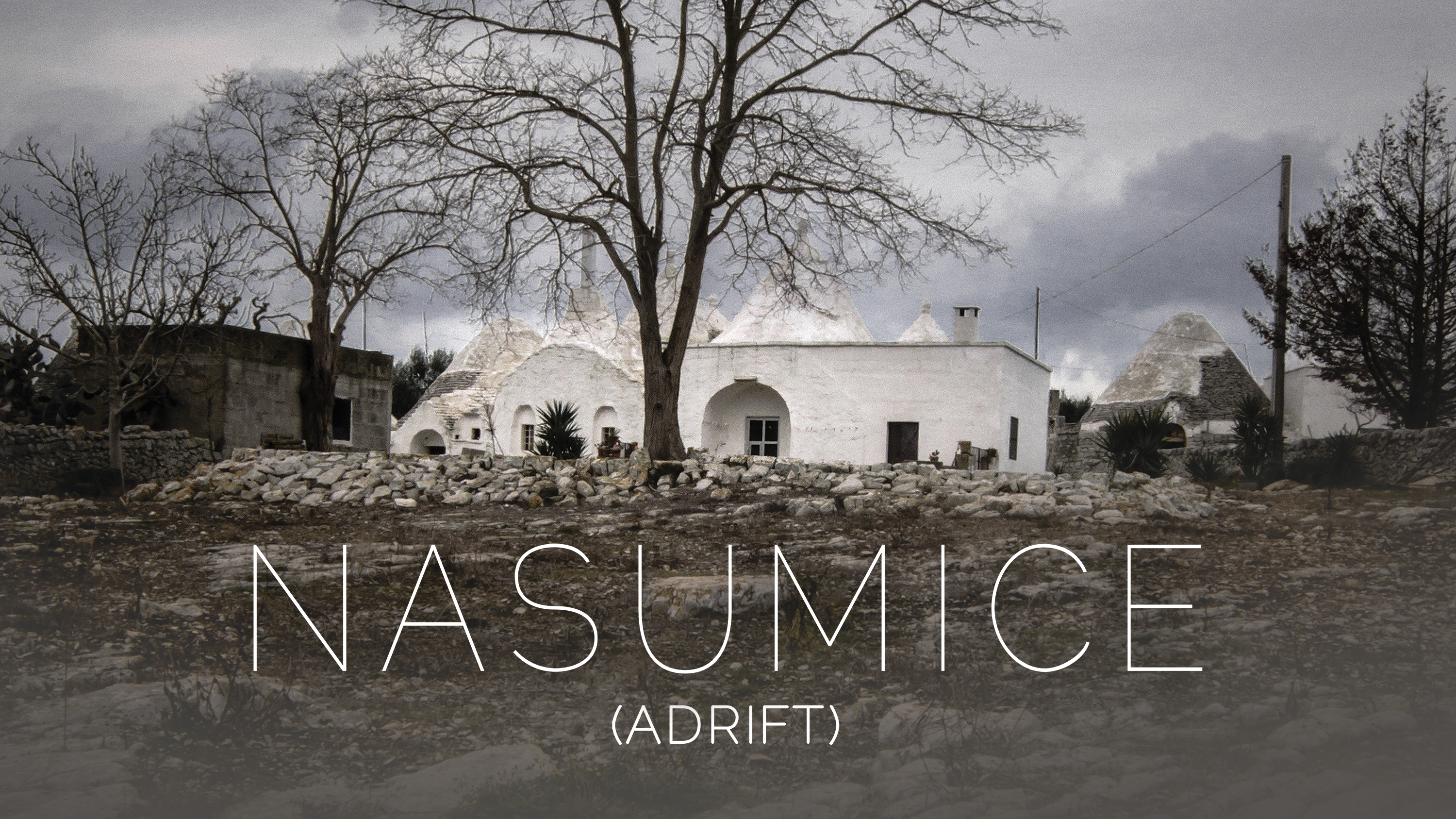
Drama, by Caleb Burdeau, United States/Italy/Bosnia, 2018.
Italy, 1994. The war in the Balkans drags on without end. Elvis, a young man from Sarajevo, is photographing tourists with his Polaroid to get by. After his camera is stolen, Elvis decides to visit Rodolfo, a stranger he met by chance in Venice. Their brief and solitary encounter takes place in the timeless landscape of the whitewashed villages, green hills and olive trees of southern Italy.
Set against the backdrop of the Yugoslav wars of 1994, Nasumice is a film about existential drift and the search for a sense of belonging. The project was born from the stories of a family friend to the director Caleb about his travel experiences in southern Italy in the 70s. When Caleb was working at Bela Tarr's film factory in Sarajevo, he met Moamer Kasumovic and the idea of making the film with Moamer in the lead role took hold. The film is a remarkably direct exploration of alienation and isolation with a unique story and beautiful cinematography. The cities, towns and hills of southern Italy form the backdrop for the story of Elvis and Rodolfo. The director combines long sweeping shots of the countryside and fixed scenes with the protagonists to create the feeling of isolation on the screen. Nasumice was shot in Venice, Rome and the Puglia countryside, and is a visually stunning independent film despite its low budget. The world premiere of Nasumice took place at the 2018 Sarajevo Film Festival.
LANGUAGE: Italian, English, Bosnian
SUBTITLES: English, Spanish, French, German, Portuguese
Tito's Death and the Vacuum of Legitimacy
On the morning of the funeral, four kings, a handful of princes, and representatives from a hundred and twenty-eight countries stood in Belgrade to watch a coffin move through streets lined with people who wept in a way that seemed to surprise even themselves. It was May 1980, and Josip Broz Tito, dead at eighty-seven, was being buried not merely as a head of state but as the last human warranty on a document nobody else had signed. Nixon was not there, but Thatcher was. Brezhnev was there. So was Saddam Hussein. The scale of it told its own story: a man who had walked out of the Comintern’s shadow, defied Stalin in 1948 and lived to describe the insult in his own memoirs, had built something so improbable, a socialist federation independent of Moscow, straddling the fault line between East and West, that the world’s most incompatible leaders felt compelled to watch it lose its center of gravity in real time.
Tito’s authority had never rested primarily on ideology. It rested on biography, on the partisan campaigns of 1941 to 1945 in which he had assembled a multiethnic resistance army out of Serbs, Croats, Slovenes, Bosnian Muslims, and Macedonians, and on the personal myth this created, a myth reinforced through decades of portraiture, oaths of loyalty recited by schoolchildren, and a cult of personality that Yugoslav historian Ivo Banac would later argue substituted for the institutional legitimacy the state never fully developed. He was Croatian by birth, married into Serbian and Slovenian circles, fluent in the symbolic language of every constituency he needed to placate. No successor could inherit that biography because no successor had lived it. Authority of this kind is non-transferable by design; it dies with the body that generated it.
Anticipating this, Tito had spent the 1970s engineering a system meant to survive him without him, and the 1974 constitution was its centerpiece. It created a collective state presidency, eight members rotating annually, one from each of the six republics and two autonomous provinces, Kosovo and Vojvodina, each holding the presidency for a single year before passing it along. The logic was ostensibly democratic, a wheel of representation ensuring no republic dominated. The actual effect, as political scientist Sabrina Ramet has detailed in her work on Yugoslav disintegration, was to institutionalize paralysis. A president who knows his term expires in twelve months has no incentive to make enemies, propose reform, or accumulate the kind of authority a crisis might require. The office became a ceremonial relay race conducted by men whose primary qualification was that they threatened no one, precisely because they lacked the capacity to matter.
Meanwhile the economy that Tito’s charisma had been papering over came due. Yugoslavia had financed its relatively high standard of living through Western loans, easily obtained during the era of nonalignment when both NATO and the Warsaw Pact courted Belgrade’s favor. By 1980, foreign debt stood near twenty billion dollars, and by the mid-1980s inflation was cresting past two hundred percent annually, eventually reaching the thousands by the decade’s end. The International Monetary Fund’s austerity demands landed on a population that had never been asked to sacrifice for socialism before, and the sacrifice fell unevenly, Slovenia and Croatia resenting subsidies flowing south to Serbia, Kosovo, and Macedonia, a resentment that had existed under Tito too but had lacked, until now, a vacuum to fill.
What disappeared in 1980 was not simply a leader but a mechanism of last resort, the phone call that could override any republic’s ambitions, the visit that could shame quarreling functionaries back into line. Historian Misha Glenny has described the post-Tito state as a body whose brain had been removed while its limbs continued operating on separate, increasingly divergent nervous systems. The republics did not secede in 1980. They simply noticed, for the first time in three decades, that nothing was actually stopping them from thinking about it.

Economic Collapse as the Silent Accelerant
A woman in Zenica stands in line at four in the morning outside a state bank, clutching a passbook that represents thirty years of deposits, and by the time she reaches the counter the dinar she withdraws will buy roughly a third of what it would have bought the previous week. This is not an isolated indignity. It is a monthly ritual repeated across Sarajevo, Skopje, Novi Sad, Pristina, in a country where inflation by 1989 has reached a documented annual rate exceeding 2,700 percent, a number so abstracted from lived experience that economists themselves struggled to describe its texture, yet ordinary Yugoslavs lived that texture daily, watching wages evaporate between the moment they were earned and the moment they were spent.
The seeds of this collapse were planted long before the queues formed. Josip Broz Tito’s Yugoslavia had financed its particular experiment in market socialism, its self-management model celebrated by Western economists as a middle path between Soviet central planning and capitalist orthodoxy, through massive foreign borrowing during the 1970s. By the time of Tito’s death in 1980, the country owed foreign creditors roughly twenty billion dollars, a debt incurred partly to paper over the structural incoherence of a federation where six republics and two autonomous provinces each ran quasi-independent economic policies while nominally sharing a currency and a central bank. The oil shocks of that decade did not cause this fragility; they exposed it.
What followed was not merely an economic downturn but a specific kind of humiliation administered by external actors. The International Monetary Fund, negotiating a series of standby agreements through the 1980s, demanded the standard package: currency devaluation, wage freezes, subsidy cuts, the dismantling of the very self-management protections that had defined Yugoslav identity since the 1950 Law on the Management of State Economic Enterprises by Workers’ Collectives. Prime Minister Ante Marković, who would later become a tragicomic figure of doomed reformism, inherited an economy where austerity was not an abstraction debated in parliament but a lived sensation of purchasing power draining from your hands. Real wages by the late 1980s had fallen to roughly half their 1979 levels, unemployment climbed past one million, and the federal government found itself administering pain without possessing the political legitimacy to distribute that pain as sacrifice rather than as theft.
This is the mechanism worth sitting with: austerity does not simply make people poorer, it makes them audit each other. When the federal government cannot pay pensions in Macedonia but somehow finds funds for infrastructure in Slovenia, when a Bosnian factory worker sees Belgrade bureaucrats retain privileges denied to the provinces, the question that forms is never “why has our shared system failed us” but “why is my republic subsidizing theirs.” The Yugoslav federal budget, structured since the 1974 constitution to require near-unanimous consent among republics for major fiscal decisions, became a machine for generating resentment precisely because it required constant renegotiation of who would bear the cost of decline. Slovenia and Croatia, the wealthier republics generating a disproportionate share of federal revenue, increasingly framed the transfers to poorer Kosovo and Macedonia not as solidarity but as extraction. Serbia, meanwhile, watched its own industrial base erode while perceiving Kosovo’s autonomous status as an affront layered atop economic grievance.
Sociologist Michael Mann, writing later about what he termed the dark side of democracy, observed that ethnic scapegoating rarely emerges from ancient hatred alone; it requires an organizational and material vacuum into which entrepreneurs of fear can insert a simplified story. The story does not need to be true. It needs only to be simpler than the truth of IMF conditionality agreements and federal transfer formulas, simpler than debt-servicing schedules denominated in deutschmarks that ordinary citizens could never hope to track. Slobodan Milošević did not invent Serbian grievance from nothing, and Franjo Tuđman did not invent Croatian resentment from nothing. They found population after population primed by years of watching their savings dissolve, their factories idle, their pensions shrink, and they offered an explanation that required no understanding of Belgrade’s negotiations with Washington creditors, only a name for who among the neighbors had taken what was yours.
The Rhetoric of Grievance: Milošević and the Weaponization of Memory
On June 28, 1989, roughly a million people gathered on the plain of Gazimestan to watch a man in a gray suit tell them they were the heirs of a defeat. Six hundred years earlier, on that same field, an Ottoman army had killed the Serbian prince Lazar and scattered his forces, and out of that scattering had grown not a historical footnote but a national liturgy, a wound that generations of epic poets, priests, and schoolteachers had kept raw on purpose. Slobodan Milošević stood before the crowd on the anniversary of the battle and spoke of unity, of courage, of a people who had been kept from prevailing not by weakness but by discord among themselves. He did not need to explain the reference. Every person standing on that plain had absorbed the myth of Kosovo before they could read, through liturgical verse, through the oral epics collected and codified in the nineteenth century, through a folk memory so dense with meaning that the historical Lazar had become indistinguishable from a Christ figure who chose a heavenly kingdom over an earthly one, sacrifice over survival. Milošević did not invent this material. He inherited a fully formed cathedral of grievance and simply moved into it as its new priest.
What he did that was new was operational. The Battle of Kosovo had functioned for centuries as a story about spiritual endurance, a way of metabolizing Ottoman rule without capitulating to it in spirit even while living under it in fact. Milošević converted that spiritual grammar into a political program aimed at a very specific, very contemporary adversary: the Kosovo Albanians who now made up the overwhelming demographic majority of the province he was standing in. The speech itself, read coldly on the page, is almost restrained, gesturing toward Yugoslav brotherhood and unity even as it warns that “armed battles” might again be necessary. But the setting did the work the words avoided doing explicitly. Helicopters had transported relics of Prince Lazar around the country in the months prior, in a kind of rolling funeral procession that let every town host its own encounter with the six-hundred-year-old bones. By the time Milošević spoke, the crowd had already been primed by an entire liturgical season to receive his ordinary political sentences as the culmination of a sacred narrative.
The sociologist and Yugoslav dissident Mihailo Marković, and later scholars like Michael Sells in his study of religious nationalism in the Balkans, have traced how this mythology functioned less as history than as what Sells termed a Christoslavic framework, in which Slavic Muslims were cast not as fellow South Slavs who had converted centuries earlier but as the permanent genetic residue of the original Ottoman betrayal, Christ-killers by proxy, race traitors who had chosen the Turkish sultan over their own blood. This is the mechanism by which a battle fought in 1389 becomes usable in 1989 and again in 1992: the myth does not narrate the past, it structures the present, providing a ready-made cast of villains onto which any contemporary neighbor can be mapped.
Anthropologists who study collective memory, particularly Maurice Halbwachs in his foundational work on the social frameworks of memory, argued that societies do not remember the past as it happened but reconstruct it continuously to serve present needs, and Yugoslavia in the late 1980s offered a textbook case. The state that had suppressed nationalist memory for four decades under Tito’s formula of “brotherhood and unity” had also, unintentionally, kept it in cold storage rather than dissolving it, so that when the economic crises of the 1980s and the death of Tito in 1980 opened a legitimacy vacuum, the old material was still fully intact, still emotionally potent, ready to be thawed. Milošević did not need to manufacture Serbian victimhood. He needed only to give it a microphone, a date, and a plain full of people already primed by their grandmothers’ songs to hear a call to arms disguised as a commemoration.
Secession and the Logic of Preemptive Violence
On the morning of June 27, 1991, a column of Yugoslav People’s Army tanks rolled toward the Slovenian border crossing at Holmec, and the soldiers inside them, mostly conscripts from Serbia and Bosnia who had never expressed any particular hatred toward Slovenes, found themselves facing territorial defense units who had spent the previous months quietly stockpiling weapons in church basements and agricultural cooperatives. The war that followed lasted ten days and killed fewer than seventy people, a statistical footnote against what would come later in Bosnia, and yet it announced something that the diplomats in Brussels and Washington had refused to metabolize: that the federation could not be dissolved through negotiation, because dissolution itself was the thing nobody with power over the army was prepared to negotiate.
Slovenia’s advantage was structural before it was military. Ethnically homogeneous, bordering Austria and Italy, with almost no Serb minority to serve as a pretext for JNA intervention, it presented Belgrade with a secession that cost nothing strategically and everything symbolically. Milošević, whose ambitions were never about Yugoslavia as an abstraction but about which populations fell under Serbian sovereignty, let Slovenia go with barely a shrug. There was no Krajina to defend in the Julian Alps, no scattered Serb villages to justify tank divisions. The war ended not because the JNA was defeated but because someone in Belgrade did the arithmetic and found Slovenia not worth the ledger entry.
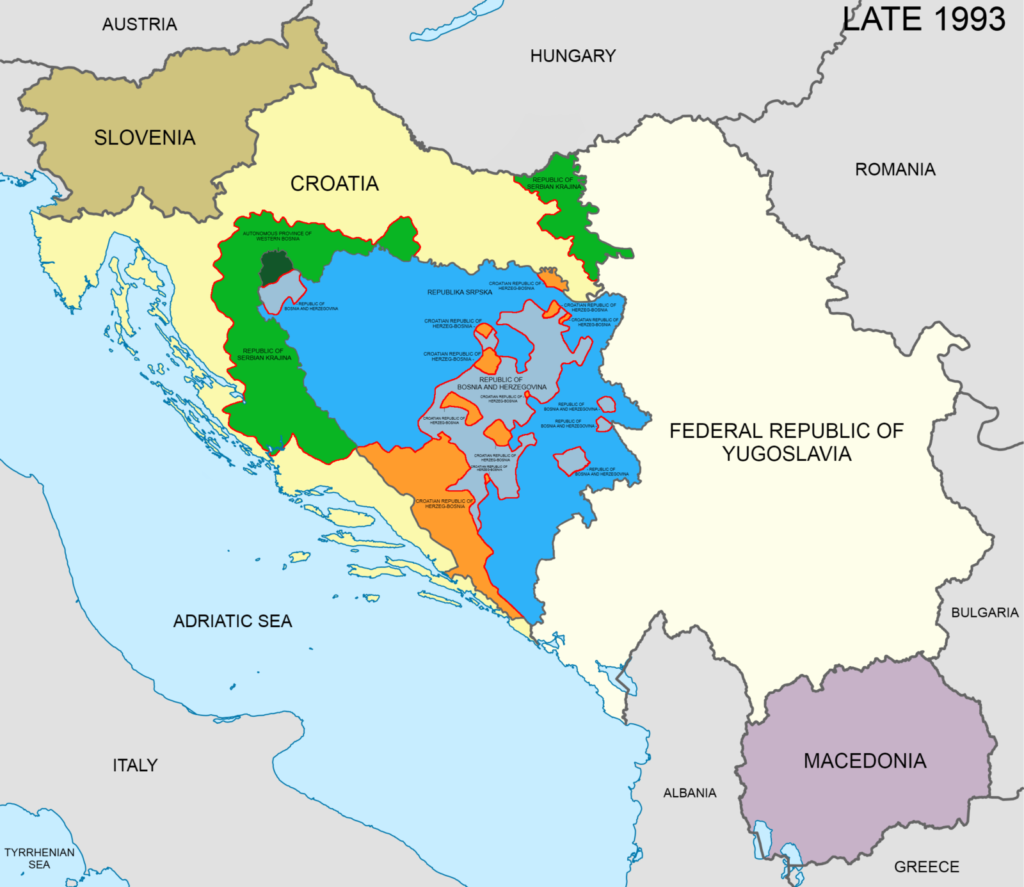
Croatia was a different arithmetic entirely. Some 580,000 Serbs lived within its borders according to the 1991 census, concentrated in the Krajina region along the Bosnian frontier and in eastern Slavonia, communities that had been there for centuries, some tracing their settlement to the Habsburg Military Frontier established in the sixteenth century precisely to buffer Christian Europe against Ottoman incursion. When Franjo Tuđman’s government pushed through a new constitution in December 1990 that redefined Croatia as the national state of the Croatian people, demoting Serbs from constituent nation to national minority, it did something that reads on paper as a technical reclassification and felt, to those on the receiving end, like a legal countdown to expulsion. Tuđman was not a subtle man. He had written openly about minimizing the number of Jewish dead at Jasenovac, and he surrounded his party with the checkerboard imagery of the wartime Ustaše state, an aesthetic choice that could not have been better designed to convince Krajina Serbs that history was repeating rather than merely rhyming.
By August 1991, Serb militias backed by JNA armor had carved out the self-declared Republic of Serbian Krajina, and the war that Slovenia avoided arrived in Croatia with a viciousness that the international press struggled to contextualize because it kept describing ethnic hatred as ancient when the actual machinery driving it was extremely modern: state television, weapons transfers, and a paramilitary economy of men like Željko Ražnatović, known as Arkan, who ran his Tigers unit as both a military formation and a criminal enterprise, looting as it burned. Vukovar fell in November after a siege of nearly three months, the city reduced to rubble so total that journalists compared it to Stalingrad, and the hospital massacre at Ovčara, where more than two hundred patients and staff were taken out and executed, became the template for what specific, intimate cruelty secession could unleash once it stopped being a parliamentary vote and became a fact enforced by artillery.
What makes this moment structurally important is not simply that Croatia suffered while Slovenia escaped, but that both outcomes taught the same lesson to every other republic watching: that recognition by the international community, however desired, would not arrive in time to prevent the violence that recognition was supposed to resolve, and that whoever struck first, whoever preemptively secured territory and expelled the population that might contest it, would be negotiating from a position no ceasefire could later undo.
A vision curated by a filmmaker, not an algorithm
In this video I explain our vision
Bosnia: The Anatomy of Ethnic Cleansing

A man stands at a checkpoint in the hills above Foča in the spring of 1992, holding a list of names typed on paper that still smells faintly of the municipal office where it was produced two days earlier. He knows the names. He went to school with some of them. He drank with the fathers. Now he waves cars through or does not, and the difference between those two outcomes is the difference between a person going home to sleep and a person disappearing into a warehouse that used to store agricultural equipment. He is not a soldier by trade. He was, until recently, a driver, a clerk, a man who fixed refrigerators. Nothing in his biography prepared him for this role, and yet he performs it with the flat competence of someone stamping documents at a border crossing.
The siege of Sarajevo lasted from April 1992 to February 1996, one thousand four hundred and twenty-five days, longer than the siege of Leningrad, and it was conducted not as a battle but as a demonstration. Serb forces held the hills; the city held the valley; and for nearly four years shells fell on breadlines, on children playing in courtyards, on a funeral procession that was itself already mourning shelling deaths, in a war crime within a war crime that repeated itself with the patience of a metronome. Snipers on Zmaja od Bosne, the street residents renamed Sniper Alley, picked off pedestrians as a matter of routine, and journalists counted the intervals between shots the way meteorologists count the intervals between lightning and thunder to estimate distance. The city had 1984 Olympic venues turned into cemeteries because there was no other unclaimed ground.
What happened in Bosnia between 1992 and 1995 was not chaos. It was administration. Camps like Omarska and Trnopolje in the Prijedor region operated on schedules, with intake procedures and designated interrogators, some of whom had been neighbors of the interned a season earlier. Hannah Arendt, writing about Adolf Eichmann‘s trial in Jerusalem in 1961, described a defendant who was neither a monster nor a fanatic but a man distinguished chiefly by his inability to think from another person’s perspective, a deficiency she called the banality of evil, and the phrase has been worn smooth by overuse, but it was never meant to comfort. It was meant to indict the ordinary. In Bosnia, the machinery required tens of thousands of ordinary hands, not a small cadre of ideologues, and those hands belonged to men who returned home for dinner.
Christopher Browning’s study of Reserve Police Battalion 101, published in 1992 as Ordinary Men, traced how a unit of middle-aged German reservists, too old for the front, hardly Nazi zealots, became efficient executioners of Polish Jews in 1942, killing at close range, day after day, with only a small percentage requesting reassignment when given explicit permission to abstain. Browning’s evidence suggested conformity and peer pressure did more work than ideology. Bosnia offers a parallel text written in real time. Neighbors who joined paramilitary units did so under a combination of coercion, opportunism, and the simple gravitational pull of a group already in motion, and the atrocities that followed were carried out with tools and manpower drawn from village life itself, tractors, hunting rifles, town halls repurposed as detention points.
Srebrenica in July 1995 concentrated this logic into six days. Dutch peacekeepers, under-armed and under mandate, stood by as General Ratko Mladić’s forces separated men and boys from women at the Potočari compound. More than eight thousand men and boys were murdered and buried in mass graves later bulldozed and scattered to a second site to frustrate identification, a forensic afterthought that testified to a bureaucratic mind still operating even in the act of atrocity. The International Criminal Tribunal for the former Yugoslavia would later rule this genocide, the only such finding on European soil since 1945, and the ruling rested not on the scale of intention alone but on the granular evidence of order forms, radio intercepts, and the testimony of men who had once been, by every ordinary measure, unremarkable.
International Paralysis and the Failure of Intervention
A Dutch soldier stands at a factory gate in Potočari in July 1995, watching thousands of men separated from their families, and he has no ammunition worth firing, no order that permits him to intervene, no authority beyond the blue helmet on his head and a mandate written by people thousands of miles away who could not have imagined this specific afternoon. He radios for air support. It does not come, or comes too late, or comes as a single symbolic strike that changes nothing. Within days, more than eight thousand men and boys are dead, and the soldier goes home to Holland to begin a lifetime of trying to explain what he witnessed to people who will never quite believe he could not have done more.
The United Nations had declared Srebrenica a safe area in 1993, one of six such zones in Bosnia, a designation that sounded like a guarantee and functioned as a trap. Safe areas require enforcement, and enforcement requires troops willing to fight, rules of engagement that permit fighting, and a chain of command prepared to accept casualties in defense of civilians who are not their own citizens. The UN provided none of these things in sufficient measure. Resolution 819, which created the safe area, was a resolution in the grammar of diplomacy but not in the grammar of war, and the several hundred Dutch peacekeepers stationed there, undermanned and under-armed, were left to embody a promise that existed on paper in New York and dissolved on contact with Ratko Mladić’s forces on the ground.
The deeper failure was structural, not merely personal to the men in Potočari. The UN’s peacekeeping doctrine had been built for conflicts where there was a peace to keep, an armistice already in place, two exhausted parties waiting for referees. Bosnia offered no such condition. This was a war still being actively prosecuted, with an army pursuing territorial conquest and ethnic homogenization as explicit strategy, and peacekeepers deployed under rules designed for a different kind of war found themselves guarding civilians they had no mandate to actually protect. The mandate spoke the language of neutrality in a conflict where neutrality was itself a choice with consequences, and those consequences fell on the people inside the safe areas rather than on the diplomats who had declared them safe.
NATO’s eventual intervention, when it came, exposed just how avoidable the preceding years of paralysis had been. Operation Deliberate Force in August and September 1995, launched only after Srebrenica had already happened, after the marketplace massacres in Sarajevo had already been counted, demonstrated within weeks what sustained air power could accomplish against Bosnian Serb positions. The bombing campaign, combined with a Croatian and Bosnian ground offensive, shifted the military balance decisively and pushed the parties toward the negotiating table at Dayton within months. The question that follows is not whether intervention could work but why it took three and a half years, some hundred thousand deaths, and a genocide recognized as such by international tribunals before anyone applied it.
This delay cannot be separated from what Western Europe believed about itself in 1991. The continent had spent forty-five years constructing an identity around the idea that its wars were finished, that the European project, the Coal and Steel Community mutating into the European Community and soon the European Union, had rendered continental warfare obsolete through economic integration and shared institutions. Yugoslavia’s collapse happened inside the same landmass as this self-congratulation, a few hours’ drive from Vienna, and the initial European response was denial dressed as diplomacy, a conviction that this was a Balkan aberration rather than a European reality requiring European force. Jacques Poos, foreign minister of Luxembourg, declared in 1991 that this was the hour of Europe, not America, and the declaration proved almost immediately hollow, because Europe had the institutions of peace and none of the instruments of enforcement, and discovered that moral confidence is not a substitute for troops willing to shoot.
The Hague, Kosovo, and the Unfinished Reckoning
You sit in a courtroom in The Hague in 1999 and watch an old man deny that anything happened at all, and the strange thing is not his denial but the fluorescent light overhead, the headphones offering simultaneous translation into languages that were, a decade earlier, supposedly one language, and the fact that the building itself, this borrowed insurance office turned tribunal, seems to embarrass everyone inside it with its temporary, provisional air, as though justice arrived wearing the wrong clothes for the occasion.
The International Criminal Tribunal for the former Yugoslavia was established by the United Nations Security Council in 1993, before the war in Bosnia had even reached its worst atrocities, which meant the institution existed in a strange anticipatory relationship to crimes not yet committed, a court waiting for its own subject matter to finish happening. By the time it closed in 2017, it had indicted 161 individuals, and among them Slobodan Milošević, who died in his cell in 2006 before a verdict could be reached, denying the tribunal the one thing it needed most, a formal reckoning with the man most associated with the wars’ architecture. Radovan Karadžić received forty years, later life imprisonment on appeal, Ratko Mladić the same, decades after Srebrenica, decades in which he lived partly in hiding, partly protected by networks of loyalty that outlasted the state that had produced them.
But tribunals prosecute individuals, and individuals are not nations, and this gap is where the unfinished quality of the reckoning actually lives. Serbia, Croatia, Bosnia, each constructed its own museum of victimhood, and these museums do not share walls. In Belgrade, Mladić is, for a significant portion of the population, a defender rather than a perpetrator, according to surveys conducted well into the 2010s by the Belgrade Centre for Human Rights showing majorities still doubting or minimizing Srebrenica. In Croatia, generals convicted and then acquitted on appeal became national heroes with streets named for them. The court could assign individual guilt, but it could not compel collective memory, and memory, unlike verdicts, is not bound by procedure.
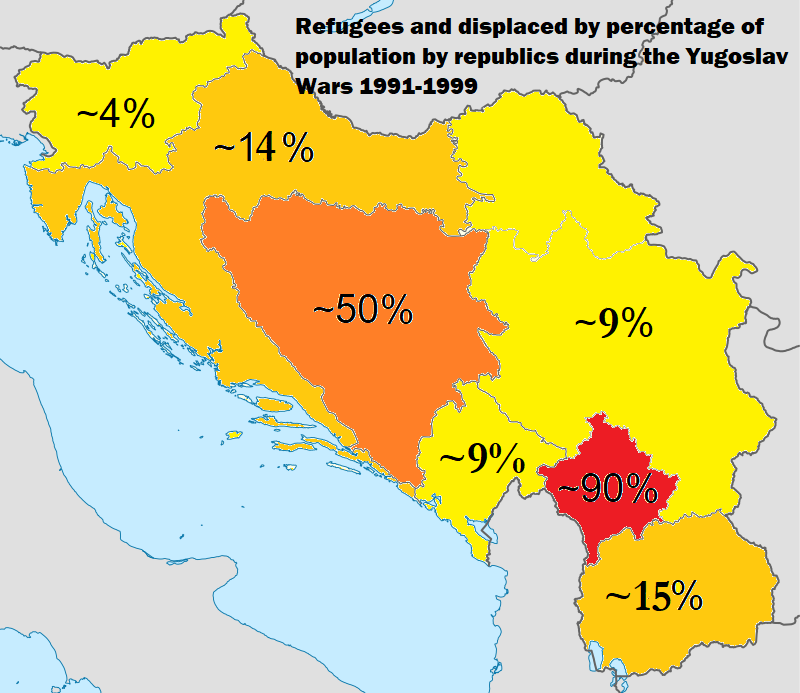
Then came 1999, a war folded inside the larger war, when Milošević turned the machinery that had emptied Bosnian towns toward Kosovo, an ethnic Albanian majority province within Serbia whose autonomy he had stripped a decade earlier, the same act, arguably, that had ignited the whole conflagration in the first place. The Kosovo Liberation Army, initially a marginal insurgency, escalated attacks; Serbian and Yugoslav forces responded with a campaign of expulsion that pushed hundreds of thousands of Kosovar Albanians across borders within weeks. NATO, having watched Bosnia unfold too slowly in the mid-1990s, intervened this time without UN Security Council authorization, a seventy-eight-day bombing campaign against Serbian and Yugoslav targets, including Belgrade itself, that killed several hundred civilians and that remains, to this day, legally uncomfortable, a humanitarian intervention that violated the very international order it claimed to defend.
Kosovo declared independence in 2008, recognized by the United States and most of the European Union, rejected by Serbia, Russia, China, and roughly half the world’s states, which means Kosovo exists now in a condition of partial reality, a country that is a country everywhere except in the diplomatic rooms where Serbia still has veto power over recognition. Serbia’s own path toward the European Union has been repeatedly conditioned on normalizing relations with a place it refuses to call a state, an absurdity that produces endless negotiated ambiguities, license plates that say nothing, agreements that resolve nothing, a frozen argument conducted through bureaucratic language because the alternative is remembering what happened when it wasn’t.
Walk through Sarajevo today and you will find bullet-pocked facades restored beside others left deliberately scarred, as if the city could not decide whether forgetting or remembering constituted the greater betrayal. The successor states share borders, shared grandparents, shared songs mangled now into separate anthems, and a history that each has learned to tell as though the others were never in the room, which is, perhaps, the only way any of them have found to keep living next door to what they did.
⚔️ Echoes of a Fractured Nation
The Yugoslav Wars remain one of the most devastating conflicts in modern European history, a violent unraveling of a multiethnic state into competing nationalisms. To understand the roots and reverberations of this tragedy, these related articles explore the mechanisms of ethnic violence, justice, and collective memory that surrounded it.
War crimes: history and international justice
The Yugoslav conflict produced some of the most documented war crimes since World War II, from ethnic cleansing campaigns to the Srebrenica massacre. This article examines how international justice systems, including the ICTY, attempted to hold perpetrators accountable and what such tribunals reveal about the limits and possibilities of post-conflict reconciliation.
GO TO THE SELECTION: War crimes: history and international justice
The foibe: history and memory of an Italian tragedy
Though rooted in an earlier conflict, the foibe massacres illuminate the same Balkan fault lines of ethnic retribution and buried memory that would later explode in Yugoslavia. This piece traces how unresolved historical grievances in the region can resurface generations later with devastating consequences.
GO TO THE SELECTION: The foibe: history and memory of an Italian tragedy
The Giuliano-Dalmatian exodus: history and testimonies
The Giuliano-Dalmatian exodus offers a haunting parallel to the displacement suffered by Bosnians, Croats, and Serbs decades later, showing how border shifts and nationalist violence force entire populations into permanent uprooting. This article situates the Yugoslav Wars within a longer Balkan and Adriatic history of exile and identity loss.
GO TO THE SELECTION: The Giuliano-Dalmatian exodus: history and testimonies
How power elites manufacture the public enemy
Understanding how political and media elites construct enemies is essential to grasping how Yugoslavia’s constituent peoples were turned against one another after decades of coexistence. This article dissects the propaganda machinery and manufactured fear that allowed nationalist leaders to weaponize ethnic difference into genocide.
GO TO THE SELECTION: How power elites manufacture the public enemy
🎬 Beyond the Headlines: Stories Worth Discovering
If these histories of conflict and identity resonate with you, Indiecinema offers a curated selection of independent films that探索 war, memory, and human resilience with unflinching honesty. Dive into stories that mainstream cinema often overlooks and discover perspectives that illuminate our shared, complicated past.
👉 EXPLORE THE CATALOG: Watch Indie Films in Streaming
A vision curated by a filmmaker, not an algorithm
In this video I explain our vision