
The Letter You Never Sent
You have written it three times already. The paper is still there, folded along a crease you made without thinking, pressed flat by the weight of your palm as though pressure alone could decide what to do with it. The words exist — you chose them carefully, revised the opening twice, crossed out the ending because it sounded too certain — and yet the letter remains unsent, held in a suspension that is neither courage nor cowardice but something more precise and harder to name. You know what you feel. That has never been the problem. The problem is that feeling and speech operate in different registers, and somewhere between the chest and the throat there is a territory that language, as you have learned to use it, cannot enter without destroying what it touches.

This is the wound Urdu poetry was built inside. Not around it, not in response to it — inside it, as architecture is built inside weather, taking the shape of what cannot be escaped. The ghazal form, which crystallized across Persian and Urdu literary culture between the twelfth and nineteenth centuries, was never a vehicle for resolved emotion. Its structure forbids resolution. Each couplet, called a sher, is formally complete and semantically autonomous — it stands alone, makes its claim, and ends without handing anything to the line that follows. The poem does not build toward a conclusion. It accumulates pressure without release, the way a person accumulates years of unspoken feeling without ever arriving at the conversation that would disperse them. When Mirza Ghalib wrote in nineteenth-century Delhi, composing the Diwan-e-Ghalib across decades of personal and political catastrophe, he was not documenting experience — he was demonstrating that certain experiences can only be held structurally, in a form that refuses to close.
What distinguishes this tradition from confession is the absence of the private self as subject. The speaker in a ghazal is not a character with a biography. He is a function — the lover, the seeker, the one who waits — and this abstraction is not evasion but precision. When Faiz Ahmed Faiz, writing in the mid-twentieth century, used the beloved as a figure that moved between the personal and the political, refusing to let either meaning cancel the other, he was exploiting a structural feature of the form: Urdu poetry has always understood that the most unbearable emotions are the ones that cannot be assigned to a single cause. The grief that arrives after a failed love is also grief about mortality. The longing for a person is also longing for a self that no longer exists. The ghazal holds these superimpositions without sorting them, because sorting them would be a lie.
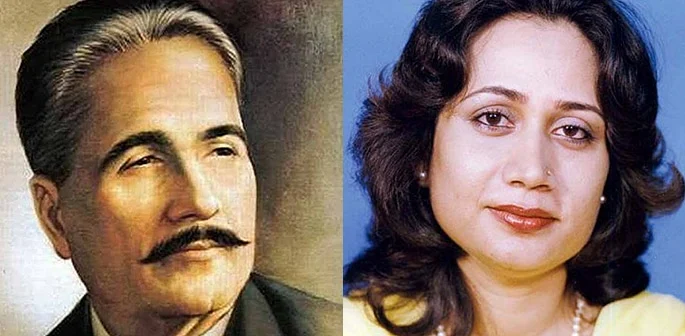
There is a word in Urdu — intezaar — that translates approximately as waiting, but the translation is immediately insufficient. Intezaar contains the quality of the wait, its texture, the specific consciousness of someone who has organized their entire interior life around an absence. English requires a sentence to say what Urdu buries in a word, and that sentence, once constructed, loses the compression that made the feeling bearable. Urdu poetry operates through this kind of compression constantly, accumulating in single lines what prose requires paragraphs to approximate. The poet Parveen Shakir, working in the latter decades of the twentieth century, wrote with a directness that seemed to violate the tradition’s characteristic indirection, and yet even her most apparently transparent lines carry a secondary pressure — a meaning that presses against the literal meaning from underneath, the way cold water presses against ice from below.
The letter in your hand is made of the same substance. It says one thing and means the pressure beneath the thing. You already know this, which is why you have not sent it.
Thirsty
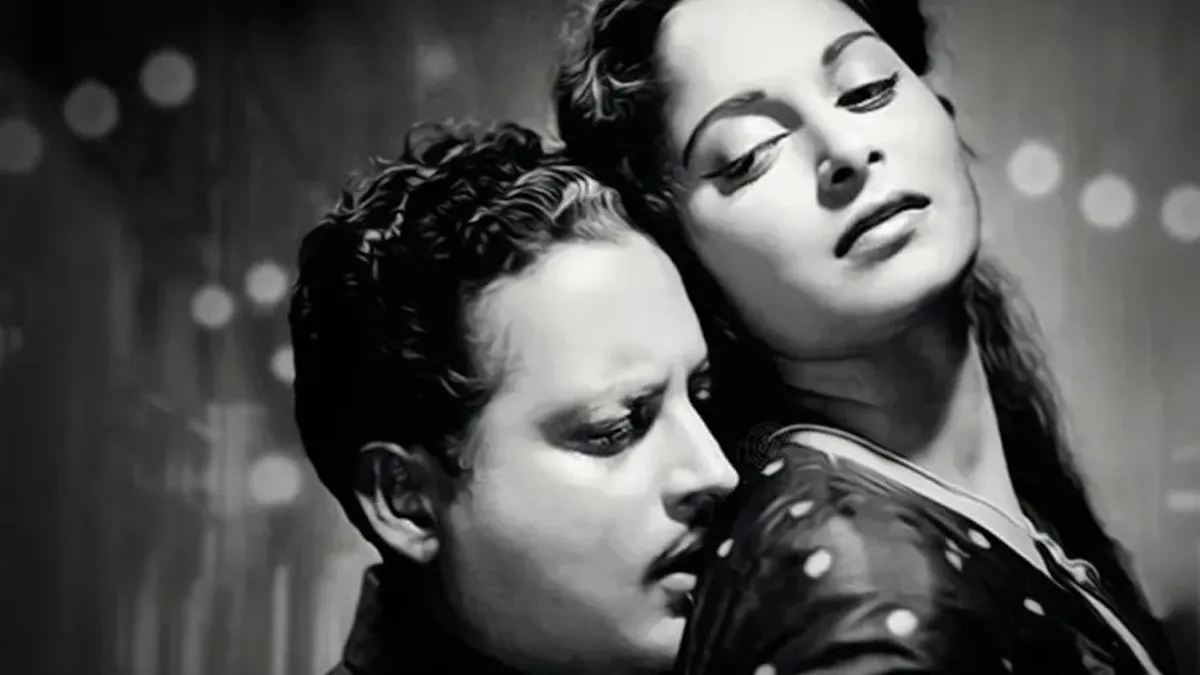
Drama, musical, by Guru Dutt, India, 1957
Thirsty is the heartbreaking story of Vijay, a young poet living in Calcutta who dreams of giving voice to the suffering and injustice of the world through his verses. Idealistic and sensitive, Vijay clashes with a society that despises his art because it is not profitable and does not cater to the tastes of the public. His brothers consider him a failure, the woman he loves leaves him for a marriage of convenience, and his poems are ignored by publishers. Only Gulabo, a prostitute with a pure heart, recognizes the beauty and truth of his words. When a misunderstanding leads everyone to believe Vijay is dead, his name and poetry suddenly become famous, exposing the hypocrisy of those who had previously rejected him.
Watching Thirsty means immersing oneself in a work that goes beyond melodrama, blending poetry, music, and imagery into a profound reflection on the human soul and the value of art. Guru Dutt, director and protagonist, creates one of the most intense and poetic films in world cinema, where black-and-white cinematography, expressive framing, and evocative lyrics produce an atmosphere of poignant melancholy. It is a film about the misunderstanding of the artist, pure love, and society’s hypocrisy, but also a universal critique of materialism and opportunism. Even today, Thirsty moves and provokes thought because it sincerely tells the story of the need to remain true to oneself in a world that measures people’s worth solely by their success.
LANGUAGE: Hindi
SUBTITLES: English, Spanish, French, German, Portuguese
A Language Built for Rupture
You are sitting with a word you cannot translate. Not because the dictionary fails you, but because the entire architecture of your language was never built to hold what this word carries. Urdu has a word, “hijr,” that means the specific ache of separation from someone you love — not grief at their death, not anger at their leaving, but the sustained, almost devotional suffering of their absence while they still exist somewhere in the world. English circles this feeling with seventeen clumsy approximations and never lands. The inadequacy is not accidental.
Urdu did not emerge from a single people deciding to communicate. It crystallized over roughly three centuries at the Mughal courts, beginning in earnest around the sixteenth century, from the violent convergence of Persian administrative elegance, Arabic theological precision, and Sanskrit’s ancient grammar of sensation. The word “Urdu” itself derives from the Turkic “ordu,” meaning camp or army — a language born, etymologically, in the zone of collision, in the place where different forces press against each other without resolution. This is not a poetic metaphor imposed afterward. It is structural. When Amir Khusrau in the thirteenth century began weaving Braj Bhasha with Persian in his verses, he was not looking for efficiency. He was reaching for something that neither language alone could hold.
Persian contributed an entire emotional cosmology built around the concept of “fana” — annihilation of the self in love or in the divine — while Sanskrit brought the body’s concrete vocabulary, the weight of physical longing rooted in the material world rather than transcendent abstraction. Arabic arrived with its geometric certainty, its capacity for absolute statement. The result was not a blend but a fault line, a language where you can say something with total conviction and its dissolution in the same breath. When the poet Mir Taqi Mir wrote in the late eighteenth century that his heart was both the wound and the instrument of its own cutting, he was not being paradoxical for effect. The grammar of the language made this the natural, almost inevitable shape of the thought.
This grammatical tolerance for contradiction is measurable in ways that go beyond metaphor. Urdu maintains a formal register, “rekhta,” developed specifically for poetry, that preserves Persian and Arabic loanwords alongside Indic roots in deliberate, unresolved tension. John Platts’ 1884 “Dictionary of Urdu, Classical Hindi, and English” documented over twenty distinct terms in Urdu for varieties of love alone — not synonyms but separate phenomenological categories, each naming a stage or texture that the others cannot cover. The sheer taxonomic specificity means that a speaker is forced to be precise about suffering in a way that English, with its single overloaded word “love,” structurally prevents.
What makes this extraordinary is that the precision does not reduce the pain — it amplifies it. When you are forced to choose the exact word for the particular flavor of longing you carry, you can no longer hide from it inside a generality. The language refuses the consolation of vagueness. The German sociologist Norbert Elias argued in “The Civilizing Process” that the development of language shapes what emotions become permissible to feel in public and in private. Urdu inverts this logic entirely: it developed a public form, the mushaira gathering of poets performing to audiences in the Mughal courts and later in the salons of Lucknow and Delhi, specifically designed for the communal experience of exquisitely articulated private devastation. The audience did not watch from a safe distance. They called out “wah wah” — roughly, “yes, yes, this, exactly this” — the moment a line struck the wound they had brought with them into the room.
The language was never designed to help you move on from loss. It was designed to make staying inside loss feel like the most honest and perhaps the most dignified thing a person could do.

The Ghazal as Emotional Trap
You have read the same message three times in a row, not because the words changed but because you needed them to. Something in the rhythm of it felt like proof — proof of depth, proof of permanence, proof that whoever wrote it meant it more than ordinary people mean ordinary things. You put the phone down and picked it up again. This is not weakness. This is the ghazal working exactly as designed, centuries before the screen existed.
The ghazal is not a poem about obsession. It is the architecture of obsession built into syllables. Its governing principle, the radif, is the compulsory refrain that closes every couplet: the same word or phrase, dragged back, regardless of where the preceding lines have traveled. Formally, no other poetic tradition forces this with such structural violence. The lover may have just described the cruelty of the beloved, the indifference of God, the wreckage of an entire season of waiting — and then the radif arrives, pulling everything back to the same terminus. The form does not allow the speaker to escape the thing they are speaking about. It encodes return as the only available motion.
Mirza Ghalib understood this not as constraint but as confession. His Diwan-e-Ghalib, completed in its canonical Urdu form by 1841, contains ghazals in which the radif functions less like a poetic device and more like a compulsion the speaker cannot name. In one of the collection’s most devastating couplets, Ghalib writes that he knows the beloved will not come, and yet he has arranged the house for a guest. The radif at the close is not a surprise — it is an inevitability. That inevitability is the point. The reader does not experience the return of the refrain as repetition. They experience it as recognition: yes, again, of course, again. The form has trained them to feel compulsion as intimacy.
The maqta, the final couplet in which the poet traditionally inscribes his own name or pen name, intensifies this trap by collapsing the distance between poet and speaker entirely. When Ghalib signs himself into the poem in the closing verse, he is not performing modesty or convention — he is making himself the final exhibit of everything the poem has enacted. He has not been observing the lover’s anguish from outside. He has been demonstrating it. The signature transforms the preceding couplets from lyric meditation into testimony, and the reader, having moved through the entire structure to arrive here, now understands that what they witnessed was not fiction. The poet has been caught in his own form.
What this produces in the reader is something no straightforward declaration of love could replicate: a learned conflation of structure with sincerity. Because the ghazal returns, the reader begins to feel that returning is itself the mark of genuine feeling. Repetition becomes evidence. The beloved who keeps appearing in every couplet must be loved more deeply than a beloved who appears once. The person who sends the same message three times must feel more than the person who sends it once and moves forward. This is not a conclusion the ghazal argues for. It is a habit the ghazal installs — quietly, through the mechanics of a form that has been repeating itself since at least the tenth century, through Persian and then Urdu, through courts and coffeehouses and now through every medium that allows a line to be copied and sent again.
What makes Ghalib’s deployment of this form so precise is that he appears to know he is trapped inside it. Several of his couplets contain a kind of rueful self-awareness, a speaker who watches himself returning to the same wound with something between horror and satisfaction. The ghazal, in his hands, does not pretend the return is healing.
What Rumi Did Not Mean
You have almost certainly encountered Rumi without knowing it. The quote on the coffee mug, the Instagram caption beneath a sunset photograph, the motivational poster in the therapist’s waiting room — these fragments arrive without origin, without context, without the name of a translator, and certainly without the twelve centuries of Islamic mystical theology that gave them their original violence. You received them as warmth. That is precisely the problem.
Coleman Barks published his renderings of Rumi’s Masnavi and Divan-e Shams in 1995, and the collection sold over half a million copies within a decade, making Rumi the best-selling poet in the United States by the early 2000s. Barks does not read Persian. He worked from existing literal translations by scholars like John Moyne, smoothing their angular, difficult English into something melodious and accessible. What he produced is not translation in any rigorous sense — it is a recomposition, a new poem written in the spirit of what he imagined Rumi to mean. The distinction matters enormously, because what Barks imagined Rumi to mean bears almost no resemblance to what Rumi actually wrote about.
Jalal ad-Din Rumi was a thirteenth-century Sufi theologian working within the Hanafi tradition of Sunni Islam. His poetry is saturated with the specific terror of divine longing — not the cozy warmth of spiritual connection, but the annihilation of the self before God, what Sufi doctrine calls fana, the dissolution of individual identity into divine unity. This is not a metaphor for self-actualization. It is a theological proposition about the obliteration of everything you consider yourself to be. The reed flute in the opening verses of the Masnavi does not cry because it misses abstract love; it cries because it has been severed from its origin, and that severance is experienced as unbearable, ongoing, physical agony. Rumi’s mysticism is soaked in the language of wound, of burning, of being consumed. The American self-help industry turned this into a permission slip to feel good about your emotions.
What the decontextualized version suppresses is not merely theological content but a specific epistemology — the idea that the seeker is wrong, that the ego seeking enlightenment is the very obstacle to it, that spiritual progress requires not validation but rupture. The scholar Omid Safi, writing on this phenomenon, identified what he called the “spiritual but not religious” Rumi, a figure manufactured to confirm that the reader’s existing intuitions about love and unity are correct and sufficient. The actual Rumi would have found this catastrophically backwards. His central argument, across thousands of verses, is that the self cannot trust its own perceptions, that the nafs — the lower soul — is constitutionally deceptive, and that genuine understanding begins only when you accept how thoroughly you do not know.
There is something almost perfectly ironic about a culture saturated with individualism adopting as its spiritual mascot a poet whose entire project was the demolition of the individual. The Rumi on the mug tells you to trust your heart. The Rumi in the original Persian tells you that your heart is a distorting mirror held by a self that does not exist in the way you imagine it does. One of these versions is usable. One of them is threatening. The marketplace chose accordingly.
Urdu ghazal poets who inherited Rumi’s tradition — Mir Taqi Mir, Mirza Ghalib, Faiz Ahmed Faiz — never made the mistake of softening the wound into a balm. Ghalib, writing in nineteenth-century Delhi, understood that the beloved in the ghazal, whether divine or human, is not there to comfort you. The beloved’s indifference, their absence, their cruelty even, is the condition that makes the poem possible. Remove the pain and you do not get a gentler poem.
Faiz and the Politics of Longing
You are reading a love poem. The lines move through absence, through a body that is not there, through a door that will not open — and somewhere around the third stanza you realize the door is a prison door, the absent beloved is a free country, and the wound being described with such exquisite care is not romantic at all, or rather it is both things simultaneously, and the simultaneity is not a metaphor but a grammatical fact about how Faiz Ahmed Faiz constructed his sentences.
When Pakistani authorities imprisoned Faiz in 1951 under the Security Act, charging him with conspiracy in what became known as the Rawalpindi Conspiracy Case, he had already spent two decades training the Urdu ghazal to hold political content without announcing it. The imprisonment gave that training its purest laboratory. Writing from Hyderabad jail and later Montgomery jail, Faiz produced what would become Dast-e-Saba, published in 1952, a collection in which every poem operates on at least two registers that refuse to resolve into each other. The beloved is never just the beloved. The chain is never just the chain. But neither is the beloved simply a symbol for the revolution, because the erotic grief in the lines is too precise, too anatomically specific, to dissolve into allegory. The wound stays wound. The longing stays longing. What shifts is the reader’s assumption that these two categories of suffering were ever separate.
This is where Faiz departs from the purely classical tradition he inherited. The ghazal had always permitted doubleness — the wine could be divine intoxication or literal wine, the beloved could be human or God — but the doubleness operated as an escape clause, a way of saying the dangerous thing under cover of the permitted thing. Faiz collapsed the escape clause. In “Mujhse Pehli Si Mohabbat Mere Mehboob Na Maang,” written well before his imprisonment but foundational to understanding his method, the speaker tells the beloved directly: your beauty still undoes me, but I have seen the world’s suffering and it has changed what love can mean. The poem does not choose between private devotion and political conscience. It insists that the choice itself is a form of violence, that anyone who asks you to keep your love pure of politics is asking you to perform an amputation.
The philosopher Theodor Adorno, writing in Minima Moralia in 1951 — the same year Faiz was arrested — argued that damaged life produces damaged forms, that the historical catastrophe of the twentieth century had entered the syntax of thinking itself, making it impossible to write a sentence that was not secretly about the social conditions of its own production. Faiz reached the same conclusion from inside a Pakistani jail cell, through a completely different tradition, without the Frankfurt School’s vocabulary. What he produced was formally identical to what Adorno theorized: a lyric in which the private wound is structurally continuous with the public wound, not because the poet made them so, but because they were always so, and the poem simply stopped pretending otherwise.
There is something almost violent in this about how it implicates the reader. If you have ever sat with a broken heart and told yourself it was a private matter, a personal failure, something happening only inside the sealed chamber of your own chest — Faiz’s syntax makes that privacy suspect. It does not deny your pain. It denies the wall you built around it. The state that imprisoned him understood this instinctively, which is why the charge was not obscenity or blasphemy but conspiracy. A man writing love poems from jail is not dangerous. A man writing poems in which love and political longing share the same verb tense, the same grammatical subject, the same ache for what has been taken — that man is doing something the authorities correctly identified as structural rather than sentimental.
A vision curated by a filmmaker, not an algorithm
In this video I explain our vision
The Wound as Social Currency

You walk into a mushaira already rehearsing your face. Not the poem — the face. The slight downward pull at the corners of the mouth, the eyes that seem to be addressing someone who left the room three years ago, the measured pause before the first verse that tells the audience: this cost me something. The poem has not yet begun and the performance is already complete.
Erving Goffman spent much of his career documenting this precise choreography. In his 1963 work Stigma: Notes on the Management of Spoiled Identity, he argued that human beings do not simply experience their social conditions — they manage the impressions those conditions produce in others. Suffering, in Goffman’s framework, is never merely endured. It is presented, calibrated, and deployed toward specific social ends. What Urdu poetic culture reveals is that this management can become so elaborate, so aesthetically refined, that the original wound and its performance become genuinely indistinguishable — not because the pain was false, but because the culture provided so perfect a costume for it that the body stopped knowing where skin ended and fabric began.
Pierre Bourdieu introduced the concept of cultural capital to describe how non-monetary resources — education, taste, manner, aesthetic sensibility — function as currencies within specific social fields. In Distinction, published in 1979, he showed that what appears to be spontaneous cultural appreciation is always also a positioning move, a way of accumulating and displaying symbolic wealth. The mushaira operates as precisely this kind of field. Within it, the capacity to articulate devastation with maximum formal precision is not merely admired — it is convertible. It buys reputation, romantic mythology, the particular authority that belongs to those who have supposedly touched something true about human experience. The ghazal becomes a certificate of depth.
This creates an economy with its own peculiar inflation. Because poetic suffering confers prestige, the expression of suffering begins to exceed its actual occasion. A poet who has experienced a moderate disappointment discovers that the cultural machinery around him amplifies and elaborates it into catastrophe, because catastrophe is what the form rewards. Mir Taqi Mir, writing in eighteenth-century Delhi as the Mughal world collapsed around him, produced verses of such concentrated grief that later critics struggled to separate biographical fact from aesthetic strategy. The grief was real — the city was genuinely dying. But the question of where his actual loss ended and the performance of loss required by the tradition began is one that even careful scholarship cannot cleanly resolve.
What this means for the person sitting in the audience, hearing a verse that strikes them with sudden recognition, is more disturbing than it first appears. They feel seen. They feel that someone has finally named something they could not name. But what has actually happened is that a highly trained social apparatus has produced in them a sensation of recognition that may be more about the apparatus than about their own interior life. The feeling of being understood by a ghazal is real. Whether the ghazal is understanding them, or whether it is simply functioning as a mirror polished to a specific cultural curvature that reflects certain shapes of pain back with flattering clarity, is a question the tradition has very little interest in raising.
The audience member who weeps at a mushaira and the audience member who weeps at a theater are not doing entirely different things — but only one of them is typically told that their response is proof of a special spiritual sensitivity, a refined capacity for feeling that marks them as belonging to a particular cultivated class. This attribution is the social function doing its quietest and most effective work: it transforms the act of being moved into evidence of distinction, and distinction into permission to perform the cycle again, with greater confidence, at the next gathering.
When She Speaks the Verse
She stands at the edge of the gathering, a cup of tea going cold in her hand, and when someone asks her to recite something, she does not hesitate the way you might expect a person carrying real grief to hesitate. She opens her mouth and out comes Parveen Shakir — “main ne us ko khud se door kiya tha, ab wo mera dard bhi nahin” — and the room does what rooms always do in that moment: it leans in, it exhales, it recognizes. The applause is not for her. It is for the language. But she is the one standing there, having just handed the room the most precise coordinates of her own interior wreckage, and the room has taken them and made something communal and comfortable out of them.
Parveen Shakir published Khushbu in 1976, and the Urdu literary world received it as a revelation precisely because a woman had written desire from the inside — not as metaphor, not as allegory dressed in male pronouns, but as the first person singular of a woman who wanted and lost and knew exactly what that felt like in the body. The critical establishment praised her for her courage. What they were also doing, without quite saying it, was building the frame that would hold every woman who came after her: the frame in which a woman’s emotional devastation, rendered in sufficiently beautiful language, becomes a cultural asset. Her pain acquires value. It becomes shareable. And the sharing, paradoxically, does not release it — it preserves it, pickles it, ensures it stays legible to the room forever.
There is a concept in sociology that Arlie Hochschild developed in The Managed Heart in 1983, which she called emotional labor — the work of inducing or suppressing feeling in order to produce an emotional state in another person. Hochschild was writing about flight attendants and bill collectors, but the mechanism she identified runs directly through every woman who has ever stood in a room and recited her devastation to an audience that wanted to feel moved without being implicated. The woman doing the reciting is managing something far more intimate than a customer interaction. She is performing a surgical extraction of her own interior life, presenting it in a form the room can consume, and then walking back to her cold cup of tea.
What makes the Urdu poetic tradition particularly exquisite in its cruelty here is that it provides not just a frame but a legitimizing vocabulary. The ghazal’s formal constraints — the radif, the qafia, the maqta where the poet names herself in the final couplet — transform the personal into the classical. When she recites Shakir, she is not just expressing grief, she is inserting herself into a lineage, demonstrating fluency, signaling depth of feeling through aesthetic precision. And the room rewards exactly that: the control, the craft, the evidence that her suffering has been properly processed into form. Raw grief would empty the room. Metered grief fills it.
The philosopher Simone Weil wrote in Gravity and Grace that attention is the rarest and purest form of generosity. What happens in that gathering room is something that wears attention’s clothing but is structurally its opposite: the audience receives the aesthetic object and returns to the woman a feeling of being seen, but what has actually been seen is the poem, not the person inside it. The recognition travels to the surface and stops there, satisfied. She has been witnessed and consumed in a single gesture that feels, from the inside, identical — because the tradition gave her no language for the difference between the two, and because she has spent years learning to want the thing she is being given, which is the room’s appreciation of her ability to transform what destroys her into something worth applauding.
The Untranslatable Remainder
You have probably read a translation of an Urdu couplet and felt something — a faint tremor, an almost-recognition, the way you feel standing outside a house where music is playing but cannot quite make out the melody. That sensation is not appreciation. It is the ghost of approximation, and the difference between the two is the entire argument.
The word dard refuses to be carried across. In Urdu it performs simultaneously as pain, as empathy, as a deep somatic ache that implies both suffering and the capacity to suffer alongside another — it is a word that contains its own witness. When Faiz Ahmad Faiz writes of dard, he is not describing an emotional state but invoking a shared ontology, a recognition that to feel is already to be implicated in the feeling of every other creature who has ever bled quietly in the same dark. English has no single vessel for this. You reach for “anguish” and it is too operatic, too exterior. You reach for “tenderness” and it collapses inward, goes domestic. You reach for “sorrow” and it simply lies there, inert, missing the relational dimension entirely — the fact that dard always knows it is not alone.
Walter Benjamin argued in 1923 that translation does not reproduce meaning but pursues what he called the pure language that no individual tongue fully speaks — the intention behind the intention, the thing words are reaching toward before they solidify into grammar. His essay “The Task of the Translator” proposed that a great translation does not make the foreign work sound natural in the target language but instead bends the target language toward the foreign, makes it strange, allows the seams to show. By that standard, most English renderings of Urdu ghazals are not translations at all. They are summaries. They deliver the plot of the feeling without the feeling’s nervous system.
What gets lost is not merely vocabulary. The ghazal form itself encodes a way of knowing. Each sher — each couplet — is structurally autonomous, capable of standing alone, yet gains meaning through proximity to the others. This is a philosophy of fragmentation as coherence, of meaning that accumulates without arguing. English literary tradition, shaped by centuries of the essay, the novel, and the sonnet’s argumentative turn, instinctively wants progression, wants each unit to build toward something. When a translator imports a ghazal into English, the temptation is to smooth the gaps, to add connective tissue the original deliberately withheld, to make the poem explain itself. The wound gets sutured before the reader ever sees it bleed.
There is a historical dimension to this forgetting that compounds the linguistic one. Urdu was consciously marginalized after 1947, assigned to one nation by bureaucratic fiat despite being the literary tongue of an entire subcontinent’s imagination. Poets who had written from Delhi, from Lucknow, from Lahore found their language reclassified as foreign within territories where it had been spoken for generations. The translations that followed — many produced during the Cold War for Western academic audiences — carried that political residue. They were acts of cultural diplomacy as much as literary endeavor, smoothing Urdu’s edges for palatability, domesticating its grief.
And yet the poems persisted. They circulated in diaspora living rooms and wedding halls and on the lips of people who could not explain their grammar but had absorbed their cadence like a second heartbeat. This is perhaps the strangest proof of poetry’s durability — that it survives not only bad translations but the conditions that produce them, that dard as a living practice continued to move between people even when the word itself had been replaced by something flatter on the page. The untranslatable does not disappear because it cannot be rendered; it simply travels underground, surfacing in the catch of breath before someone begins to sing.
💔 When Language Becomes the Architecture of Longing
Urdu poetry lives at the crossroads of beauty and devastation, where every verse is a wound that refuses to heal. The articles gathered here explore the philosophical and aesthetic territories that border this tradition — love as philosophical inquiry, language as identity, and the self torn apart by feeling. Follow these paths to deepen your encounter with poetry as a form of knowledge.
Love in Philosophy: From Plato to Fromm
From Plato’s Eros to Fromm’s art of loving, philosophy has never stopped asking what love truly is and why it costs so much. This article traces the long arc of love as a philosophical problem, revealing how thinkers across centuries mapped the same wounds Urdu poets set to verse. Understanding love as a concept sharpens our ability to feel it as an experience.
GO TO THE SELECTION: Love in Philosophy: From Plato to Fromm
Poetry as a Form of Knowledge: History and Theory
Poetry is not merely decoration but a distinct mode of knowing the world, one that reaches where reason cannot follow. This article examines the tradition of poetry as epistemology, exploring how the lyric form carries truths that resist translation into prose. Urdu ghazals find their deepest justification precisely here, in the claim that a couplet can hold what a philosophy cannot.
GO TO THE SELECTION: Poetry as a Form of Knowledge: History and Theory
Tagore’s Gitanjali: Analysis
Tagore’s Gitanjali — a collection of devotional poems soaked in longing, surrender, and transcendence — stands as South Asia’s most celebrated testimony to the power of lyric feeling. This article explores how Tagore shaped a poetic language that moved between the human and the divine, a gesture deeply familiar to Urdu poetry’s own spiritual registers. Reading Gitanjali alongside Urdu verse illuminates a shared subcontinental aesthetic of ecstatic sorrow.
GO TO THE SELECTION: Tagore’s Gitanjali: Analysis
Fromm’s The Art of Loving: Analysis
Erich Fromm argued that love is not a feeling that happens to us but a discipline we must practice, a radical act of attention and vulnerability. This analysis of The Art of Loving unpacks his vision of mature love against the backdrop of a society that confuses possession with devotion. The resonance with Urdu poetry is unmistakable: both Fromm and the great ghazal poets know that love demands everything and forgives nothing.
GO TO THE SELECTION: Fromm’s The Art of Loving: Analysis
Discover the Cinema of the Soul on Indiecinema
If poetry teaches us to feel more precisely, cinema at its finest teaches us to see more honestly. On Indiecinema you will find a curated streaming selection of independent and art-house films that share the same emotional courage as the finest Urdu verse — films that wound you gently and leave you changed. Come and explore a cinema that dares to speak where words almost fail.
👉 EXPLORE THE CATALOG: Watch Indie Films in Streaming
A vision curated by a filmmaker, not an algorithm
In this video I explain our vision

