
The Drunk at the Bar Who Sees Too Much
He is already there when you arrive, sitting at the far end of the bar where the light does not quite reach, a glass in front of him that nobody remembers filling. He is not loud yet, but he will be. You notice him the way you notice a draft coming under a door — not with your eyes but with something older, some animal register that tells you the temperature of a room has changed. His coat is wrong for the season. His eyes are too awake for the hour.

You order your drink and make the mistake of meeting his gaze.
What happens next is not violence, not madness, not the operatic collapse you might expect from someone who looks the way he does. He simply tells you something true. Something about the couple two stools down, the way the woman’s left hand keeps moving toward her wine glass every time the man finishes a sentence. Something about the bartender’s jaw, clenched since nine o’clock. Something about you — and here is where it becomes uncomfortable — something about why you really came in tonight, which is not the reason you would give anyone who asked.
He is laughing before you can respond. Not at you, exactly. At everything, at the whole arrangement, at the magnificent and terrible fact that all of it is visible to anyone willing to look without the protective film of politeness that the rest of you have learned to keep over your eyes at all times. He is laughing because what he sees is, in some fundamental sense, funny. The way tragedy is funny when you are standing close enough to it.
By the time you finish your drink, you want to leave. Not because he has been cruel. Because he has been accurate.
This is the oldest social contract you have never signed but have always honored: the seer must be made to seem like the drunk. The person who names what is happening in a room must be discredited by their own excess, their own disarray, the way their life does not hold together in the places where yours does. Society has always tolerated the fool because the fool is safely contained within his foolishness. The jester can say anything precisely because no one is required to act on it. But the seer is different. The seer says the same things as the fool, sometimes with the same slurred mouth, the same trembling hand on the bar rail, and yet the words land differently. They land like a diagnosis you did not ask for and cannot unfeel.
The sociologist Erving Goffman spent years documenting how social order is maintained not through force but through the collective, mostly unconscious management of what can be acknowledged in public. His 1963 work on stigma describes with clinical precision how a society marks out those who fail to perform normalcy correctly, consigning them to a category where their perceptions, however accurate, need not be taken seriously. The drunk at the bar is stigmatized not primarily because he drinks but because he refuses the performance. He will not pretend not to see what he sees. And that refusal is the thing that cannot be forgiven.
What we call the cursed poet — and we have given him many names across many centuries and many languages — is this figure before the name, before the legend, before the beautiful photograph taken after the wreckage. He is the man at the bar who is being asked, with every polite back turned toward him, to stop. To stop seeing, or at minimum to stop saying. To contain his vision inside himself where it cannot disturb anyone’s evening.
Some of them do stop. We do not know their names.
The others keep talking, keep laughing at the magnificent absurdity of it all, keep ordering one more drink in the light that does not quite reach.
The Lost Poet
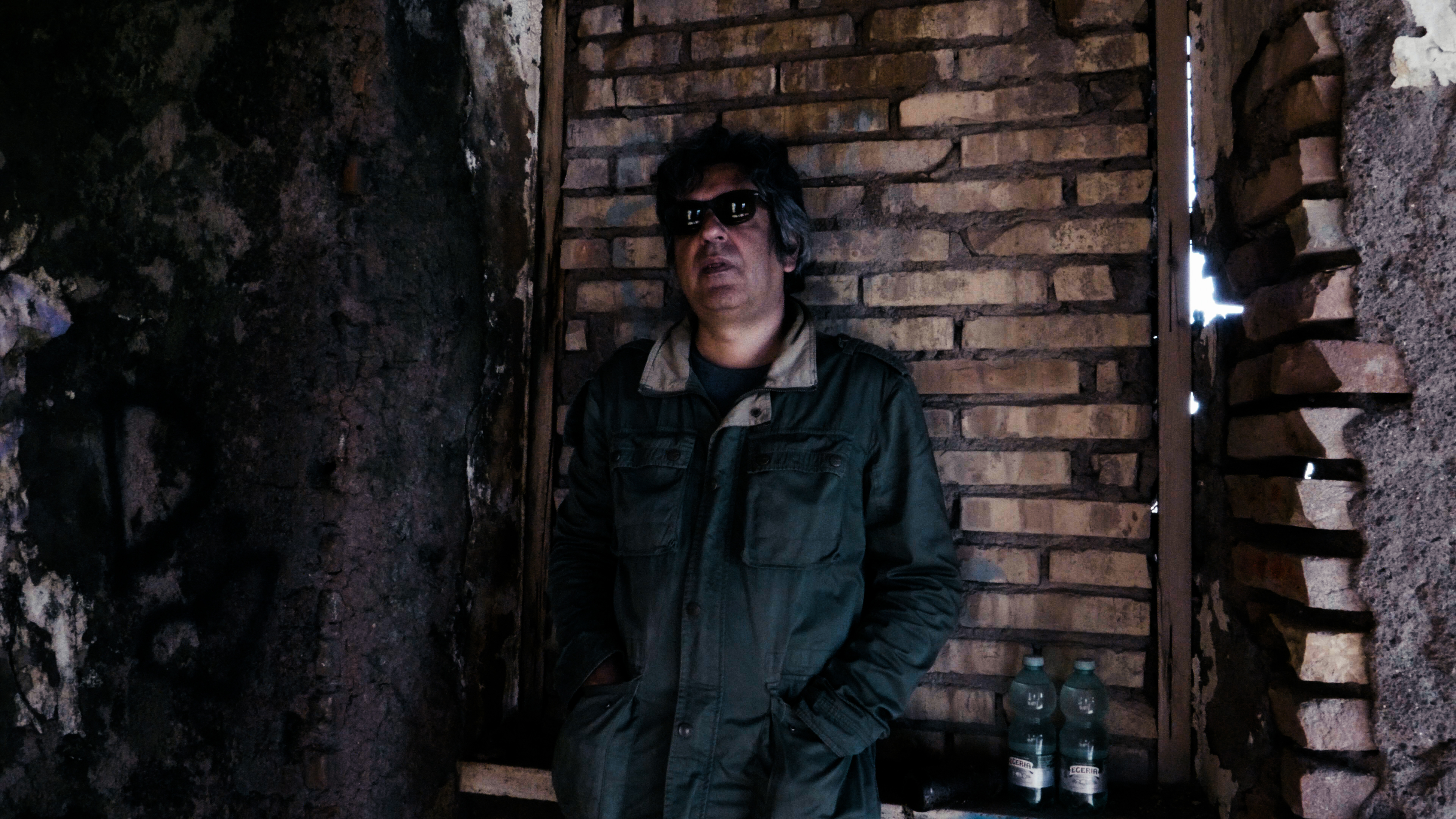
Drama, by Fabio Del Greco, Italy, 2024.
Dante Mezzadri wants to see an old friend, nicknamed the Iguana, whom he has lost sight of for many years, and who has managed to turn their shared youthful passion for poetry into a job, becoming a famous writer and poet. The man escapes from his bourgeois life and his wife to live homeless on the Roman coast, printing and trying to sell his poetry collections. At night he sleeps in a park of old carnival floats, inside a papier-mâché tank, and waits for the opportunity to meet his old friend, who however never shows up for appointments in the places they frequented when they were young, now in ruins. Dante's poetry books do not interest anyone and to support himself he is forced to "change product": he starts selling the infamous "cannibal pill" on behalf of young drug dealers, a new drug that sells like hot cakes and causes sensory and consumerist ecstasy. However, he realizes that this powerful drug is very dangerous for those who take it, he comes into conflict with his ethical conscience and throws all the pills into the sea. However, the dealers want to collect their money.
Shot over a period of 2 years, the film is a reflection on the cultural and artistic rubble of the society in which the protagonist lives, in an increasingly mechanized, consumerist and arid world. Dante Mezzadri is yet another human being who has renounced his inspiration and his creativity, but unlike many he is not willing to give his life to a system that distances him from his true identity. The physical world around him, however, seems constructed in such a way that it seems impossible to escape from this "invisible cage". The enthusiasm of the people he meets is ignited only by sensory gratification, by unreal visions of personal affirmation and success, by "metaverses" that offer an escape into an illusory and destructive reality. The poet's house on the coast, where he met with his friends as a young man, is just a pile of abandoned rubble. What happened to all those who wanted to become poets and ended up becoming something else? Are there internal forces with which that house can be "rebuilt"?
LANGUAGE: Italian
SUBTITLES: English, Spanish, French, German, Portuguese
What ‘Cursed’ Actually Means: A Word Stripped of Its Romanticism
You have probably used the word yourself, loosely, the way people do — to describe someone difficult, someone brilliant and self-destructive, someone whose suffering seemed almost too coherent to be accidental. The word arrives ready-made, pre-loaded with a certain glamour, and you deploy it without thinking much about where it came from or what it cost the people it was first applied to.
Paul Verlaine published his collection of critical portraits in 1884 under the title Les Poètes maudits. He was writing about Tristan Corbière, Arthur Rimbaud, Stéphane Mallarmé, and others — real men, most of them already broken by the time the ink dried. Corbière died of tuberculosis at twenty-nine. Rimbaud abandoned poetry entirely before he was twenty, spent his remaining years trading guns in Abyssinia, and died of bone cancer at thirty-seven. These were not metaphors. These were bodies. These were men who could not pay rent, who were refused by publishers, who drank because the alternative was a clarity too painful to sustain without anesthesia, who died in conditions that in any other profession would have triggered an institutional inquiry.
What Verlaine did — and this is the trap, the original sin of the whole mythology — was frame material devastation as spiritual election. The poverty was not poverty. It was proof. The exclusion was not institutional failure. It was the world’s inability to recognize genius. By the time this framing had circulated through literary salons, crossed the Channel and the Atlantic, and returned to us through a century of biographies, album liner notes, and undergraduate essays, the original brutality had been laundered into something almost enviable.
Pierre Bourdieu, in The Rules of Art published in 1992, gave us the clearest structural account of how this laundering works. The literary field, he argued, operates through a specific inversion of economic logic: those who succeed commercially are suspected of selling out, while those who fail materially are credited with artistic integrity. This means that poverty and rejection, rather than being understood as outcomes of an unjust distribution of resources, become symbolic capital — proof of authenticity, evidence of an uncompromising relationship with the work. The cursed poet is, in Bourdieu’s framework, not a victim of the field but its most useful product. His suffering legitimizes the entire system. It proves that art exists above commerce, that genius cannot be contained by institutions, that the market’s inability to recognize true value is the market’s failure, not the poet’s.
This is where the aestheticization becomes genuinely sinister. Because once suffering is symbolic capital, it can be accumulated, displayed, even performed. The curse stops being something that happens to you and becomes something you can inhabit, curate, reproduce. And when that happens, the actual material conditions — the hunger, the addiction, the social isolation, the early death — stop being problems to be addressed and become plot points in a story that the culture needs in order to feel good about itself. The suffering of the poet reassures everyone else that they made the right choice, that comfort and compromise were reasonable, that only the truly mad and truly great refuse the terms on which normal life is offered.
What gets lost in this transaction is any serious reckoning with what the curse actually was. It was not a mystical condition. It was the predictable outcome of a society that had no structural support for artists who did not produce what the market wanted, no safety net for the mentally ill, no treatment for addiction beyond incarceration or institutionalization, and a cultural ideology that turned all of this into evidence of romantic distinction rather than collective failure. The word maudit was a diagnosis dressed up as a crown. And the people who wore it — who were made to wear it — mostly did not survive long enough to take it off.

Rimbaud, Verlaine, and the Violence of Being Seen
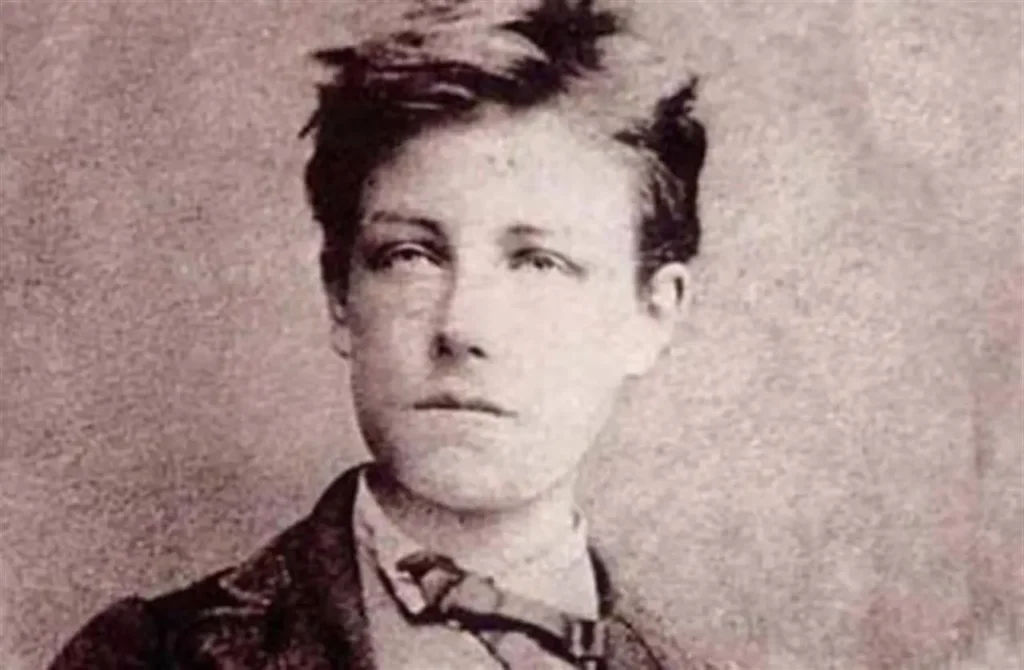
There is a moment, probably familiar to you even if you have never lived it exactly, when you realize that the person who sees you most clearly is also the one most likely to destroy you. Not out of malice. Out of the unbearable pressure of being witnessed.
Arthur Rimbaud was nineteen when he finished the Illuminations. He was twenty when the relationship with Paul Verlaine had already become a sustained catastrophe of need and alcohol and brilliance and mutual ruination. He was twenty-one when he stopped writing altogether, packed the manuscripts away, and eventually left for Africa to trade coffee and rifles and, according to some accounts, to smuggle arms into Abyssinia. He would spend the remaining decade of his short life doing this, dying of bone cancer at thirty-seven, reportedly asking in his final delirium to be carried to a ship. What is extraordinary is not the abandonment of poetry. What is extraordinary is how completely he meant it. He did not publish under a pseudonym. He did not write in secret. He simply stopped, as though he had calculated the exact temperature at which language becomes a trap and had decided, with the same ferocity he brought to everything, to walk away before it closed around him entirely.
Think of a man running through the streets of a foreign city at two in the morning, rain on the cobblestones, a bundle of papers tucked under his arm that he has already decided to burn. He reaches a rented room, a single lamp, a fireplace barely alive. He feeds the papers into it one by one, not in grief, not in rage, but with the methodical calm of someone completing an obligation. This is not self-destruction. This is a kind of ruthless self-preservation that the world will later call madness because it cannot afford to call it lucidity.
The Brussels hotel room in July of 1873 is one of those events that history has been content to frame as a love story gone wrong, a quarrel between two difficult men. Verlaine fired two shots. One passed through Rimbaud’s left wrist. The wound was not fatal. The relationship was. But what actually happened in that room was not a crime of passion in any ordinary sense. It was the collision of two incompatible relationships to visibility. Verlaine needed Rimbaud to remain the incandescent thing he had discovered, the boy-genius who made him feel close to something real. Rimbaud needed to become something else entirely, something Verlaine could not follow and could not release. The gun was the articulation of that impasse in the only vocabulary desperation makes available.
Michel Foucault, writing in the early 1960s in his history of madness, argued that Western modernity did not simply observe mental illness but actively produced it as a category precisely in order to manage those whose perceptions threatened the social order. The madman, in Foucault’s analysis, is not someone who has lost their grip on reality. The madman is someone who has maintained too firm a grip on a reality that the collective cannot tolerate. The designation functions as exclusion. You are not wrong, you are ill. You are not dangerous to our assumptions, you are dangerous to yourself. This is a far more efficient neutralization than argument or exile, because it makes the designated person responsible for their own confinement.
Rimbaud never accepted that designation. He refused it by refusing the entire apparatus, the literary world, the Parisian salons, the identity of the poet as social role. He understood, with what you might call precocious precision, that being seen as a genius was simply another form of being contained. The cage was gilded and the lock was made of admiration, but it was still a lock.
And the only way out was to become unrecognizable, even to yourself.
The Ones Who Did Not Survive Their Clarity
There is a particular quality of light at five in the morning that does not console. You have been awake since two, or perhaps you never slept, and the notebook open on the table in front of you holds sentences that frighten you slightly, not because they are bad but because they are too accurate. The window is ajar. The city outside is beginning its mechanical resurrection, indifferent to whatever you have just understood about yourself. You close the notebook. You do not know what to do with what you have written.
This is where several of them lived permanently. Not as a dramatic condition but as a structural one — a chronic exposure to a frequency the surrounding world did not broadcast and could not receive.
Gérard de Nerval walked Paris with a lobster on a leash, which everyone remembers as an eccentricity, a charming anecdote for literary biographies. What is less remembered is that he translated Goethe's Faust at seventeen with a precision that astonished Goethe himself, that he spent years constructing an elaborate personal mythology across his prose poems that was not madness but a rigorous alternative cosmology, and that he was found hanged in the rue de la Vieille-Lanterne in January 1855 wearing his customary coat, as if he had simply stepped out for a walk that did not return. The psychiatric institutions he cycled through, including the famous clinic of Dr. Esprit Blanche where he was treated with genuine care, could not resolve the fundamental problem, which was not clinical in origin. The problem was that Nerval required a world that could hold his vision, and no such world existed in the France of Louis-Napoleon.
Georg Trakl, writing in German during the years immediately before 1914, produced poems of such condensed anguish that they still feel radioactive — “Decay” written in 1912, “Grodek” written in 1914 after witnessing ninety wounded men for whom he, as the sole medical officer, could do almost nothing. He died of a cocaine overdose in a military hospital in Kraków at twenty-seven, likely deliberately, though the biographical record is uncertain enough that the uncertainty itself feels meaningful. What is certain is that he had been given a front-row position to humanity’s capacity for organized self-destruction, and he had the particular misfortune of possessing a nervous system calibrated to register every frequency of it.
Sylvia Plath published The Bell Jar in January 1963 under a pseudonym, partly out of fear of the repercussions. She died in February of the same year. The critical apparatus surrounding her death has spent decades arguing about her husband, her psychiatrist, her medication, the frozen pipes that sealed her children in their room while she sealed the kitchen — as if the cause were a matter of biographical forensics rather than structural logic. Adrienne Rich, writing in 1963, understood something that the biographical approach refuses: that the conditions Plath navigated, the demand that a woman be simultaneously exceptional and invisible, brilliant and domestic, ambitious and self-effacing, were not background context but the very substance of the pressure that accumulated.
Alejandra Pizarnik, who read Plath and Nerval and Trakl and Artaud with the attention of someone studying a map, died in Buenos Aires in 1972 at thirty-six. Her notebooks, published posthumously, reveal not a person destroyed by sensitivity but a person who had thought with extraordinary clarity about the position she occupied and found no exit that did not require her to become someone else entirely. “I don’t want to go into the words,” she wrote. But she had no other country.
The question that circles all of them is not whether they were fragile. It is whether the system that produced their clarity also guaranteed that clarity would have nowhere to go.
The Myth Industry: How Suffering Gets Sold
There is a particular kind of silence in a publishing office when someone reads a manuscript for the second time. Not the first time, when it was submitted by a living writer who needed money and was told, with varying degrees of politeness, that the market was difficult, the voice too singular, the commercial prospects uncertain. The second time. When the writer is dead and the manuscript sits on the desk with a different weight entirely, and the editor turns the pages with something that is not grief and is not joy but functions, economically, like both.
This is not metaphor. This is the machinery.
Walter Benjamin understood in 1935, writing “The Work of Art in the Age of Mechanical Reproduction,” that the moment a work is detached from its original context of creation, something he called its aura begins to transform. But Benjamin was thinking about reproduction. What the myth industry discovered was something crueler: that death is not just a form of reproduction but a form of authentication. The corpse guarantees the aura. The suffering, once it can no longer make demands, becomes a selling point. The biography becomes the blurb.
Sylvia Plath died in February 1963. “The Bell Jar” had been published one month earlier under a pseudonym, to modest notice, to the kind of reception that a living writer absorbs and moves past. After her death, the novel was reissued under her real name and has never gone out of print. It has sold millions of copies across decades, translated into dozens of languages, assigned in high school curricula, quoted in therapy waiting rooms. The woman who wrote it was refused a Fulbright extension, rejected from a writing program, and left with two small children in a cold London flat while her estranged husband was publicly celebrated. The market did not mourn her. It waited. And then it harvested.
This is the conversion Benjamin’s framework helps us see: biographical tragedy becomes commodity not despite its pain but because of it. The suffering is the product. What was unrepeatable and private and destructive in the living person becomes, in reproduction, an inexhaustible resource. Each reprint is clean. Each new edition has a new introduction by someone who was not there. The wound is kept open not to heal but to sell.
The editor reading the dead man’s manuscript turns a page. His expression does not change. He makes a small note in the margin, the kind of practical note a craftsman makes when a problem resolves itself. The problem, in this case, was the writer himself. The difficulty of his personality, the inconvenience of his demands, the embarrassment of his poverty. Death has solved the administrative problem. What remains is only the work, stripped of the person who bled into it, ready to be packaged with a tasteful cover photograph and a back-cover note that describes the tragedy in two sentences, clinically, as if it happened to someone else, as if it were simply part of the story rather than the story’s prerequisite.
The sociologist Pierre Bourdieu mapped this terrain in “The Rules of Art” in 1992, showing how the literary field operates through a systematic inversion of economic logic: the works that sell least during a lifetime accumulate what he called symbolic capital, which converts, posthumously, into the very commercial value it appeared to refuse. The cursed poet is not a failure of the system. He is the system working correctly. The refusal to reward living difficulty is not an oversight. It is structural. The market requires the myth, and the myth requires the death, and the death requires that someone, somewhere, first ensured the life was made impossible enough to end.
Which means the publisher’s cold satisfaction is not incidental to the story. It is the story’s engine.
A vision curated by a filmmaker, not an algorithm
In this video I explain our vision
Charles Baudelaire and the Crime of Lucidity

You walk through the city at dusk, that particular hour when the light turns the color of old brass and the working day releases its people onto the streets like a pressure valve slowly opened. You notice things. The woman outside the pharmacy counting coins with a precision that has nothing to do with forgetfulness and everything to do with arithmetic that does not add up. The man on the bench who is not resting but has simply stopped, in the way that objects stop when they are no longer carried. The smell of the metro exhaust mixing with a street vendor’s roasting chestnuts, and underneath both, something older and more insistent, the smell of the city’s true labor, which is the labor of containing its own contradictions. You notice all of this and then, because you have been taught that sensitivity is a private matter and the street is a shared one, you look away.
Baudelaire did not look away. This is not a romantic statement about artistic temperament. It is an accusation against everyone else.
When Les Fleurs du Mal was published in June 1857 and immediately prosecuted by the Imperial French government for offenses against public morality, the trial revealed something more interesting than censorship. It revealed that the bourgeois machinery of the Second Empire could tolerate poverty, disease, prostitution, and spiritual devastation as social conditions, but could not tolerate them as subjects of beauty. The crime was not the darkness. The darkness had always been there. The crime was the attention paid to it, the insistence that the broken and the corrupted and the sexually complex deserved the full force of aesthetic seriousness. Six poems were suppressed. The suppression lasted until 1949. Nearly a century of official silence over what a man had actually seen walking the streets of Paris.
Albert Camus, writing almost a hundred years later in The Rebel, defines revolt not as revolution but as a sustained refusal, the human gesture that says no to the conditions imposed upon consciousness while remaining inside those conditions, enduring them without surrendering to them. The rebel does not escape. The rebel insists, and the insistence costs everything. What Camus describes philosophically, Baudelaire had already performed biologically. The syphilis contracted in his early twenties, the laudanum, the hashish documented in Les Paradis Artificiels in 1860, the debts that made his entire adult life a negotiation with creditors and the editorial judgment of a mother who found him embarrassing — none of this was accidental weakness. It was the shape that revolt takes when it has nowhere external to go and turns inward, when the system is too total to be refused from the outside and so the refusal becomes self-consumption.
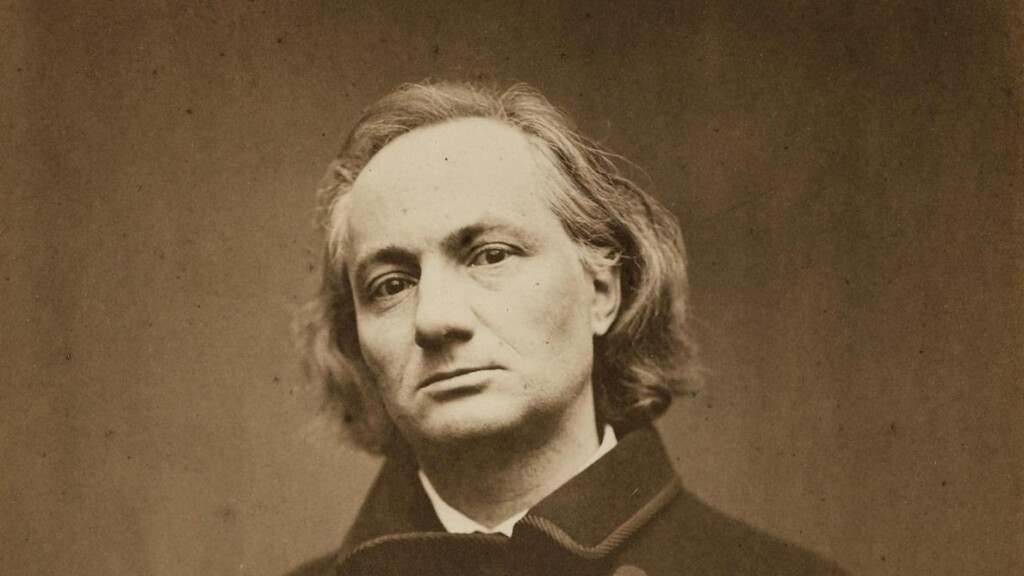
His mother, Caroline Aupick, remarried a general after his father’s death, and Baudelaire spent decades writing her letters of almost unbearable need, asking for money, for understanding, for the recognition that what he was doing mattered. She withheld it with the consistency of someone who had decided that respectability was a moral position. He died in 1867, partially paralyzed from a stroke, unable to speak, in a Catholic nursing home in Paris, at forty-six. The last photograph shows a face that has been used by thought the way weather uses a coastline.
What he had actually seen, beneath the Haussmann renovations that were physically demolishing the old Paris to build a city optimized for commerce and military suppression of future uprisings, was that modernity’s transaction was this: beauty in exchange for honesty, comfort in exchange for sight. The flâneur he invented as a literary posture was not a dandy’s affectation. It was a methodology of refusal. To walk slowly through a city designed for speed and production, to stop where stopping is not profitable, to look at what the city displays only accidentally —
The Living Cursed: Those Who Survived and Were Punished Differently
There is a man in a small room in Lisbon. He is not famous. He has no audience. He works by day as a commercial translator and by night he writes, and writes, and writes — filling pages that stack into boxes, that fill a trunk that sits in a corner of a rented room and that no one will open for decades. He dies in 1935 of cirrhosis, aged forty-seven, and the trunk goes with him into obscurity before it goes into history. Inside it: 27,543 manuscript pages, fragments of heteronyms, letters never sent, poems in three languages, an entire civilization of interior lives that the world had not asked for and would not receive until long after the body was gone. This is not tragedy in the theatrical sense. It is something quieter and more damning: a life lived in absolute creative surplus within a social structure that had no category for what he was doing.
Erving Goffman, writing in Stigma: Notes on the Management of Spoiled Identity in 1963, described how societies construct normative frameworks so rigid that any deviation from them — any divergence in behavior, vocation, or visibility — produces not neutral difference but active spoilage. The stigmatized person is not simply different. They are rendered less than. And what Goffman understood, with a sociologist’s precision that reads almost like cruelty, is that the stigma does not require hostility to function. Indifference works just as well. The trunk in the corner does not need to be burned. It only needs to remain unopened.
Survival, for the cursed poet, was never the reprieve it appeared to be. It was the punishment administered more slowly, with greater bureaucratic patience. Anne Sexton was hospitalized repeatedly across the late 1950s and into the 1960s, her breakdowns catalogued, her inner life translated into clinical language by institutions that were professionally committed to not reading her as a poet but as a case. She won the Pulitzer Prize in 1967 for Live or Die. The prize did not stop the pathologization. The two systems — literary recognition and psychiatric management — ran in parallel, indifferent to each other, each processing the same woman according to its own logic. Goffman would have recognized this immediately: the stigmatized identity adheres even when the surface evidence contradicts it. The prize does not lift the diagnosis. The diagnosis persists, reshaping how every subsequent act is read.
Allen Ginsberg‘s FBI file ran to hundreds of pages. The Bureau opened its investigation in the 1950s and maintained it for decades, cataloguing his associations, his politics, his sexuality, the people he knew and the poems he read aloud at readings the agents attended, notepad in hand. There is something almost perfectly Kafkaesque in the image: a man standing at a microphone howling, and in the audience, someone writing it down for a government archive. The surveillance was its own form of stigma management — a social institution asserting its right to define what kind of person this was, regardless of what the poems said.
What connects these three figures is not their suffering, which was real but hardly identical, and not their talent, which was extraordinary but not the point. What connects them is the particular mechanism by which their survival was converted into continued punishment. Pessoa’s punishment was invisibility so complete it outlasted him by decades. Sexton’s was the institutional refusal to allow her pathology and her poetry to occupy the same category of serious human production. Ginsberg’s was surveillance, the state’s insistence on reading his work not as literature but as evidence.
Goffman’s insight was that stigma is not a property of the person but of a relationship between an attribute and a social stereotype. The cursed poet did not bring the curse. The curse was the social structure pressing back against a life that refused to fit cleanly into its available spaces.
You Already Know This Figure: You Have Tried to Make Him Smaller
You already know this figure. Not from books, not from the biography section of a library where the dead are safely framed behind glass. You know him from the office, from the dinner table, from the group chat you quietly left because one person kept saying things that made the comfortable silences impossible. He was the one who named the dynamic everyone else had agreed, without speaking, never to name. He said it clearly, maybe even gently, and the room shifted the way rooms do when someone has broken an unspoken contract. You did not argue with him. You changed the subject, or laughed in a way that suggested he was being dramatic, or you diagnosed him privately as someone who simply could not let things go.
This is the contemporary mechanism, and it is more efficient than exile or poverty or the bottle, though it often ends there too. The first instrument is diagnosis. When a person’s perception becomes socially inconvenient, the culture has learned to relocate the problem from the world to the nervous system. What was once called prophetic is now called anxious. What was once called visionary is now called dysregulated. Michel Foucault traced this displacement across centuries in his 1961 work on madness, showing how reason has historically used the category of unreason not to understand it but to contain it, to draw a border around the voice that sees too clearly and label the territory beyond that border as illness. The label is not always wrong. But it is applied with suspicious consistency to those whose clarity is most threatening, and almost never to those whose blindness is most convenient.
The second instrument is irony. A society that has learned to treat everything as potentially ridiculous has found in irony the perfect tool for neutralizing seriousness without engaging it. You have watched this happen in real time: someone makes an observation that lands with weight, and someone else responds with a joke, and everyone laughs, and the moment dissolves, and the observation is never returned to. The joke is not cruelty. It is something worse. It is a social solvent applied precisely where attention was about to crystallize into recognition. David Foster Wallace saw this clearly, writing in the mid-nineties about irony as a defensive posture that had become so total it left no ground from which to speak sincerely without appearing naive. The cursed poet was always the one who kept speaking sincerely anyway, and paid the price of appearing naive, excessive, unhinged.
The third instrument is algorithmic invisibility, which is the newest and perhaps the most elegant of the three because it requires no active suppression. The voice simply does not travel. It speaks into a system engineered to amplify what confirms and to attenuate what disturbs. The reach of a thought is now partly a function of how comfortable it makes the people who first encounter it, and comfort is not the natural habitat of truth that costs something to hear. The cursed poet does not need to be burned or institutionalized when he can simply be rendered statistically irrelevant, his signal lost in the noise not by censorship but by the architecture of attention itself.
And so the question that does not close easily, the one that sits at the center of all this history from Villon to Rimbaud to every voice you have personally muted, is not really about the poets. It is about the cost borne by a society that generates, with remarkable regularity, people capable of seeing what it cannot afford to see, and then spends its considerable energy ensuring that seeing them does not become contagious, because somewhere beneath the diagnosis and the irony and the algorithmic silence, it already knows they are right.
🖋️ Voices from the Margins: Poets, Rebels, and Cursed Souls
The figure of the cursed poet has haunted Western culture for centuries, emerging wherever genius collides with alienation, excess, and the refusal to conform. These articles trace the intellectual and artistic currents that shaped the poets, thinkers, and outlaws who paid the highest price for their vision. Explore the lives and ideas that illuminate the dark corridors of literary and philosophical history.
The Spanish Golden Age: Literature and Culture
The Spanish Golden Age produced some of the most tormented and brilliant literary voices in European history, from mystical poets to sharp satirists who dared mock the powerful. This era’s culture was a fertile ground for figures who lived between divine inspiration and social condemnation. Understanding its tensions helps illuminate why so many of its writers walked the razor’s edge of censorship and ruin.
GO TO THE SELECTION: The Spanish Golden Age: Literature and Culture
Francisco de Quevedo: Life and Works
Francisco de Quevedo stands as one of the most emblematic cursed figures of Spanish literature, a poet of savage wit and profound melancholy who was imprisoned by the very court he satirized. His verse oscillates between baroque virtuosity and existential despair, making him a canonical ancestor of the poète maudit tradition. His life and work reveal how literary genius and political danger were often inseparable destinies.
GO TO THE SELECTION: Francisco de Quevedo: Life and Works
Montaigne: Life and Essays
Montaigne invented the essay as an act of radical self-examination, turning his own life, doubts, and contradictions into a literary form that defied the certainties of his age. Like many cursed poets, he lived at the border between privilege and vulnerability, navigating religious wars and personal loss with extraordinary intellectual honesty. His Essays remain a monument to the writer who refuses easy answers and embraces the full complexity of human experience.
GO TO THE SELECTION: Montaigne: Life and Essays
Albert Camus: Life and Philosophical Thought
Albert Camus built his entire philosophical project around the absurdity of a world that offers no transcendent meaning to human suffering, a vision deeply resonant with the cursed poet’s condition. His life—from poverty in colonial Algeria to the heights of European literary fame—was itself a drama of displacement and moral urgency. Camus gives us perhaps the most lucid modern framework for understanding why certain artists are doomed to burn against the indifference of the universe.
GO TO THE SELECTION: Albert Camus: Life and Philosophical Thought
Discover the Cinema of the Poètes Maudits on Indiecinema
If these stories of cursed voices and visionary rebels speak to you, Indiecinema’s streaming platform is your next destination. Explore our curated selection of independent and avant-garde films that bring to life the raw, uncompromising spirit of artists who refused to be silenced. Join us and let the cinema of the margins transform the way you see the world.
👉 EXPLORE THE CATALOG: Watch Indie Films in Streaming
A vision curated by a filmmaker, not an algorithm
In this video I explain our vision

