
The Ordinary as Wound
You are standing in a kitchen that smells of yesterday’s soup, and the person across from you is saying something that does not matter, and yet it matters completely. Not because of the words — the words are nothing, a request to pass the salt, a comment about the weather turning — but because of the silence underneath them, the specific weight of a silence that has been accumulating for years between two people who once touched each other’s faces in the dark. You know this kitchen. You have lived in this kitchen. The table is slightly too small, the light is slightly too harsh, and the ordinary objects sitting on the shelves — the ceramic pot, the mismatched cups, the dish towel hanging crooked on its hook — have the unsettling quality of witnesses. They have seen everything. They will outlast everyone.

This is where certain writers begin, and it is where Natalia Ginzburg never stops. Not in the dramatic corridors of history, not in the grand architecture of ideology or aesthetics, but precisely here, in the room where nothing is happening and everything has already happened. Her genius — and it is a genuine, structural genius — is her refusal to look away from the smallness of life, not because she finds comfort in smallness, but because she understands, with a precision that is almost surgical, that smallness is where the real violence occurs. The violence of habit. The violence of familiarity turned indifferent. The violence of two people sitting down to eat who no longer see each other.
What Ginzburg understood, and what makes her prose so unnerving to read even today, is something that the sociologist Erving Goffman spent his career trying to name in academic language: that the performance of ordinary life is not a relief from meaning but its densest concentration. Goffman’s work throughout the 1950s and 1960s — The Presentation of Self in Everyday Life, published in 1959, being the most systematic account — argued that the rituals of the mundane are not trivial but are, in fact, the primary theater in which identity, power, and damage are enacted. Ginzburg did not need that argument made academically. She had already written it into the bones of her sentences.
There is a moment, familiar to anyone who has lived inside a long relationship, when you realize that the person sitting across from you has become a piece of furniture in your perception — not unloved, necessarily, but no longer seen. You have stopped looking. The philosopher Simone Weil, writing in the early 1940s, called attention in the most radical sense possible — the willingness to truly look at another person without immediately folding them into your own needs and projections — one of the rarest and most demanding acts a human being can perform. Weil understood that most of what we call love is actually a form of organized inattention. Ginzburg understood the same thing, and she wrote about it without sentimentality and without consolation, which is precisely why reading her feels less like reading and more like being caught.
The ordinary, in her world, is not a backdrop. It is the wound itself. The argument that burns nothing down but leaves a fine layer of ash over everything. The letter that was never written. The meal prepared in silence and eaten in silence and cleared away in silence while outside the window the city continues its indifferent motion. Her prose does not raise its voice. It does not need to. It operates by accumulation, by the patient, almost unbearable stacking of small true details until the weight becomes something the reader carries in their chest without knowing exactly when they picked it up. And by the time you feel it, you realize you have been carrying it your whole life, in every kitchen, at every table, in every silence that once was something else.
The Smartphone Woman
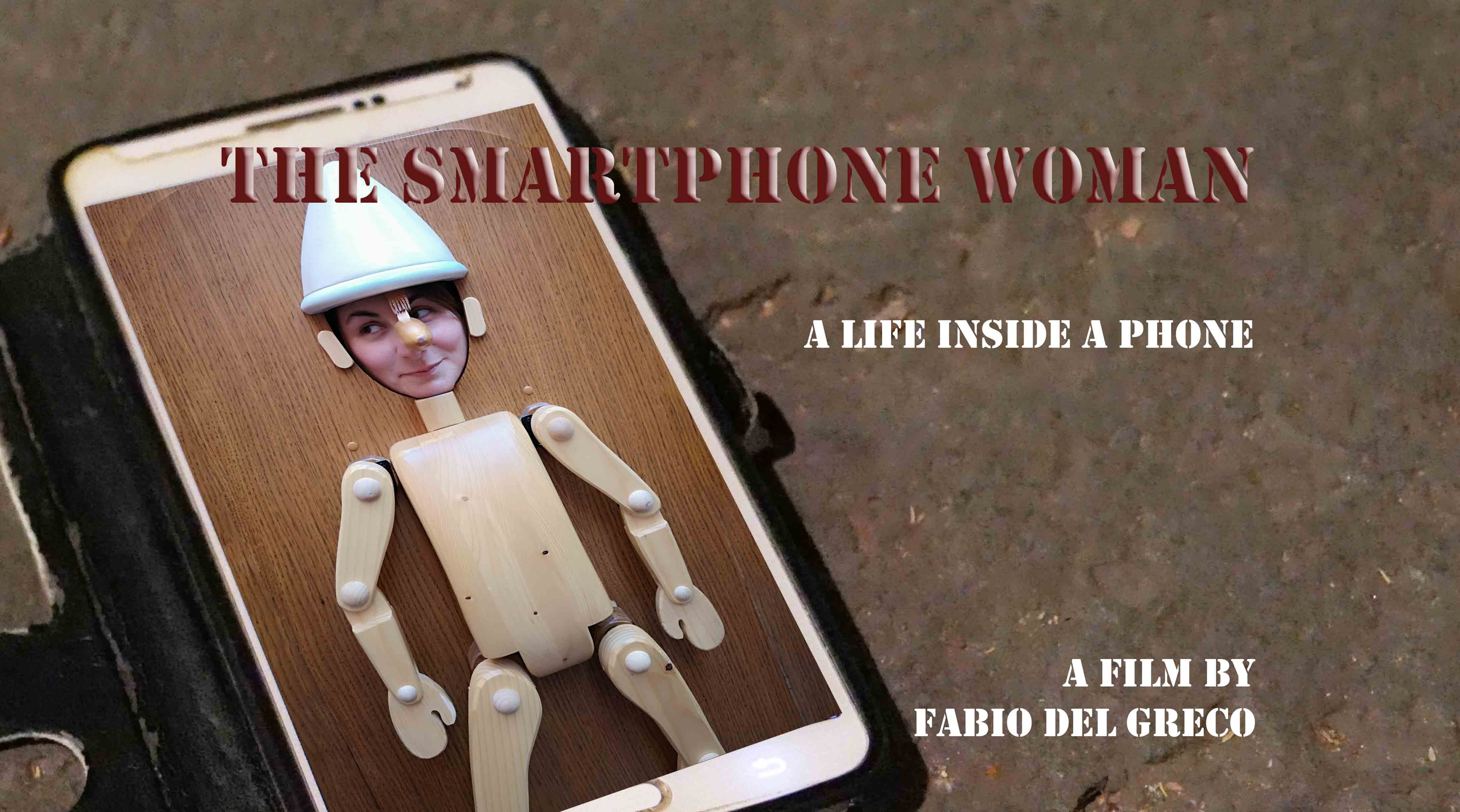
Drama, thriller, dark comedy, by Fabio Del Greco, Italy 2020.
On a bridge over the Tiber River, an elderly and severely ill man has decided to end his life, but an unusual discovery changes his mind: he comes across a lost smartphone. Intrigued, he decides to return home and watch the videos contained within it. On the screen, a series of videos unfold, telling the story of a woman who has emigrated from southern Italy to Rome to work as a teacher in schools and her struggles with integration in a social reality she cannot fully grasp.
"The Smartphone Woman" is a realistic tale of a woman's life and her complex relationship with an "infernal" city. It portrays the challenges she faces, her connection to her origins, the social discomfort she discovers in the outskirts, and the eerie presence of the ghosts of ancient Roman empire. Fabio Del Greco employs a fragmented style, using pieces of "real life" shot with the smartphone, to construct a narrative that ambiguously oscillates between fiction and truth. This creates a captivating exploration of the discomfort and alienation within the bustling city, contrasting with the peaceful village life from which the protagonist hails. The film is constructed with a variety of heterogeneous characters and situations, an emotional kaleidoscope, weaving between evenings of exploration in the Eternal City and daily struggles. Realistic smartphone-shot videos are alternated with a narrative thread reminiscent of film noir and, ultimately, surrealism in the finale. On screen, a succession of grotesque characters unfolds, representing the director's vision of a tumultuous humanity. The film's potency lies in the emotion it manages to convey and in the protagonist's naive perspective. "The Smartphone Woman" is a must-see for enthusiasts of independent and experimental cinema.
LANGUAGE: italian
SUBTITLES: English, French, German, Portuguese, Spanish
A Life Assembled from Fracture
You already know what it feels like to carry something that has no name yet. You walk through a room, you set a cup down, you answer someone’s question, and underneath all of it there is a weight you cannot locate precisely, only sense — the way you sense the presence of a wall in the dark before your hand touches it. Natalia Ginzburg spent her entire literary life writing from inside that sensation, and the reason she could do it with such unsettling accuracy was not talent alone. It was that her life had been built, or rather demolished and rebuilt, in ways that made evasion structurally impossible.
She was born in Palermo in 1916 into a family of extraordinary intellectual density. Her father, Giuseppe Levi, was a prominent biologist whose laboratory would eventually produce three Nobel Prize winners among his students, including Salvador Luria and Rita Levi-Montalcini. Her mother, Lidia Tanzi, came from a Milanese socialist background. The household was loud, argumentative, exacting, and deeply Jewish on her father’s side, though the family’s relationship to Judaism was more cultural than observant — which meant that when the Fascist racial laws arrived in 1938, they did not strike a practiced religious identity so much as a human one. The laws did not ask what you believed. They asked what you were. And what the Ginzburg family was, under that cold bureaucratic gaze, was suddenly inadmissible.
By 1938 Natalia had already married Leone Ginzburg, a man of Russian-Jewish origin who had been one of the founding figures of the Einaudi publishing house in Turin and a committed anti-Fascist whose opposition to Mussolini was not a position but a vocation. He had already been imprisoned once before their marriage. The racial laws made the life they were building together a kind of permanent improvisation against erasure — they moved, they hid the shape of their activities, they wrote and edited and organized under conditions of mounting danger. In 1940 Leone was sent into internal exile in a small village in the Abruzzo, and Natalia followed him with their children. It was there, in that involuntary stillness, that she wrote her first novel, published under a pseudonym because her real name was legally prohibited.
Then, in February 1944, Leone Ginzburg was tortured and killed by the Nazis in the Regina Coeli prison in Rome. He was thirty-five years old. Natalia was twenty-seven, a widow with three children, living under occupation in a country that had officially declared her kind unworthy of citizenship. She did not write about this immediately. She could not. But the event entered her language the way a fracture enters bone — invisibly at first, then permanently. Every sentence she wrote afterward bore the weight of that absence without announcing it. This is perhaps the most precise thing one can say about her literary voice: it is the voice of someone who has learned that loss does not arrive as drama but as a permanent rearrangement of the ordinary.
What is remarkable — and genuinely uncomfortable to sit with — is that she did not transform her biography into monument. She did not build a cathedral of grief. The critic and essayist Cesare Garboli, who knew her work better than almost anyone, observed that her writing operates through a studied refusal of emphasis, a deliberate flattening of register that makes the unbearable quietly visible. This is not stoicism. Stoicism is a performance of control. What Ginzburg practiced was something closer to what the psychoanalyst Wilfred Bion called the capacity for negative capability — the ability to remain in uncertainty and loss without reaching for resolution. She had not chosen that capacity. It had been installed in her by history, by 1938, by 1944, by the specific texture of a life in which the ground had been removed more than once and she had learned, not to float above it, but to live without expecting it to return.

The Grammar of Smallness
You are reading a sentence for the second time and you already know exactly how it will end. It is a short sentence. It tells you that someone made coffee, or that the rain started, or that a woman sat down at a table and did not speak. And yet something in you slows. Something in you pays attention in a way you do not quite understand, because nothing is happening, and the sentence is flat, and the word used to describe the rain is the same word that was used three pages ago. This is not accident. This is not poverty of craft. This is Natalia Ginzburg doing the most demanding thing a writer can do: refusing you the comfort of beautiful language at the precise moment you most want it.
Ginzburg built her prose out of repetition, brevity, and the deliberate refusal of elevation. Her sentences return to the same words the way a person returns to the same anxiety — not because imagination has failed, but because reality itself does not offer synonyms. In her essays and her novels alike, the furniture appears again and again: the table, the window, the coat, the hands. She does not ornament them. She does not reach for the striking metaphor that would signal to you that a serious writer is present. She lets the coat be a coat. And in doing so, she places an enormous demand on the reader, who has been trained by literary culture to read meaning only when it arrives dressed for the occasion.
Roland Barthes, writing in 1953 in his first major work, identified what he called the degree zero of writing — a neutral, colorless style that strips language of both bourgeois flourish and political posturing, a writing that refuses to perform its own authority. He saw it as an ethical position, not merely an aesthetic one. The choice to write without ornamentation is, for Barthes, a choice to acknowledge that language has been used as a weapon of power, that style has historically served as a class marker, a signal of belonging, a way of excluding those who do not know the code. To write simply is to refuse that complicity. Ginzburg never used Barthes’s vocabulary to describe what she was doing — she was suspicious of theory in the way that people who have lived through catastrophe often are — but her practice enacts his argument with a precision that no manifesto could achieve.
Her 1963 collection of essays, Le piccole virtù, is perhaps the clearest demonstration of this. The title itself announces the scale she has chosen to work in: the small virtues, not the grand ones. She is not interested in heroism, in sacrifice rendered as spectacle, in grief that has been sculpted into monument. She is interested in the particular texture of a life as it is actually lived — in boredom, in the specific weight of certain afternoons, in the way love reveals itself not through declaration but through the accumulation of small, almost invisible acts. Her sentences perform this argument structurally. They are short because the moments she is describing are short. They repeat because life repeats. They resist climax because the truth she is reaching for does not arrive in climaxes.
This is where her style becomes genuinely destabilizing, because it forces you to recognize that everything you have learned to call literary excellence — the rich image, the complex syntax, the earned epiphany — is also a set of conventions with a history, and that history is not neutral. Grandeur in writing has almost always served those who already had grandeur in life. The ornate sentence belongs to the world of those with time to construct it, with education to justify it, with power to demand that others slow down and admire it. Ginzburg’s flatness is not modesty. It is a refusal. And refusals, when they are sustained across an entire body of work, begin to look less like style and more like
Family as the Site of Everything
You already know the feeling. Someone at a dinner table says a word — a nickname, a phrase worn smooth by repetition — and the room shifts almost imperceptibly, as if a current passed through the floorboards. Nothing dramatic happens. No one cries. But something has been transmitted, something that arrived long before anyone at that table was born, and it will leave with everyone when they go home. Natalia Ginzburg understood this transmission as the central fact of human life, and she spent her entire literary career mapping its exact mechanism.
In Tutti i nostri ieri, published in 1952, she does something that most war novelists refuse to do: she refuses to let history exist anywhere except inside the household. The Second World War does not arrive in that novel as ideology or military strategy. It arrives as an atmosphere that settles over a provincial family like weather, warping the small decisions, the courtships, the petty rivalries between siblings, until the private and the political become indistinguishable. The violence is not only outside in the streets. It is in the logic of how people love each other, how they fail each other, how they inherit from their parents the precise shape of their inability to speak. History in Ginzburg is never a backdrop. It is what a family is made of.
Le voci della sera, which appeared in 1961, strips this even further down. The novel watches two provincial families across decades, and what it observes is not tragedy in any recognizable form but something quieter and therefore more devastating: the way a generation transmits its defeats to the next without ever naming them as such. The young people in that book carry the weight of their parents’ compromises the way they carry a surname — automatically, without having chosen it, without fully understanding what they are carrying. Elsa’s love story dissolves not because of any single catastrophic event but because both she and Tommasino are already shaped by inheritances they cannot see clearly enough to refuse. The devastation Ginzburg captures here is the kind that produces no visible wound.
Then there is Lessico famigliare, published in 1963 and awarded the Premio Strega that same year, which is where her method becomes fully transparent. The book reconstructs her own family’s private language — the recurring phrases, the jokes, the references that functioned as a kind of tribal code among the Levis in Turin. On the surface this looks like nostalgia, like a loving inventory of a lost world. But Ginzburg is doing something far more unsettling. She is demonstrating that the family’s private lexicon was the medium through which an entire political reality — antifascism, exile, arrest, the murder of Leone Ginzburg in Regina Coeli prison in 1944 — was processed, survived, and inevitably distorted. The family’s language did not protect them from history. It was the vessel in which history was stored, and stored imperfectly, and passed on. What sounds like a phrase from childhood is also a scar. What sounds like warmth is also a form of forgetting.
This is where Ginzburg diverges sharply from the dominant literary uses of family memory. Maurice Halbwachs, writing on collective memory in the 1920s, argued that individual memory is always socially framed — that we remember what our group allows us to remember, in the forms our group has prepared for us. Ginzburg enacts this thesis without ever citing it, and she adds something Halbwachs did not fully reckon with: the family is not just a frame for memory but an active site of ideological production. The phrases a father repeats, the stories a mother edits, the silences that become structural — these are not innocent. They teach children what reality looks like, which means they also teach them what to overlook. In Ginzburg’s world, the most consequential political education a person receives happens not in school or in the street but at the table, in a language so intimate it feels like the shape of one’s own thinking rather than something that was ever imposed from outside.
The Tyranny of Roles We Never Chose
There is a particular kind of exhaustion that has no name in most languages — the tiredness of being, for decades, exactly the person everyone decided you were before you had any say in the matter. Ginzburg’s women know this exhaustion from the inside, and when you read them, you recognize it not as a literary device but as the precise texture of a Tuesday morning, the particular weight of a kitchen that was never chosen, a name taken at marriage that slowly replaced the one you were born with until even you forgot which one was yours.
Her characters are not oppressed in the dramatic, visible sense that makes oppression easier to argue against. They are something more insidious: they are contained. Celia, Valentina, the nameless wives and daughters who populate her fiction and her family chronicle, move through lives that were already furnished when they arrived. The furniture of gender, of class, of provincial respectability — it was all in place. Simone de Beauvoir, writing The Second Sex in 1949, gave this condition its philosophical grammar: immanence, the state of being confined to repetition and maintenance rather than transcendence and self-creation, the fate assigned to women not by nature but by a civilization that mistook its own arrangements for biology. Ginzburg does not argue this. She renders it. The difference matters enormously, because argument can be refuted and rendering cannot.
What Ginzburg shows, page after page, is that the trap does not require a jailer who knows he is cruel. The father who loves his daughter genuinely and still cannot see her as a subject with a trajectory of her own — he is not a villain. He is a product. Pierre Bourdieu spent much of his career trying to account for exactly this: how domination perpetuates itself without conscious malice, how the structures that limit human possibility are internalized so completely that they feel like preference, like temperament, like simply who you are. He called it symbolic violence, and the term is precise because the word violence is precise. Something is being done to the body and to the self, even in the absence of any raised hand. The woman who apologizes for existing too loudly in a room does not know she has been taught to apologize. She experiences it as modesty, as consideration for others, as a kind of natural grace.
Ginzburg herself moved between these two positions — the one who is contained and the one who escaped containment just enough to write about it — and the tension never fully resolved. She married Leone Ginzburg in 1938, took his name, bore his children, followed him into internal exile in the Abruzzo mountains during the Fascist years, and then, in 1944, watched the Nazis murder him in a Roman prison. She was thirty years old. The grief she carried after that did not make her a tragic figure in the sentimental sense; it made her a writer who knew that identity is not a possession but a negotiation conducted under duress, and that the duress is often so ambient it registers as atmosphere rather than force. When she returned to writing, she wrote about families not as havens but as the primary site where symbolic violence is rehearsed and perfected, where each generation teaches the next how to diminish itself appropriately.
The daughters in her world do not rebel in the way that would make the story satisfying. They absorb. They adjust. They become, slowly and without noticing, the shape of the container they were placed in. And what is almost unbearable about reading this is not the injustice of it — injustice can be metabolized — but the recognition that the container was built with love, sometimes, and that the love does not cancel the compression. Bourdieu argued that symbolic violence is most effective precisely when it is exercised through the forms of care, and Ginzburg spent four decades writing the proof of that without ever once citing the theorem.
A vision curated by a filmmaker, not an algorithm
In this video I explain our vision
Writing Against Consolation

There is a moment most people recognize without wanting to admit it: you are explaining something to a child, something difficult — loss, failure, the indifference of the world — and you hear yourself softening it, rounding the edges, inserting a small promise at the end that things will make sense eventually. You do this, you tell yourself, out of love. Ginzburg looked at that gesture and named it for what it also was: a form of cowardice dressed as tenderness, a way of protecting yourself from the child’s unmediated terror of the truth.
Le piccole virtù, published in 1962 and gathering essays written across the previous decade, is precisely this act of naming. The title itself is a provocation. The small virtues — thrift, caution, prudence, the careful management of one’s life — are what most parents spend their years transmitting to their children, and Ginzburg opens by arguing, with the calm of someone who has already thought this through completely, that they are the wrong gift. What children need, she writes, is exposure to the great virtues: generosity, indifference to money, a willingness to inhabit uncertainty without flinching. The small virtues, she insists, are instruments of survival in a world that has already defeated you. To hand them to a child is to pre-install the defeat.
This is not a sentimental argument about raising free spirits. It is something more structurally corrosive. What Ginzburg is dismantling is the entire architecture of consolation that adults build around children — and then, quietly, around themselves. The essays in the collection move from childhood to marriage to grief to work, and in each domain the same mechanism is exposed: the story we tell to make the unbearable feel purposeful, the narrative frame that converts loss into lesson, suffering into character. She refuses every single one. Her prose does not reach for the redemptive turn because she understood that the redemptive turn is itself a lie — not always malicious, but structurally dishonest, because it implies that pain has a yield, that endurance is justified by what it produces. Her own life had given her sufficient evidence to doubt this. Leone Ginzburg, her first husband, died under torture in a Roman prison in 1944, having been arrested by the Nazi-Fascist occupation. He was thirty-five. There was no yield from that. There was no lesson that made it bearable except the lesson that some things are simply not bearable, and you continue anyway, not because you have found meaning but because continuing is what happens to people who survive.
This is the emotional logic underlying the essays, and it is also why the collection remains so disorienting to read even now. Most essay writing, even when it deals in difficulty, offers the reader a resting place — an insight at the end of the paragraph, a resolution at the end of the piece. Ginzburg systematically denies this. The essays in Le piccole virtù conclude not with answers but with open weight. She describes her life, her children, her grief, her work, with a specificity that feels almost brutal in its refusal to generalize. She will not let the particular dissolve into the universal because that dissolution is exactly the consolation she is refusing. The moment experience becomes wisdom, it stops being experience.
Roland Barthes, writing in Mythologies in 1957, identified the ideological function of what he called naturalization — the process by which cultural constructs are made to feel inevitable, biological, given. The small virtues are precisely this kind of myth: they have been naturalized into the definition of good parenting, responsible adulthood, civic decency. Ginzburg’s essays perform a slow denaturalization of that entire category, not through argument but through the weight of her own specificity. She shows you what those virtues look like from inside a life where they were not enough, where nothing was enough, and where the pretense that something might be enough is itself the most dangerous story of all. The reader finishes the book unsettled in a way that is difficult to locate precisely, because what has been taken away is not a belief but a habit of comfort so old it felt like skin.
History Wearing a Housedress
You have read the letter three times and still cannot say whether it contains bad news. The sentences are ordinary. Someone is coming to visit. Someone else has found work. The weather has been strange. And yet something in the way it was written — the particular flatness of it, the absence of certain names — tells you that something has been swallowed, that the real information is living in the white space between the lines. Natalia Ginzburg understood this as a structural principle, not merely a stylistic preference. She understood that catastrophe rarely announces itself in the language of catastrophe. It arrives wearing the clothes of the quotidian, and if you are not paying attention to the quality of silence in a room, you will miss it entirely.
Her novel published in 1963, Lessico famigliare, is built from the dialect of a single family — the private phrases, repeated jokes, verbal tics, and inherited insults that constitute a household’s interior grammar. It reads, on its surface, like memoir rendered as comedy. The father bellows. The mother frets. The children scatter and return. But embedded in those family catchphrases, calibrated against the rhythm of the dinner table and the morning argument, is the entire arc of Italian Fascism, the anti-Jewish laws of 1938, the arrests, the executions, the years when certain names could not be spoken aloud in certain rooms. Ginzburg does not explain any of this. She does not pause to annotate. Leone Ginzburg, her first husband, died under torture in the Regina Coeli prison in Rome in 1944, and the book does not dwell on this. It registers it the way a body registers a fracture — in the changed angle of how weight is carried afterward.
This is the political method she developed across a career that spans from the 1940s through the 1990s, and it is a method that has no real precedent in Italian letters. Hannah Arendt argued in The Origins of Totalitarianism that the great danger of authoritarian systems is precisely their capacity to colonize the ordinary — to make the bureaucratic management of atrocity feel like administration, like paperwork, like a Tuesday. Ginzburg arrived at something adjacent from the other direction: she showed how resistance to that colonization, and the grief that follows its partial failure, also lives in the ordinary. Not in speeches. In the way a woman waits for a telephone call that does not come. In the way someone refers to a dead man in the present tense because the past tense is still too large to inhabit.
After the Liberation, the Italian left fractured under pressures both internal and external — the Cold War alignment, the debates within the Communist Party, the postwar disillusionment that Pavese, Calvino, and others navigated in their various ways. Ginzburg participated in this moment as an editor at Einaudi in Turin, one of the most politically and intellectually serious publishing houses in postwar Europe, but she processed the fracture not through political essays or public declarations. She processed it through characters who no longer know how to talk to each other, who have been through something they cannot name, who set the table for dinner and feel, without being able to say why, that the person sitting across from them is already absent. This is what postwar disillusionment actually feels like from the inside — not ideological crisis but a peculiar blankness, a sense that the words one used before no longer correspond to anything solid.
What Ginzburg grasped, with an almost unnerving precision, is that history does not happen to public figures in public squares. It happens to people who are trying to sleep, who are trying to finish a meal, who are writing letters they will reread three times without being able to say whether the news is good or bad. The political and the personal are not metaphors for each other in her work. They are the same tissue, and she never once let you forget which one actually bleeds.
The Question That Stays Open
You pick up a book written in 1963 and somewhere around the third page you stop, not because the prose is difficult but because it is not difficult at all — because a woman is describing the particular exhaustion of a Tuesday afternoon in a house where everyone is present and no one is really there, and you recognize it so completely that the recognition feels less like reading and more like being caught.
This is the specific discomfort that Natalia Ginzburg produces, and it has never faded. Le piccole virtù appeared that year, and Lessico famigliare won the Strega Prize in 1963, and both were written by someone who had survived Fascism, exile, the death of her husband Leone Ginzburg at the hands of the Gestapo in 1944, and two subsequent marriages, and had emerged from all of it not with grand proclamations but with this: sentences so precise about ordinary life that they function like a scalpel. The question worth sitting with is not why her work endures. It is why its endurance should feel this strange, this slightly unsettling, as though something has gone wrong in the distance between her moment and ours.
The philosopher Simone Weil, writing in the early 1940s, argued that attention — real attention, the kind that does not immediately impose meaning — is among the rarest and most morally serious acts available to a human being. Ginzburg practiced exactly this on the domestic world, which is to say on the world that had been assigned to women and then told it did not quite count as world. She did not romanticize it or condemn it. She looked at it with the patience of someone who understood that the most consequential silences are always the ones inside the rooms where people love each other. And what she found there — the small tyrannies disguised as habits, the roles absorbed so early they feel like personality, the grief that circulates through families without ever being named as grief — is still there. It is still there in the same configuration, wearing slightly different clothes.
This is where the discomfort sharpens into something more specific than nostalgia or admiration. When a text written sixty years ago reads as contemporary, the usual response is to celebrate the writer’s timelessness. But timelessness is sometimes just another word for stagnation. Betty Friedan published The Feminine Mystique the same year Lessico famigliare won its prize, diagnosing what she called the problem with no name — the formless dissatisfaction of women whose lives had been organized around others so thoroughly that they had lost the capacity to locate their own desire. Both books were describing the same interior weather. And if you read them now, what you find is not a historical document but a current dispatch, which means the problem Friedan could not name is still circulating without its name, still producing that same Tuesday-afternoon weight that Ginzburg recorded with such terrible accuracy.
The inheritance she wrote about — the way a family transmits not just its language and its jokes but its structure of feeling, its particular grammar of what can be said and what must be endured — does not dissolve with feminist legislation or cultural progress or the accumulation of individual freedoms. It moves underground. It becomes the dynamic that everyone in the room can feel and no one will mention, the inherited silence that looks, from the inside, exactly like normal life. Georges Perec, whose 1965 novel Les Choses examined how material culture colonizes intimate desire, understood this same transmission as something almost geological — sediment that accumulates so slowly it is indistinguishable from the ground itself.
Ginzburg understood it as something you could hear if you listened to the right register. She listened, she wrote it down, and decades later the sound is identical, which means the only honest response to her work is not appreciation but the harder, more uncomfortable work of asking what, precisely, we have been doing with all the time in between.
🌿 Italian Literature, Memory, and the Feminine Voice
Natalia Ginzburg stands at the crossroads of personal memory, Italian cultural identity, and women’s writing. These related articles explore the world of Italian neorealism, the literature of witness, and the voices that shaped twentieth-century European thought alongside Ginzburg’s own singular path.
Alberto Moravia: Life and Works
Alberto Moravia was one of the defining figures of Italian twentieth-century literature, a contemporary and interlocutor of Ginzburg within the same Roman intellectual milieu. His unflinching depictions of bourgeois society, alienation, and sexuality place him in direct dialogue with the moral urgency that runs through Ginzburg’s own prose. Reading Moravia alongside Ginzburg illuminates the shared concerns and contrasting temperaments of postwar Italian fiction.
GO TO THE SELECTION: Alberto Moravia: Life and Works
Pier Paolo Pasolini and the Roman Suburbs
Pier Paolo Pasolini‘s engagement with the Roman suburbs reveals a restless search for authenticity in a rapidly modernizing Italy, a search that echoes Ginzburg’s own attention to the marginal and the domestic. Both writers bore witness to a Italy transformed by war, consumerism, and social upheaval, each from a fiercely personal vantage point. This article situates Pasolini’s geographic and poetic imagination within the broader landscape of Italian neorealist culture.
GO TO THE SELECTION: Pier Paolo Pasolini and the Roman Suburbs
Annie Ernaux: Life and Works
Annie Ernaux, like Natalia Ginzburg, built a literary universe from the raw materials of autobiography, family, and social class, transforming intimate experience into universal testimony. Both writers share a spare, almost surgical prose style that refuses sentimentality while achieving profound emotional resonance. Exploring Ernaux’s life and works deepens our understanding of how women writers have redefined the boundaries between memoir, fiction, and political witness.
GO TO THE SELECTION: Annie Ernaux: Life and Works
Virginia Woolf: Life and Works
Virginia Woolf‘s exploration of memory, domestic life, and the inner world of women writers makes her an essential point of reference for understanding Ginzburg’s literary project. Both authors confronted the challenge of writing as women within male-dominated literary cultures, carving out spaces for a distinctly feminine narrative consciousness. This article traces Woolf’s life and major works, offering a comparative lens through which Ginzburg’s achievement gains additional depth.
GO TO THE SELECTION: Virginia Woolf: Life and Works
Discover Independent Cinema on Indiecinema
If the worlds of literature, memory, and the human condition speak to you, Indiecinema is your streaming destination for independent and auteur cinema that shares the same depth and courage. Explore films that challenge, move, and transform — all in one place, curated for those who believe stories matter.
👉 EXPLORE THE CATALOG: Watch Indie Films in Streaming
A vision curated by a filmmaker, not an algorithm
In this video I explain our vision

