The Peasant Who Refused to Disappear
You are standing in a room you were never supposed to enter. The floor is cold stone. The people around you speak a language that sounds like yours but carries a weight you have never been taught to hold — the weight of having always belonged. You feel it in the way they hold their wine glasses, in the way they laugh without checking first whether laughing is permitted. You are not poor anymore, technically. But your body remembers.

Verdi’s body remembered. He was born in 1813 in Le Roncole, a hamlet so flat and featureless in the Po Valley that the horizon looks like a sentence that refuses to end. His father ran a tavern and a small grocery. The family was not destitute in the way that means starvation, but they were profoundly, structurally outside — outside the conservatories, outside the academies, outside the invisible architecture of cultural legitimacy that decided, long before any audition, who was allowed to produce beauty and who was allowed only to consume it at a respectful distance. When the young Giuseppe pressed his face against the window of that world, he was not a prodigy gazing at his destiny. He was a peasant child calculating the distance between where he stood and where the door might be.
The myth of natural genius is one of the most elegant social anesthetics ever invented. It works precisely because it feels generous. To say that someone possessed an innate gift is to celebrate them, or so it seems. But Pierre Bourdieu, in his 1979 analysis of cultural capital and social reproduction, laid bare the mechanism with devastating precision: the discourse of natural talent exists primarily to naturalize what is in fact structurally produced, to make inequality look like a fact of biology rather than a consequence of power. When we say Verdi was simply born with it, we are not paying him a compliment. We are erasing everything he fought against. We are making his ascent look inevitable when it was, in every material sense, nearly impossible.
He was rejected by the Milan Conservatory in 1832. The rejection letter cited his piano technique as insufficient and noted that he was already past the age limit for admission. He was eighteen. The institution that would later claim him as the supreme expression of Italian soul found him, at the moment he first knocked, unworthy of entry. There is something almost too perfect about this fact — not as irony, but as revelation. The conservatory was not wrong about what Verdi was. It was simply enforcing the logic of a system that required certain bodies to prove themselves twice, three times, in ways that bodies born inside the gate were never asked to prove anything at all.
What followed was not the smooth unfolding of destiny. It was a series of contingencies, debts, and acts of private stubbornness that no fairy tale would choose to include because they are too unglamorous, too granular, too much like actual life. A local merchant named Antonio Barezzi believed in him and funded his studies in Milan under the composer Vincenzo Lavigna. Barezzi was not a patron in the aristocratic sense. He was a man of commerce who recognized something and decided to back it with money he could not easily spare. This is also erased from the legend, because the legend requires a lone genius, not a network of small economic decisions made by people who will never appear in the history books.
The plains of the Po Valley are extraordinarily difficult to romanticize. They offer no drama of altitude, no picturesque poverty. They are simply flat, endless, and indifferent. That is where this began. Not in inspiration. Not in the visitation of some divine musical faculty. In a specific body, in a specific place, pressing against a specific door, refusing — with a stubbornness that would define every bar he ever wrote — to accept that the door was final.
Don Barry: A Quixotic Exploration
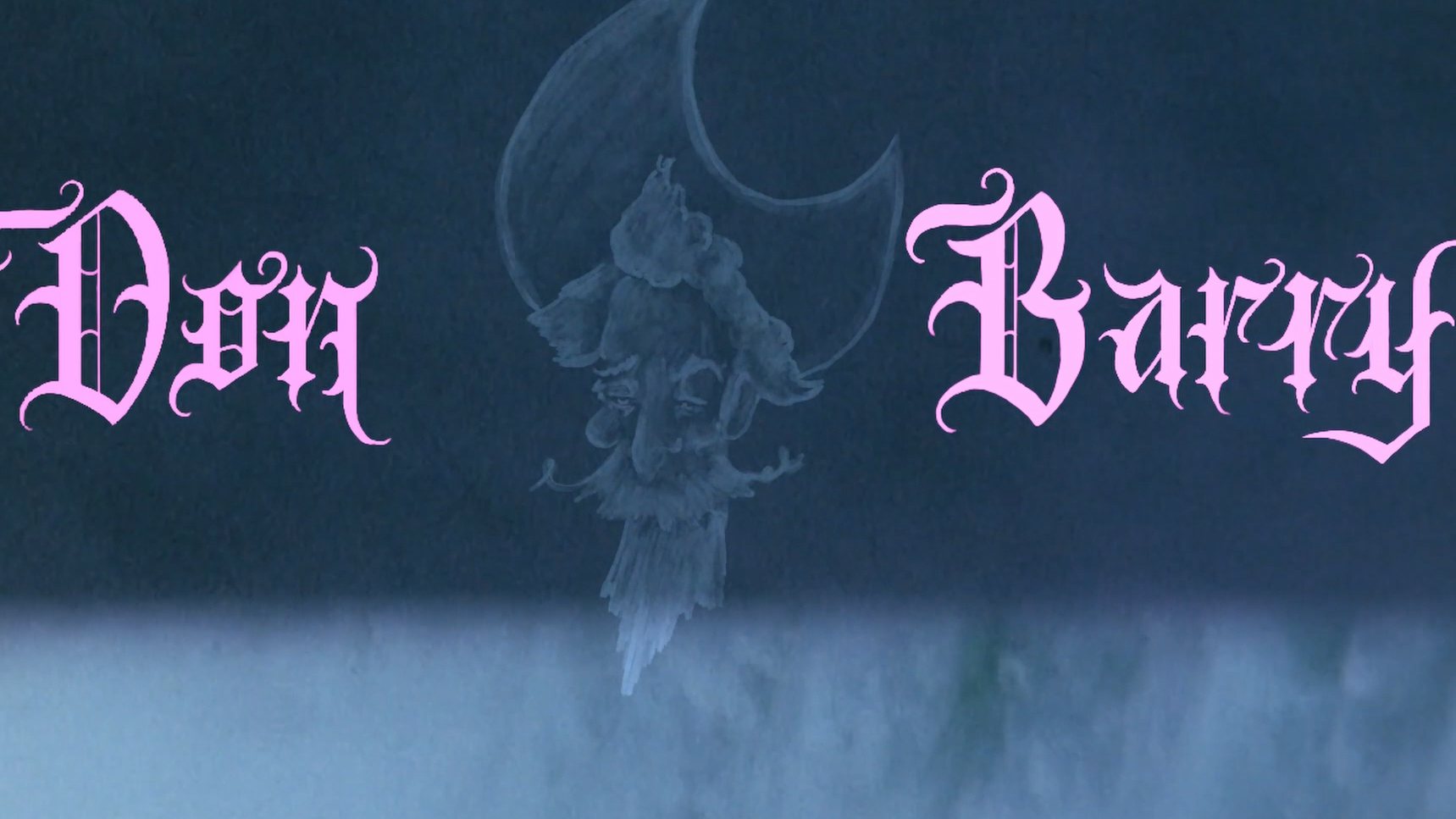
Docufiction, Experimental, by Paul Smart, Mexico, 2026.
Don Barry: A Quixotic Exploration is a debut feature that places the biography of an eighty-year-old experimental filmmaker and artist, Barry Gerson, within the metanarrative of Miguel de Cervantes’ Don Quixote. Don Barry was filmed in the city of Guanajuato during the 51st edition of the Cervantino Festival, as well as during the vibrant Day of the Dead celebrations held in the city’s UNESCO-listed tunnels. The film honors the director’s long friendship with artist Barry Gerson, drawing inspiration from Cervantes’ Don Quixote. Paul Smart’s directorial choices create something new that celebrates life and goes beyond conventional storytelling. A search for magic in our real lives. A moving film about the meaning of life, art, and death. Not to be missed.
Paul Smart is a proud outsider filmmaker with a long history of film screenings. In the 1980s, he emerged in New York’s vibrant youth art scene, working in theater production and later filmmaking, before retreating to rural upstate New York, in the Catskill Mountains, where he made a living writing and screening independent films in old parish halls for rural audiences, many of whom had never seen a film.
LANGUAGE: English
SUBTITLES: Spanish, French, German, Portuguese
What the Risorgimento Actually Wanted From Him
There is a particular kind of crowd that doesn’t see the person standing in front of it. It sees a symbol it has already decided upon, and the person inside that symbol can protest, retreat, fall silent — none of it matters. The crowd has already finished the transaction without asking permission.
This is precisely what happened in the theaters and piazzas of mid-nineteenth-century Italy, where audiences took Verdi’s name and converted it into an acronym — Vittorio Emanuele Re D’Italia — that announced the dream of a unified kingdom under a Savoy king. They wrote it on walls. They shouted it in the streets. They turned the four letters of a composer’s surname into a political slogan, a rallying cry, a flag that could be painted and repainted without the man’s consent. Verdi was, in this sense, the most spectacular example of what Eric Hobsbawm described in “The Invention of Tradition” — the 1983 collection he co-edited with Terence Ranger — as the deliberate fabrication of cultural continuity to serve political ends. Nations in formation, Hobsbawm argued, do not simply inherit symbols; they manufacture them, retroactively and urgently, dressing recent constructions in the costume of ancient necessity.
The Risorgimento needed an artist who could stand for the whole, someone whose work already stirred collective feeling in darkened theaters and could be conscripted into a larger mythology of blood and soil and destiny. Verdi’s choruses were enormous, literally — the “Va, pensiero” of Nabucco in 1842, the Hebrew slaves lamenting their lost homeland by the waters of Babylon, landed in Milan with a force that no pamphlet or manifesto could replicate. Something in the harmonic simplicity, the long unbroken melodic line, the shared breath of hundreds of voices moving as one, produced an almost physical sensation of collective longing. That the text was ostensibly about ancient Hebrews was irrelevant, or rather, it was precisely what made it usable. Displacement allows projection. You sing about someone else’s exile and mean your own subjugation.
But Verdi himself was a more complicated and considerably less pliable figure than the movement required. He was a republican at heart, an admirer of Mazzini’s uncompromising idealism rather than Cavour’s diplomatic pragmatism or the dynastic arithmetic that would eventually produce the Kingdom of Italy in 1861. He accepted election to the first Italian parliament, serving briefly as a deputy, and found the experience so dispiriting that he withdrew from public life at the earliest opportunity. The political world, with its compromises and performances and self-interested theater, repelled the man who made his living in theater of a different kind. He returned to Sant’Agata, his farm in the Po valley, and grew wheat.
This retreat was never understood for what it was — a refusal. The nationalist narrative required continuity, a great artist who had foreseen and celebrated and willed the nation into existence through his art. The inconvenient silences, the political disillusionment, the man who preferred his fields to Rome’s corridors, were smoothed over or simply ignored. What remained was the acronym, the slogan, the usable portion. Hobsbawm’s insight cuts here with particular sharpness: invented traditions require not richness but simplicity, not the full human record but the selective extract that fits the frame already built.
The strange cruelty of this process is that it does not feel like violence to those performing it. Admiration is its instrument. The crowd shouting “Viva Verdi” in 1859 genuinely loved what it believed Verdi represented. It is simply that what it loved was a cipher, a compression, a man reduced to four letters on a wall — and the actual Verdi, stubborn and complicated and quietly resistant, stood somewhere behind that wall, ungratefully alive.

Nabucco and the Seduction of Being Needed
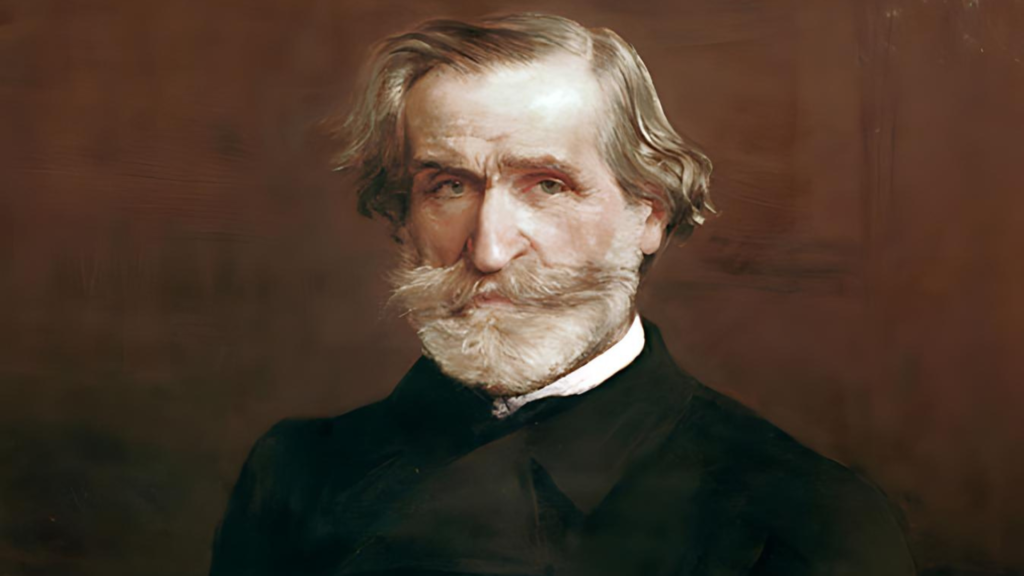
There is a particular kind of silence that falls in a crowded room when something happens that no one expected but everyone, it turns out, had been waiting for. Not the silence of shock. The silence of recognition. The kind that precedes tears you cannot quite explain, tears that feel borrowed from a grief larger than your own life.
That silence fell at La Scala on the night of March 9, 1842. The opera was new, the composer was twenty-eight years old, and somewhere in the third act a chorus of Hebrew slaves standing on the banks of the Euphrates began to sing about a homeland they could not return to. The melody was so simple it seemed ancient, as if it had always existed and Verdi had merely been the first person to hear it clearly enough to write it down. The audience did not applaud at the end. They wept. And then they demanded it again, breaking every convention of the theater, turning a performance into something that no longer belonged to the stage.
What happens to a young man in that moment? What happens when an entire civilization presses its longing into your hands and says: carry this?
Verdi had survived the worst years a person can survive. His wife and both children had died within two years of each other. He had written an opera he considered a failure. He had told his publisher he was finished with music. The story he told later, about how Merelli thrust the libretto of Nabucco into his coat pocket and how he read it that night despite himself, may or may not be precise in its details, but it is exact in its psychology. You do not return to the thing that destroyed you through discipline. You return through ambush. The music found him when his defenses were down, and the result was not craft but eruption.
“Va, pensiero” is not a sophisticated composition. Musicologists have noted its almost hymn-like regularity, the way it moves in plain diatonic steps, the way it asks nothing difficult of the ear. This is precisely why it became a collective hallucination of longing for a people who were not Hebrew slaves and who were not in Babylon but who were, in 1842, living under Austrian occupation in a fragmented peninsula that had not yet decided whether it was a nation. The song gave them permission to feel their exile from a future they had not yet built. It named a grief that had no official name.
And Verdi became that grief’s address. He became the place where Italians sent their longing.
Think about what it means to be loved for what you represent rather than what you are. There is a vertigo in it that almost no one describes honestly. You watch strangers use your image, your name, your work, for purposes you never chose and cannot control. People weep at something you made and you know, with the terrible clarity of the creator, exactly how it was assembled, exactly where the seam is, exactly how ordinary the mechanics are beneath what they are experiencing as sacred. The love is real. It is also not quite for you. It is for the vessel you accidentally became.
Erik Erikson wrote about the crisis of identity formation in young adulthood with the seriousness it deserves, arguing in “Identity: Youth and Crisis” that the consolidation of self requires time and the freedom to experiment without consequence. Verdi was denied that freedom at twenty-eight. He was handed a symbol’s life before he had finished constructing a person’s life. The Risorgimento would spend the next decades writing his initials on walls as an acronym for a king, as if even his name was not his own.
The thing about being needed on that scale is that it does not ask your permission. It simply happens, and you either become the symbol or you spend the rest of your life quietly negotiating your distance from it.
The Years in the Galley: Creation as Survival and Trap
There is a specific kind of fatigue that does not announce itself as collapse. It accumulates quietly, in the body’s reluctance to rise in the morning, in the hand that hovers over the blank page longer than it used to, in the almost imperceptible delay between impulse and execution. You have seen it in people who work not because they love what they do but because stopping would mean something worse than exhaustion. Verdi knew this fatigue from the inside, and he named it himself with a word that has since become one of the most honest self-diagnoses in the history of art: galera. The galley. The oar that must be pulled regardless of wind or will.
Between 1842 and 1851, he composed roughly fourteen operas. The arithmetic alone is staggering, but numbers never capture what it costs to fill them. These were not works produced in the tranquility of artistic sovereignty. They emerged from a machinery of contracts, deadlines, impresarios, censors, singers with specific vocal ranges that had to be honored, theater managements with specific box-office anxieties that had to be appeased. Walter Benjamin, writing almost a century later in his essays on the conditions of cultural production, argued that under capitalism the artist does not simply sell a product — the artist sells the labor of creating, submitting the very act of imagination to the logic of the market. What Benjamin described in theory, Verdi was living in flesh and nerve.
Ernani arrived in 1844, shaped partly by the demands of Venice’s La Fenice and the commercial appetite for something bold and politically charged enough to move audiences. Macbeth followed in 1847, and here something shifts — it is the work of a man fighting against the current of his own constraints, insisting on psychological interiority at a moment when the industry wanted spectacle. Then Luisa Miller in 1849, smaller in scale, more domestic in its tragedy, as if the composer was searching for a vocabulary that contractual obligations had never taught him to use. And between these recognizable titles, a dozen others, some of which Verdi himself would later dismiss with a kind of cold clarity, as works he had produced under duress, as a man produces anything under duress: adequately, mechanically, with a competence that is its own kind of quiet humiliation.
The grief underneath all of this is not metaphorical. His wife Margherita Barezzi had died in 1840, shortly after the loss of both their children. He entered the anni di galera as a man who had already survived a devastation that most people are mercifully spared. The production pressure did not wait for mourning to finish. The contracts did not pause for the slow relearning of how to want things. In a letter from that period he wrote of his health failing, of nervous crises, of a body that was submitting its complaints in the only language available to a body: through symptoms, through breakdowns, through the insistence on being noticed. The galley, he seemed to understand, was not imposed entirely from outside. He had rowed toward it too, because work was the only structure that made time bearable after loss, and because the alternative — silence, stillness, the terrifying freedom of no obligation — felt more dangerous than overproduction.
This is the trap Benjamin’s framework illuminates with particular sharpness: that the bondage of commercial creation can become indistinguishable from the will to create, until the artist can no longer tell which oar belongs to survival and which to art. Verdi pulled both, simultaneously, for nearly a decade, and the tension between them — never fully resolved — is audible in the music itself, in the moments where something raw and unguarded breaks through the surface of an otherwise serviceable score, like a voice insisting on being heard even when no one has asked for it.
Rigoletto, Trovatore, Traviata: The Trilogy That Broke the Stage
You are sitting in a theater in Venice, March 1853, and the woman dying on stage is someone you would not have received in your home. You know what she is. You have perhaps crossed her in the street and looked away, or looked too long and then looked away. And now you are weeping. The curtain falls and you applaud with the same hands that would have signed the document barring her from respectable society, and tomorrow morning nothing will have changed. This is not hypocrisy in the simple sense. It is something more structural, more interesting, and more damning.
In the space of two years Verdi staged three consecutive ruptures, each one placing at the center of the operatic universe a figure the tradition had kept at the margins or used only as decoration for someone else’s tragedy. The hunchbacked jester who loves his daughter with a ferocity that shames every noble in the room. The bastard son wandering through a war that has no name for him. The courtesan who chooses love and is destroyed not by her own excess but by the respectable world’s need to reclaim the man she loves. These are not romantic archetypes. They are social casualties given arias.
Rigoletto arrives first, in 1851, and what it does to the stage is almost violent. The deformed body at the center of Italian opera was simply not done. Physical difference had always been comedic shorthand or narrative punishment, never interiority, never grief so wide it breaks the voice trying to contain it. When he cradles what he believes is the Duke’s body in that sack, believing he has finally reversed the cruelty of power, and discovers instead his daughter, the dramatic mechanism is not irony — it is the oldest truth about the powerless: that their vengeance always falls back on themselves. Verdi understood this not as poetic justice but as the mechanics of a rigged system.
Then Violetta. Simone de Beauvoir, writing in The Second Sex in 1949, identified with clinical precision the transaction that Verdi staged in 1853: society creates the conditions for the fallen woman, uses her, and then punishes her for existing. The courtesan is produced by male desire and then condemned by male respectability. Violetta Valéry does not die of tuberculosis. She dies of the requirement that she disappear once she has served her purpose. Germont père arrives in the second act not as a villain but as something worse — a reasonable man making a reasonable request. His respectability is the weapon. He asks her to sacrifice herself for the family’s honor, which means for his son’s ability to re-enter a world that never had to account for her. She agrees. This is the part that should stop you cold: she agrees. Because she has internalized the logic of her own expendability so completely that she performs it voluntarily, and we call this love.
Bourgeois audiences in the 1850s wept for Violetta and returned home to enforce the exact codes that killed her. The emotional release the opera provided may have actually functioned as pressure valve rather than confrontation — you could feel the injustice for three hours and leave the injustice intact. This is what the Frankfurt School theorists, Adorno most precisely in his 1941 essay on popular music, would later describe as the cultural industry’s capacity to simulate critique while neutralizing it. Verdi may not have intended this. But the history of how his trilogy was received suggests that radical form can be metabolized by the very systems it indicts.
The fallen woman, the marked body, the nameless son — each of them occupies the stage not as exception but as evidence. Evidence of what the world was doing to people while telling itself it was civilized.
A vision curated by a filmmaker, not an algorithm
In this video I explain our vision
Strepponi, Silence, and the Contracts We Call Love

She stands at the window of a house that took years to become hers, watching the carriages arrive from Milan, from Paris, from places that once celebrated her voice and now pretend they cannot remember it. The visitors come for him. They always come for him. She arranges flowers, reads, writes letters in a hand that is precise and controlled even when the words inside them are not. She has been doing this for years. She will continue doing it.
Giuseppina Strepponi and Giuseppe Verdi began living together in Paris in 1847 before their eventual marriage in 1859, twelve years during which the world had a word for what she was, and the word was not flattering. She had been one of the most celebrated sopranos in Italy, the voice that had launched Nabucco in 1842 by convincing the management of La Scala to take a chance on an unknown composer, and that original act of professional belief had quietly transformed, over time, into something the operatic world would not officially name. She gave up her career as her voice declined. She followed him to Sant’Agata, to that flat stretch of the Po valley that Verdi loved with a farmer’s ferocity, and she lived there in a silence that was not chosen so much as assigned.
Judith Butler, writing in the context of gender and performativity, argues that social legitimacy is not simply granted or withheld as a judgment on individual behavior — it is actively produced through repeated acts of recognition and exclusion that make certain lives legible and others unreadable. The unmarried woman who had previously had children outside wedlock, who had followed a man to a provincial estate and called it home without a priest’s blessing, was not merely disapproved of. She was made illegible. The neighboring families of Busseto, the very town that had once subsidized Verdi’s education and now considered him its greatest treasure, organized their social lives around her exclusion with an almost bureaucratic efficiency. Invitations arrived that included his name and omitted hers. Doors opened for him that remained simply, neutrally closed when she stood beside him.
What the letters reveal is harder to summarize than scandal. They are long, often philosophical, sometimes furious, almost always honest in a way that formal relationships rarely permit. She writes to him about loneliness with a specificity that is not complaint but diagnosis. He writes back with a gruffness that in other hands would read as coldness but in his contains something more like respect — the respect of a man who does not soften the truth because he believes she can bear it. They were building, letter by letter, argument by argument, a form of intimacy that did not fit the available templates.
A man sits in a theater surrounded by strangers who are weeping at music he composed for reasons they will never fully understand. Afterward they mob him in the corridor, touch his sleeve, say things that mean nothing. He accepts it with the particular exhaustion of someone who has learned that public adoration is its own kind of solitude. She is not there. She is at Sant’Agata, or she is in the carriage, or she is standing slightly behind him in a room where no one quite knows how to introduce her. Her past — the celebrated soprano, the woman who had loved where she should not have loved — is both the foundation of everything he became and the precise instrument used to diminish her.
Butler would say that this is how the contract works: the terms are never stated aloud because stating them would make them visible, and visibility would make them vulnerable to refusal. The arrangement sustains itself through the silence of everyone who benefits from it, including, sometimes, the person it costs the most.
Otello and Falstaff: The Two Faces of a Man Who Outlived His Era
There is a particular kind of stillness that settles into a room when almost everyone you have known is gone. Not grief exactly, not anymore — grief has a heat to it, a forward pressure. This is something else: the strange suspension of a man who has outlived his context, who sits among objects that remember people no longer living, who finds himself, against all reasonable expectation, almost amused by the situation. This is where Verdi was writing from, at the end. Not from loss, but from the far side of it.
He was seventy-three years old when Otello reached La Scala in February 1887, and the work carries in its bones the full weight of a man who has spent half a century watching human beings dismantle themselves. What Otello enacts is not simply jealousy — Othello’s particular tragedy, the one Shakespeare understood and Verdi deepened through Boito’s libretto, is the tragedy of a man who surrenders his own perception to someone else’s narration. Iago does not invent what Otello fears. He merely finds it, already waiting, already half-formed in the architecture of Otello’s insecurity, and gives it a shape, a name, a story to inhabit. The philosopher René Girard, in his 1961 Mensonge romantique et vérité romanesque, argued that human desire is fundamentally mimetic — we want what we are told to want, we fear what we are shown to fear, we see through borrowed eyes far more often than we admit. Otello is Girard’s argument made flesh and blood and music. The man destroys Desdemona not because of what she did but because of the story he has accepted about what she might have done, a story built from nothing, from a handkerchief, from a pause, from a smirk on someone else’s face. The horror is not that he is monstrous. The horror is that he is ordinary in his susceptibility to narrative.
And then, six years later, at seventy-nine, Verdi did something that no logic of career or psychology or cultural expectation could have predicted. He wrote a comedy. Not a gentle comedy, not a sentimental valediction, but Falstaff — a work of such structural daring, such compressed ironic intelligence, that it continues to baffle those who expect a final masterpiece to arrive in the key of solemnity. The image of Falstaff himself, that vast, ridiculous, magnificent figure who understands perfectly that the world finds him absurd and decides to find the world equally absurd in return, is one of the most radical self-portraits an artist has ever embedded in a major work. Think of an old man who has genuinely lost almost everything — money, status, the body that once defined him, the world that once made sense of him — sitting in a tavern ordering more wine, laughing first, before anyone else can laugh at him. That conversion of humiliation into comedic sovereignty is not resignation. It is a philosophical act.
Milan Kundera, in The Book of Laughter and Forgetting, written in 1979, makes the distinction between the laughter of the devil and the laughter of the angels — the first seeing the absurdity beneath human pretension, the second celebrating the lightness of existence. Falstaff contains both simultaneously. The final fugue, in which every character on stage, including Falstaff himself, sings that all the world is a joke, tutto nel mondo è burla, is not cynicism dressed as wit. It is something more unsettling: the recognition that the joke does not diminish the life, that the farce and the tragedy were always the same material arranged differently.
Verdi had buried his first wife, his two children, his closest collaborator Camillo Du Locle, most of his generation. He had watched the musical world reorganize itself around Wagner’s gravitational pull. He had been declared obsolete and then rediscovered and then declared obsolete again. And he sat down, at the age of seventy-four, to begin composing Falstaff, a work about a man who refuses the dignity of tragedy.
The Hotel and the Silence After
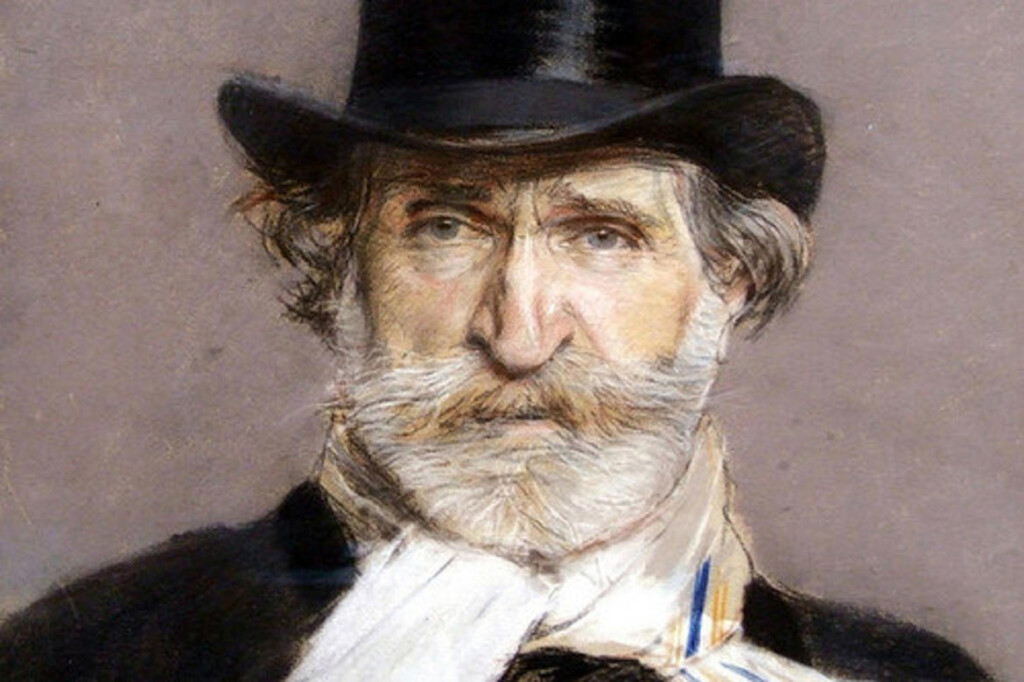
He had checked into the Grand Hotel et de Milan in late December, and within days the city knew what was coming. They brought straw and laid it thick across the cobblestones outside, muffling the hooves of passing horses so that the sound of ordinary life would not break through the walls and disturb whatever was left of him. That image — a metropolis going quiet on its knees, bending the logistics of an entire street to protect one man’s dying — is either the most beautiful thing a civilization can do or a confession of everything it refuses to do while people are still alive enough to benefit from it.
He died on January 27, 1901, at ten minutes past two in the morning. He was eighty-seven years old. The stroke had come days before, and he had lived in that suspended state that is neither presence nor absence, the body still warm, the mind already somewhere the straw could not reach. Arrigo Boito was there. Teresa Stolz was there. The friends who had survived him in loyalty if not in years. Outside, Milan held its breath in the way that cities only do when they have already decided that someone belongs to history rather than to the present tense.
Boito, who had spent decades in Verdi’s orbit — first as the young provocateur who wrote a poem that seemed to mock the old guard, then as the librettist who gave Verdi his last two operas and perhaps his most searching ones — reportedly stood by the bed and said nothing. There is a particular grief that cannot organize itself into words because it has been anticipated for too long. You have rehearsed it so many times that when it arrives it does not feel like an event. It feels like the last note of a piece you have known your entire life finally resolving, and the silence that follows is not empty. It is full of everything that came before it.
Sigmund Freud, writing just a year earlier in a different register entirely, had begun to describe mourning as the slow and painful withdrawal of emotional investment from a lost object. But what he could not fully account for was what happens when the lost object is not a person but a frequency — a way that the world sounded when a particular consciousness was still moving through it. Verdi had changed what Italian ears expected from music, from drama, from the relationship between a human voice and everything it carries. When he stopped, something in the acoustic imagination of an entire culture went quiet in a way that straw on cobblestones cannot explain.
The funeral cortege moved through Milan in silence so dense it was described by witnesses as a physical thing. Months later, when his body was transferred to the Casa di Riposo per Musicisti — the home for retired musicians he had founded and funded, the project he considered his truest work — two hundred thousand people lined the streets. Toscanini conducted. The crowd, spontaneously, began to sing the chorus of the Hebrew slaves from Nabucco. Va, pensiero. The song of a people who want to go home and cannot.
There is something that should stop you inside that image: two hundred thousand people singing a lament composed sixty years earlier, in a street, without rehearsal, because no other language was available for what they felt. And then there is the question you cannot quite shake loose — about all the other composers, all the other voices, all the music that never found a Boito, never found a Ricordi, never found a city willing to lay down straw before it was too late to matter, and what exactly we have agreed to call civilization in their absence.
🎭 The Soul of European Culture and Its Masters
Giuseppe Verdi’s operas are deeply rooted in a broader tapestry of 19th-century European thought, where art, literature, and philosophy intertwined in extraordinary ways. Exploring the intellectual and creative worlds surrounding Verdi helps us understand the spiritual urgency that animated his music. These related articles trace the cultural currents that shaped the era of grand opera and romantic expression.
Alchemy in Literature: From Dante to Goethe
The interplay between esoteric symbolism and artistic creation runs as a golden thread through Western literary history, from Dante’s Divine Comedy to Goethe's Faust. Verdi himself drew on literary masterpieces — including works by Shakespeare and Schiller — that were steeped in this tradition of symbolic transformation. Understanding how alchemy shaped European literature illuminates the deeper layers of meaning embedded in operatic dramaturgy.
GO TO THE SELECTION: Alchemy in Literature: From Dante to Goethe
Schopenhauer: Life and Philosophical Thought
Arthur Schopenhauer‘s philosophy of the Will and its redemption through aesthetic experience was profoundly influential in 19th-century Europe, shaping the way artists and composers understood suffering and transcendence. Verdi’s later operas, with their tragic intensity and compassion for the human condition, resonate deeply with Schopenhauer’s vision of art as the highest form of solace. Exploring his thought provides a compelling philosophical lens through which to experience the emotional universe of Verdian opera.
GO TO THE SELECTION: Schopenhauer: Life and Philosophical Thought
Giordano Bruno and the Hermetic Tradition
Giordano Bruno, the Italian philosopher and martyr of free thought, embodies the restless spirit of Italian intellectual life that would continue to echo through the centuries. His defiance of authority and passionate pursuit of truth prefigure the patriotic and humanistic themes that run throughout Verdi’s operatic works, many of which became rallying cries for Italian unification. The Hermetic tradition he championed also reminds us of the hidden spiritual dimensions that permeate Italian cultural identity.
GO TO THE SELECTION: Giordano Bruno and the Hermetic Tradition
Alchemy in the Italian Renaissance
The Italian Renaissance was not only a period of artistic splendor but also a time of intense alchemical and esoteric inquiry, when the boundaries between art, science, and spiritual practice were fluid and fertile. This cultural atmosphere nurtured a particular vision of the artist as a transformer of raw human experience into something transcendent and enduring. Verdi, as the great inheritor of Italian expressive tradition, can be seen as a late alchemist of the soul, transmuting history and passion into timeless musical drama.
GO TO THE SELECTION: Alchemy in the Italian Renaissance
Discover the Art of Independent Cinema on Indiecinema
If the worlds of music, philosophy, and cultural history captivate your imagination, you’ll find that independent cinema offers equally profound explorations of the human spirit. On Indiecinema, our curated streaming platform, you can discover films that dare to go beyond the mainstream — works that resonate with the same depth and courage found in Verdi’s greatest operas. Join us and let independent storytelling transform your inner world.
👉 EXPLORE THE CATALOG: Watch Indie Films in Streaming
A vision curated by a filmmaker, not an algorithm
In this video I explain our vision