
The Séance as Social Mirror
The candles have burned low enough that the faces across the table from you are more shadow than flesh, and the woman at the head of the table has not spoken for three minutes, which is long enough that you have started counting your own heartbeats. You came tonight because your brother invited you, and your brother came because his wife insisted, and his wife insisted because she has not slept without dreaming of her dead daughter for eleven months. The table is mahogany. The curtains are velvet. The medium’s hands are resting palm-up on the white tablecloth, and you are holding the hand of a stranger to your left, and everyone in the room is pretending that this is a perfectly ordinary thing to do on a Tuesday evening in 1852.

What happened in the drawing rooms of mid-nineteenth century America and Britain was not primarily a supernatural event. It was a social one. The Fox sisters — Kate and Margaretta, daughters of a Methodist farmer in Hydesville, New York — reported hearing unexplained rappings in their home in March of 1848, and within two years they were performing for audiences in New York City’s Barnum Hotel, charging admission, corresponding with journalists, and generating the kind of media coverage that would today be called viral. The rappings themselves were almost certainly the audible cracking of toe joints, a fact Margaretta confessed to in 1888 before recanting the confession the following year. But the four decades between the first knock and that retraction contained something the confession could not undo: a movement of between one and eight million adherents in the United States alone by the early 1850s, according to estimates cited by historian Ann Braude in her 1989 study Radical Spirits, a movement so large and so fast that it requires an explanation that has nothing to do with whether the dead were actually speaking.
The speed of spiritualism’s spread belongs to a specific kind of historical hunger. The 1840s in the anglophone world were a decade of cholera epidemics, of infant mortality rates that made it statistically likely that any family of four children would lose at least one before adulthood, of a Protestant theology increasingly uncomfortable with its own silence on what happened to the soul in the immediate hours after death. The doctrine of the resurrection of the body at the Last Judgment left a long, cold corridor between the moment of death and any promised reunion, and spiritualism offered to collapse that corridor entirely. The dead were not waiting. The dead were here, tonight, in this room, behind the curtain, available for questions about where they had put the will and whether they had suffered and whether they still loved you.
The sociologist Max Weber, writing decades later in The Sociology of Religion, described the way religious innovation clusters around populations experiencing what he called a “theodicy of suffering” — not abstract theological suffering but the specific, grinding, daily kind that produces the need for a framework that makes loss legible. Spiritualism was precisely that framework, dressed in the language of empiricism rather than faith, which was its masterstroke. It arrived at the moment when science was beginning to displace scripture as the dominant register of truth, and it offered itself not as belief but as experiment. The séance was not a prayer. It was, its practitioners insisted, an investigation. The medium was not a prophet. She was, they claimed, a sensitive instrument, like a galvanometer, registering forces that science had not yet fully mapped.
This linguistic maneuver did something that purely religious movements cannot easily do: it made skepticism a form of participation. You did not have to believe to attend. You had only to observe, to keep an open mind, to hold the stranger’s hand in the dark and wait.
Cathnafola - A Paranormal Investigation
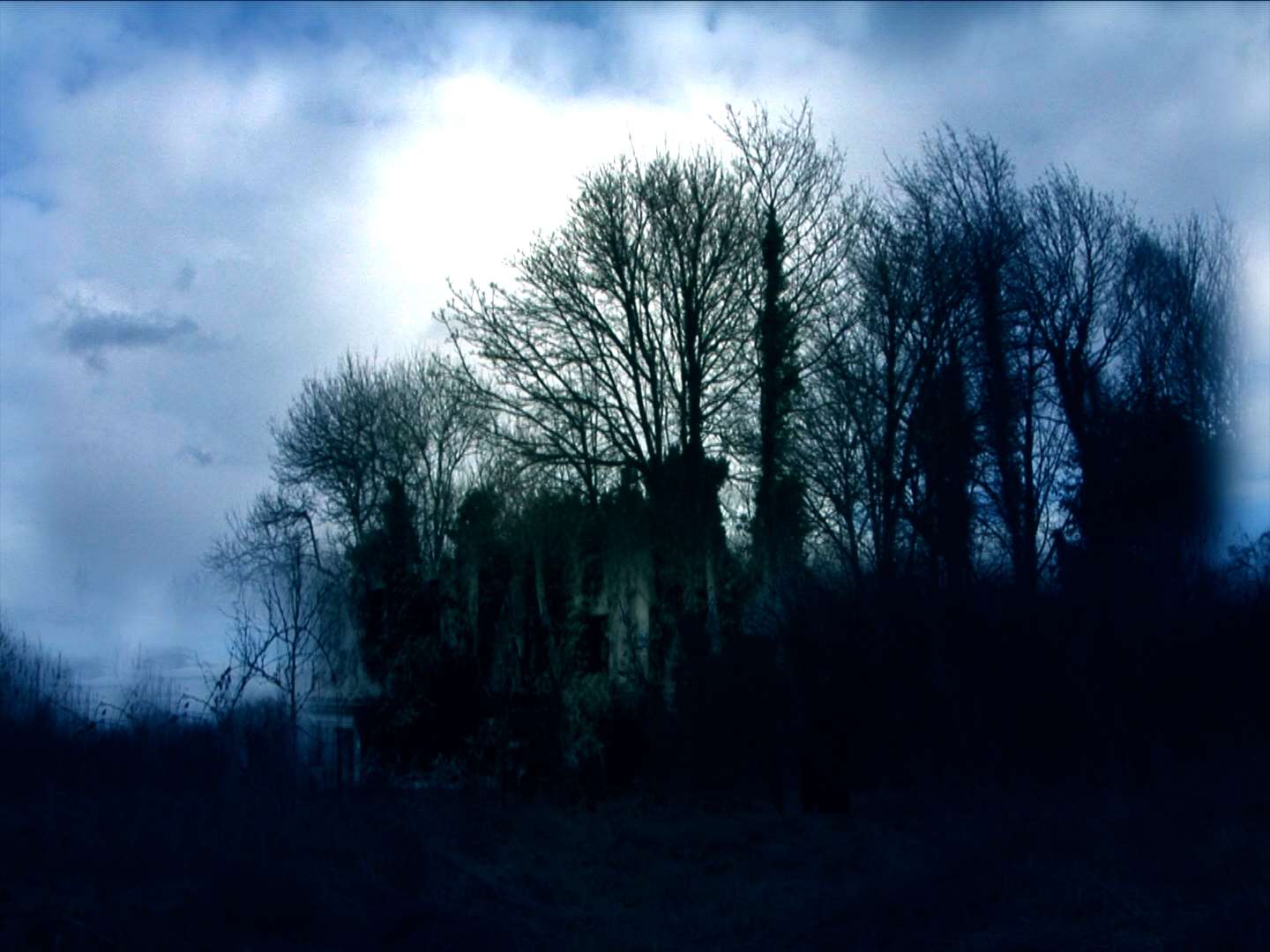
Documentary, horror, by Jason Figgis, USA, 2014.
In "Cathnafola", everything begins when renowned paranormal investigator Chris Halton of Haunted Earth UK receives footage filmed by three teenagers at the ruins of Cathnafola House in Ireland. Determined to unearth the truth behind the location’s bloody past, Halton embarks on a nighttime exploration of the infamous ruins—and soon uncovers terrifying and disturbing revelations.
LANGUAGE: English
SUBTITLES: Spanish, French, German, Portuguese
The Fox Sisters and the Architecture of Belief
You are eleven years old and you hear knocking inside the walls of your house, and the knocking answers back when you speak to it. This is not a metaphor. This is Hydesville, New York, March 1848, and Kate Fox is snapping her fingers in the dark bedroom of a rented farmhouse while her older sister Margaret watches, and something — whatever it is — responds in kind. Their mother, Margaret Sr., runs to the neighbors. Within days, half the county has pressed into that house to listen.
What happened next is the part history tends to flatten into scandal. The Fox sisters became famous throughout the northeastern United States, then famous across the Atlantic, with séances documented in newspapers from Rochester to London by 1852. The speed of that contagion is not incidental — it is the entire argument. A genuine historical curiosity does not travel that fast unless it finds a wound already open and waiting.
The wound was demographic and almost unbearably literal. Between 1847 and 1851, cholera epidemics swept the United States in waves, killing tens of thousands. Tuberculosis was endemic. Child mortality in mid-nineteenth-century America meant that a significant portion of any household had already buried someone young and recently. When the Fox sisters offered a technology of contact — a systematic, repeatable method of communication with the dead — they were not selling superstition to the credulous. They were offering a structural solution to a structural problem: grief without terminus, loss without any framework for resolution. William James, writing in 1896 in “The Will to Believe,” would articulate something adjacent to this when he argued that the human mind under conditions of genuine uncertainty is not irrational to reach for provisional belief. James was defending a philosophical position, but the Fox sisters had already proven his point empirically, forty years earlier and with far more force than any lecture.
What is harder to metabolize is the sociology of who believed. The movement did not gather primarily among the uneducated or the isolated. Horace Greeley, the most influential newspaper editor in America, investigated the rappings and emerged sympathetic. The judge John Worth Edmonds, a New York State Supreme Court justice, became a committed Spiritualist and said so publicly in 1853. The social theorist Robert Dale Owen — son of the utopian industrialist Robert Owen — spent years documenting phenomena and published “Footfalls on the Boundary of Another World” in 1859. These were not men incapable of skepticism. They were men incapable of something else: of sitting with the irreversibility of death inside a culture that had not yet built secular rituals adequate to that irreversibility. The church was losing ground to science; science offered nothing personal in return. Spiritualism moved into exactly that vacuum, not as fraud filling a gap but as a genuine cultural technology responding to a genuine failure of existing systems.
Margaret Fox confessed to fraud in 1888, demonstrating before a New York audience that the sounds had been produced by cracking the joints of her toes. The confession was itself immediately disputed, then retracted by Margaret herself the following year. None of it mattered structurally. By 1888, Spiritualism had been a mass international movement for four decades. It had generated its own journals, its own investigative societies — most notably the Society for Psychical Research, founded in London in 1882 by figures including Henry Sidgwick, then president of Trinity College, Cambridge — its own schisms and orthodoxies. A confession from one of its origin figures landed on that edifice the way a stone lands on a river: it broke the surface briefly and the current continued. Movements built on hunger do not collapse when their founding myth is interrogated, because the hunger itself was never the myth.

Grief, Industrialization, and the Market for the Dead

You are standing in a parlor in Rochester, New York, in 1848, and the woman across the table from you has just lost a child. This is not metaphor. The child died of scarlet fever at four years old, as children routinely did in a country where infant mortality hovered above 200 per 1,000 live births and where a fever that arrived on Tuesday could empty a crib by Friday. The woman is not eccentric. She is not credulous in any way that distinguishes her from her neighbors. She simply cannot tolerate the silence where the child used to be, and when Margaret Fox claims to hear knocking from the walls of her Hydesville farmhouse — knocking that answers questions, knocking that counts and responds and remembers — the bereaved woman across the table does not reach for skepticism. She reaches across.
What made the mid-nineteenth century peculiar was not grief itself, which is as old as language, but the specific geometry of loss that industrial modernity had engineered. Between 1850 and 1880, the United States was transformed by a convergence of catastrophes that left the living outnumbered in their own emotional lives: the Civil War killed approximately 620,000 soldiers, many in conditions so chaotic that families received no remains, no confirmation, no physical fact to bury. The epidemic logic of industrializing cities — cholera moving through contaminated water systems, tuberculosis feeding on overcrowded tenements — produced death that was anonymous, sudden, and structurally invisible. Karl Marx, writing in Capital in 1867, described industrial labor as a system in which the worker’s body was consumed at a rate that the market had already priced and accepted. The living were raw material. The logic that processed them could not, when they died, offer anything resembling ceremony.
Into this vacuum, spiritualism installed itself with the precision of a product that understood its market. Séances were ticketed events. Mediums charged by the session. Publications like the Banner of Light, founded in Boston in 1857, ran columns of spirit messages alongside advertising for the practitioners who delivered them. The dead, in this economy, generated revenue. They were testimonial, spectacle, and service simultaneously. When Ann Braude documented this phenomenon in Radical Spirits in 1989, she observed that women constituted the overwhelming majority of practicing mediums, which meant that spiritualism opened a professional income stream for women who had no other credentialed access to public authority. The market for the dead was also, quietly, a labor market for the living — specifically for the living that the same industrial order had rendered economically marginal.
What nobody said aloud, because saying it would have collapsed the entire architecture, was that the commodity being sold was not contact with the dead. It was the temporary suspension of grief’s most unbearable feature: its irreversibility. The séance did not return the child or the soldier or the factory worker crushed beneath machinery. It returned the sensation of proximity, the fiction of continuity, the feeling that time had not yet closed. Philippe Ariès, in The Hour of Our Death published in 1981, traced how Western cultures had progressively medicalized and bureaucratized dying across the nineteenth century, removing it from the domestic space where it had been witnessed communally and relocating it behind institutional walls. The result was a population that had lost the traditional scaffolding for processing death and had not yet constructed anything to replace it. Spiritualism was not the replacement. It was the commerce that filled the construction gap.
The movement grew fastest precisely where industrialization had been most violent. The mill towns of New England, the devastated counties of Virginia and Pennsylvania after the war, the immigrant neighborhoods of New York where cholera had moved through entire families in a week — these were its territories. The geography of séances maps almost perfectly onto the geography of industrial casualty, which means that what looked like a spiritual awakening was also, measured differently, a damage report.
The Scientific Establishment and Its Embarrassments
You have spent years trusting the instruments. The calibrated scale, the controlled variable, the replicable result — these are the tools that tell you what is real. Now imagine holding those tools in a darkened room in London in 1874, watching a woman who appears to have materialized from a sealed cabinet, and believing, against every instinct your training has built, that the instruments might be telling you something true.
William Crookes was not a credulous man. He had discovered thallium in 1861, contributed fundamental work to cathode ray research, and would later be knighted for services to chemistry and physics. When he announced in the Quarterly Journal of Science that his investigations into the medium Florence Cook had produced results he could not explain through fraud or illusion, the scientific community did not engage with his data. It ridiculed him. The implicit contract of Victorian rationalism was suddenly visible: the method was sacred only when it confirmed what the institution already believed.
Alfred Russel Wallace had co-developed the theory of natural selection independently of Darwin, presenting his findings simultaneously at the Linnean Society in 1858. He was, by any measure, among the most rigorous naturalists of his century. His conversion to spiritualism, detailed in his 1875 work On Miracles and Modern Spiritualism, was treated by his contemporaries not as a scientific claim requiring refutation but as a personal collapse, evidence that a great mind had finally succumbed to grief or eccentricity. What neither his supporters nor his critics could comfortably examine was the logical structure of his argument: that the emergence of human consciousness represented a discontinuity in evolutionary process too sharp to be explained by selection alone, and that phenomena witnessed at séances constituted, however imperfectly, empirical data pointing toward that discontinuity.
The Society for Psychical Research, founded in Cambridge in 1882 under the philosopher Henry Sidgwick, attempted to resolve this institutional embarrassment by building a new kind of institution around it. Its founding membership reads like a census of late Victorian intellectual life: Frederic Myers, Edmund Gurney, and eventually William James, who would bring the society’s methods into dialogue with his own Varieties of Religious Experience published in 1902. Their approach was genuinely rigorous — they developed systematic protocols for witness testimony, investigated fraud with the same energy they brought to authenticating phenomena, and produced in 1886 a two-volume study called Phantasms of the Living that catalogued over seven hundred cases of apparent telepathic communication. The scientific establishment ignored it almost entirely, not because the methodology was weak but because the conclusion was inadmissible.
What the Society’s failure actually exposed was a structural feature of rationalism that its practitioners preferred not to examine: the prior commitment to a particular ontology that determined, before any experiment began, which results could count as results. The philosopher of science Thomas Kuhn would not articulate the mechanics of this problem until 1962 in The Structure of Scientific Revolutions, but the Victorian researchers were living it in real time. Anomalous data does not simply enter a paradigm and force its revision. It gets reclassified as error, fraud, or the symptom of a disordered mind, and the researchers who produced it are quietly expelled from the community of credible witnesses.
The deeper embarrassment, the one that neither side in these Victorian debates could fully name, was that the hunger driving people into darkened séance rooms was not irrational. It was continuous with the same hunger that drove the empirical project itself — the refusal to accept that the most important questions were permanently beyond investigation. The spiritualists and the scientists shared a founding premise, which is precisely why their confrontation generated so much heat and so little light. Both camps believed that truth was discoverable. They disagreed only about where the boundary of the discoverable had been permanently fixed, and who had the authority to draw it.
Women, Power, and the Medium's Body
You are sitting in a parlor in 1872, and the woman across from you has closed her eyes. She is not speaking — not exactly. Something is speaking through her, and that distinction is doing enormous cultural work that neither of you will ever fully name.
The language of mediumship was, from its earliest institutional form, a language of surrender. The medium did not claim to know; she claimed to be known through. She did not assert authority; she dissolved into a conduit. And yet by 1870, women like Emma Hardinge Britten were commanding lecture halls of thousands, issuing pronouncements on theology, mortality, and the structure of the cosmos — activities that, in any other register, would have been classified as preaching, and preaching was a space from which women were systematically barred. The paradox was not incidental. It was the architecture.
Alex Owen’s 1989 study of Victorian female mediumship maps this terrain with forensic precision, demonstrating that the trance state functioned as a kind of social alibi. A woman in trance was not responsible for what emerged from her body. She was absent, or claimed to be — a hollow instrument through which spirits of the dead, angels, or unnamed intelligences expressed themselves. This framework permitted utterances that, delivered by a conscious woman in full possession of her faculties, would have triggered immediate social sanction. The passivity was the permission slip. The more completely a woman could perform self-erasure, the more expansive the authority she was granted to occupy.
What makes this mechanism genuinely unsettling is that it did not simply borrow patriarchal logic — it weaponized it. The Victorian medical and cultural establishment had long insisted that women were by nature more porous, more receptive, more susceptible to influence than men. Their nervous systems were understood to be finer, their boundaries between self and world more permeable. Hysteria, that great nineteenth-century catch-all diagnosis, was essentially a theory about female bodies as badly sealed containers. Spiritualism took this pathologizing framework and inverted its valuation without touching its structure. Yes, women were porous — and that porousness was now a gift, a qualification, a form of sacred fitness. The same physiology that made a woman unfit for rational public life made her uniquely capable of serving as a bridge between worlds.
The medium’s body, then, became a site of profound and unresolved contest. Physicians like John Milne Bramwell and the researchers of the Society for Psychical Research, founded in London in 1882, subjected female mediums to investigative protocols of escalating intimacy — physical searches, controlled enclosures, observation of bodily functions during trance. The scrutiny was framed as scientific, but its texture was something else: a recapitulation of the very surveillance and bodily policing that organized Victorian women’s lives outside the séance room. To be authenticated as genuine, a medium had to submit her body to examination. The spirits could only be real if the woman could be proven empty.
Some mediums refused this bargain entirely, building careers on exactly the kind of theatrical showmanship that investigators were trying to eliminate. Florence Cook, whose materializations of the spirit “Katie King” captivated London in the early 1870s, operated in a space where performance and belief were deliberately kept indistinct. Whether or not her phenomena were fraudulent — and the evidence suggests they largely were — the cultural function she served was not. She gave her audiences permission to believe in a continuity beyond death, and she did it by making her own body the evidence. The fraud, if it was fraud, was a woman using the tools available to her.
What spiritualism revealed, and what its critics could never quite articulate cleanly, was that the line between genuine spiritual authority and skilled social navigation is nearly impossible to draw from the outside, and perhaps not much easier from within.
A vision curated by a filmmaker, not an algorithm
In this video I explain our vision
Theosophy and the Colonization of the Occult

You have probably never questioned why the word “esoteric” carries a faint perfume of the East — why hidden wisdom, in the Western imagination, almost always arrives from somewhere else, spoken by someone darker, older, more ancient than modernity permits.
Helena Blavatsky understood this hunger with the precision of a surgeon and the instincts of a showman. When she co-founded the Theosophical Society in New York in 1875 alongside Henry Steel Olcott and William Quan Judge, she was not merely organizing a new spiritual movement — she was constructing a machine for the production of exotic authority. Her foundational text, Isis Unveiled, published in 1877, ran to nearly 1,400 pages and proposed that beneath all world religions lay a single primordial wisdom-tradition, accessible only to initiates. The argument was seductive precisely because it was unfalsifiable: the deeper truth was always deeper still, always elsewhere, always encoded in texts that the uninitiated could not read.
What made Theosophy structurally different from the Spiritualist seances that preceded it was not its ambition but its geography. Blavatsky relocated the source of occult knowledge to the Himalayas, to Tibet, to Mahatmas — ascended masters she claimed communicated with her through letters that materialized, literally, inside a specially built cabinet in Adyar, India, where the Society’s international headquarters had moved by 1882. The Society for Psychical Research investigated these materializations in 1885, and Richard Hodgson’s report concluded with methodical brutality that the letters were fraudulent, the cabinet rigged, the Mahatmas a fabrication. Blavatsky died in 1891 without recanting a word, and her followers chose belief over evidence with a loyalty that itself tells you something about what Theosophy was actually providing.
It was providing a solution to a specifically Victorian crisis. Darwinism had destabilized the comfort of divine order; industrial capitalism had made the material world feel suffocatingly banal; colonial expansion had flooded European drawing rooms with artifacts, manuscripts, and rumors from civilizations that suddenly seemed both inferior and disturbingly ancient. Edward Said would later describe Orientalism as a discourse that simultaneously elevated and immobilized the East — rendering it timeless, mystical, feminized, available for Western interpretation. Theosophy was Orientalism in spiritual dress. It needed India and Tibet to be repositories of primordial wisdom precisely because that framing kept those places outside history, outside politics, outside the possibility of self-representation.
Annie Besant, who inherited the movement’s leadership after Blavatsky’s death and eventually became President of the Indian National Congress in 1917, represents the contradiction at its most vivid. She championed Indian self-rule while simultaneously insisting that Indian spiritual knowledge required Western theosophical interpretation to be properly understood. The colonized were wise but not wise enough to explain their own wisdom. This is not a minor inconsistency in an otherwise admirable biography — it is the structural logic of the entire enterprise made flesh.
Blavatsky’s second major work, The Secret Doctrine, published in 1888, introduced the concept of root races — a cosmological history of humanity divided into successive civilizational stages, with the Aryan race positioned as the current apex of spiritual evolution. The text’s racism was not incidental. It formalized, in the language of cosmic law, the hierarchies that European imperialism had spent three centuries enforcing by violence. By 1935, when Nazi ideologues were already mining Theosophical vocabulary for racial metaphysics, the intellectual lineage was not a misappropriation — it was a logical extension of frameworks that had been built to naturalize superiority while calling it spirituality.
What the Theosophical Society ultimately colonized was not just Eastern doctrine but the very concept of seeking — the human reflex toward transcendence was captured, repackaged, and sold back to people as a commodity whose value depended entirely on its apparent inaccessibility, its foreignness, its capacity to make the buyer feel chosen among the merely curious.
Death as Democratic Doctrine
You are sitting across from someone you loved who died three years ago, and nobody in the room has a collar, a cassock, a seminary degree, or any credential that preceded this moment. The table is plain wood. The medium is a seamstress from Rochester. And somehow this feels, in 1852, like the most radical thing a human being has ever done.
Spiritualism arrived in mid-nineteenth-century America with the grammar of revolution precisely because it dismantled the tollbooth between the living and the dead. Every prior Western tradition had placed a specialist at that gate — a priest, a rabbi, a minister, someone trained, ordained, and institutionally authorized to manage the traffic between this world and whatever follows it. The Catholic Church had built an entire economy around that gatekeeping function: indulgences, last rites, prayers for the dead, purgatory as a kind of theological waiting room where the clergy held the keys. Protestant reformers had attacked the booth but kept the gate. Spiritualism announced there was no gate at all.
The political valence of this was not incidental. Andrew Jackson Davis, whose 1847 work “The Principles of Nature, Her Divine Revelations, and a Voice to Mankind” essentially provided spiritualism with its founding metaphysics, was deeply embedded in the democratic utopianism of the Jacksonian moment — a period in American life when the franchise was being extended, when self-made authority was celebrated, when the word “aristocracy” had become a slur. Davis had no formal education. He was the son of a shoemaker. His cosmological system, dictated in trance, sold thousands of copies and was taken seriously by people who also read Emerson. The message and the messenger were inseparable: if a poorly educated boy from Poughkeepsie could access the fundamental laws of the universe directly, without institutional mediation, then the universe itself was a democracy.
What nobody quite paused to examine was what happens to accountability when authority becomes entirely personal. Institutional religion, for all its corruption and violence, had at least produced a structure within which claims could be challenged, heretics named, councils convened. A bishop who fabricated doctrine could theoretically be confronted by other bishops. A medium who fabricated messages from the dead answered to no one — or rather, answered only to the dead, who remained conveniently unavailable for cross-examination. The horizontality that felt like liberation was also a perfect insulation from scrutiny. You could not audit a séance the way you could audit a synod.
By the 1870s, when the movement had grown to an estimated eleven million adherents in the United States alone, the privatization of metaphysical authority had produced an extraordinary proliferation of incompatible cosmologies, each backed by the unimpeachable testimony of spirits. Some mediums channeled beings who endorsed free love. Others received messages supporting temperance, land reform, women’s suffrage, or racial hierarchy. The dead, it turned out, held opinions that tracked with suspicious precision to what the medium already believed before entering the trance state. William James, who spent years with the American Society for Psychical Research investigating these claims, understood this problem with characteristic precision: in his 1897 “The Will to Believe,” he had already identified how the emotional need for a conclusion contaminates the epistemology that supposedly leads to it. The séance room was that contamination made architectural.
There is something almost elegant about a theology that requires no buildings, no texts, no hierarchy, and no shared creed — elegant in the way that a system with no load-bearing walls is elegant until you need to hang something heavy. The women who dominated spiritualist practice as mediums were genuinely finding, in trance performance, a form of public authority unavailable to them anywhere else in Victorian society. Kate and Maggie Fox became internationally famous before either had turned twenty. That authority was real and its social meaning should not be condescended to. But real authority exercised within a framework that cannot be questioned is not liberation — it is just a different kind of captivity.
The Persistence of the Invisible
You are scrolling through a livestream at two in the morning, watching a man in a darkened corridor hold up a device that beeps when electromagnetic fields fluctuate, and the comments are filling with the word “activity,” and somewhere in you — the educated, skeptical, thoroughly modern you — something tightens with attention that you did not invite.
The institutions that inherited spiritualism’s ambitions tried to launder them through methodology. The Society for Psychical Research, founded in London in 1882 with figures like Frederic Myers and Henry Sidgwick at its center, spent decades subjecting mediums to controlled conditions, cataloguing thousands of cases of alleged telepathy, apparitions, and crisis hallucinations. Myers’s posthumously published “Human Personality and Its Survival of Bodily Death” in 1903 ran to nearly thirteen hundred pages and attempted to construct a scientific psychology of the subliminal self that could accommodate phenomena academic psychology refused to touch. The effort was not fringe by the standards of its moment — William James participated, took it seriously, and never entirely dismissed it. What the SPR produced was not proof of survival but something stranger: a record of how disciplined, credentialed minds bent themselves into extraordinary shapes trying to hold open a door that the rest of the century was slamming shut.
What replaced systematic psychical research was not resolution but fragmentation. By the 1970s, parapsychology had secured a brief institutional foothold — J.B. Rhine’s laboratory at Duke University had been running card-guessing experiments since the 1930s, and in 1969 the Parapsychological Association was admitted to the American Association for the Advancement of Science — yet the findings never accumulated into anything a physicist could use. The hunger they were trying to feed, however, did not dissolve with the failed replications. It migrated. It entered the language of human potential movements, then the metaphysical bookshops of the 1980s, then the vast, structureless ecosystem of New Age commerce that turned the desire for invisible connection into aromatherapy, crystal grids, and angel card decks retailing for twenty-two dollars. The commodification was not a corruption of something purer — it was the same impulse wearing the available costume of its era, which happened to be late-capitalist self-optimization.
What the digital turn did was not create new believers but give existing belief a nervous system. Ghost-hunting culture, which had lived in regional folklore and occasional television specials, became globally networked after 2000. The equipment changed — electromagnetic detectors, thermal cameras, real-time audio processors that convert static into phonemes and let the user hear words in noise — but the theological structure beneath it remained identical to what a Rochester family was doing in 1848 when they devised a system of knocks to communicate with something they could not name. The technology does not debunk the séance; it extends it, gives it a vocabulary of legitimacy borrowed from engineering while preserving its essential function, which is the refusal to accept that the person who was here is simply nowhere.
Neuroscience has, in the decades since Antonio Damasio’s “Descartes’ Error” in 1994, moved steadily toward explaining consciousness as a biological process continuous with digestion and thermoregulation — elegant, reductive, and for many people privately unendurable. The more precisely science maps the neural correlates of grief, love, and self-recognition, the more unbearable the implication becomes that these are events in tissue rather than signatures of something that persists. Spiritualism did not arise from ignorance. It arose from the collision between what science was beginning to claim and what the human animal could not stop needing to believe, and that collision has not ended — it has only moved into new rooms, new screens, new frequencies, carrying the same unanswerable question about what remains when the body that held a person stops holding anything at all.
🌀 Beyond the Veil: Spirits, Souls & Hidden Worlds
Spiritualism has always drawn from deeper currents of human thought — the longing to contact the dead, the belief in invisible worlds, and the search for meaning beyond the material. These articles explore the philosophical, esoteric, and cultural traditions that gave birth to and were nourished by the spiritualist impulse.
Helena Blavatsky and Theosophy: the Woman Who Revolutionized Esoteric Thought
Helena Blavatsky stands as one of the most towering figures in the modern esoteric revival, weaving together Eastern philosophy, Western occultism, and a bold claim to hidden spiritual knowledge. Her Theosophical Society, founded in 1875, created the intellectual atmosphere in which Spiritualism could evolve into a broader, systematized worldview. Understanding Blavatsky is essential to understanding how the nineteenth century transformed ghost-table séances into a full metaphysical doctrine.
GO TO THE SELECTION: Helena Blavatsky and Theosophy: the Woman Who Revolutionized Esoteric Thought
The Theosophical Society: History, Principles and Influence on Western Culture
The Theosophical Society was not merely a club for the curious — it became one of the most influential esoteric institutions in Western history, shaping everything from modern yoga movements to avant-garde art. Its principles of universal brotherhood, the study of unexplained natural laws, and the investigation of latent human faculties directly mirrored the ambitions of Spiritualism. This article traces how the Society grew from a small New York gathering into a global force redefining humanity’s relationship with the invisible.
GO TO THE SELECTION: The Theosophical Society: History, Principles and Influence on Western Culture
Spirit Photography: When the Lens Captures the Invisible
Spirit photography emerged in the mid-nineteenth century as Spiritualism’s most dramatic and controversial technological ally, offering apparent visual proof that the dead could be captured on film. Photographers like William Mumler claimed to photograph ghostly apparitions hovering beside the living, and their images circulated widely in a culture already primed by séances and mediumship. This article examines how the camera became a sacred instrument in the spiritualist imagination, and how science and faith collided in the darkroom.
GO TO THE SELECTION: Spirit Photography: When the Lens Captures the Invisible
Medieval Mysticism: History and Main Figures
Long before the Fox Sisters heard their famous rappings in 1848, medieval mysticism had already mapped out a rich inner landscape of divine communication, visions, and contact with unseen spiritual presences. Figures like Meister Eckhart and Hildegard of Bingen developed sophisticated theologies of the soul’s ascent that anticipated many spiritualist intuitions about consciousness surviving death. This article provides a deep historical backdrop for understanding how Spiritualism inherited — and secularized — centuries of mystical longing.
GO TO THE SELECTION: Medieval Mysticism: History and Main Figures
Discover the Spirit of Independent Cinema on Indiecinema
If these themes of invisible worlds, spiritual seeking, and the mystery of consciousness resonate with you, Indiecinema’s streaming platform offers a carefully curated selection of independent and documentary films that explore exactly these territories. From esoteric journeys to meditations on the afterlife, you’ll find films that dare to ask the questions mainstream cinema ignores. Join us and let the screen become your portal.
👉 EXPLORE THE CATALOG: Watch Indie Films in Streaming
A vision curated by a filmmaker, not an algorithm
In this video I explain our vision

