
The Man Who Wrote Inside the Mouth of the Beast
You sit at a desk and you write a sentence. Then you read it back — not as a writer, but as someone else entirely, someone with a different set of eyes, a colder set of interests, someone who is paid to find the trapdoor beneath your metaphors. You change a word. Then another. Then you wonder whether the act of changing it is itself evidence of something, whether the correction reveals the original impulse more nakedly than leaving it would have. This is not paranoia in the clinical sense. This is the precise, rational calculation of a mind that has correctly understood its environment.

Ismail Kadare wrote in this condition for decades. He was born in 1936 in Gjirokastër, a city of stone towers in the Albanian south that would also produce, by the cruel arithmetic of history, Enver Hoxha, the man who would eventually become the apparatus reading over Kadare’s shoulder. Hoxha ruled Albania from 1944 until his death in 1985, constructing in that time one of the most hermetically sealed and ideologically paranoid states the twentieth century managed to produce — which is a crowded field. By the early 1960s, Albania had quarreled its way out of alignment with Yugoslavia, then with the Soviet Union after Khrushchev’s 1961 denunciation of Stalinism, and eventually even with China by 1978, leaving it suspended in a self-declared isolation so total it functioned less like a country than like a controlled experiment in human endurance. The regime built over 170,000 concrete bunkers across a nation of fewer than three million people — one bunker for roughly every seventeen citizens — a statistic that stops being absurd the moment you understand it was not about military defense but about the geometry of fear, about making the landscape itself an argument for siege.
In 1967, Hoxha announced that Albania would become the world’s first officially atheist state. Churches were converted into sports halls, mosques into warehouses, and religion was reclassified not merely as superstition but as active counterrevolutionary contamination. Priests were imprisoned or executed. The move was not incidental — it was the logical terminus of a totalitarian project that could not tolerate any loyalty prior to or above the state. When you abolish God, you are not making a philosophical statement. You are eliminating the last conceptual space that exists outside your jurisdiction.
Into this architecture of total surveillance and enforced uniformity, Kadare introduced something extraordinarily dangerous: a literature of ambiguity. His 1963 novel The General of the Dead Army sent an Italian military officer back to postwar Albania to recover the bones of fallen soldiers, constructing from that premise a meditation on defeat, memory, and the absurdity of national myth so layered in irony that the regime alternately celebrated and condemned it, never quite certain which side of the ideological line it fell on. That uncertainty was not accidental. It was, in the deepest sense, the method. A text that cannot be definitively indicted cannot be definitively silenced, and Kadare understood — with a precision that was itself a survival strategy — that the totalitarian mind is most disarmed not by direct opposition but by meaning it cannot fully apprehend.
What this required of him psychologically is almost impossible to reconstruct from the outside. Georges Perec, writing in France in a condition of freedom, described the act of writing as an attempt to retain something against the passage of time. For Kadare, the stakes were calibrated entirely differently: writing was simultaneously the act most central to his existence and the act most likely to destroy it. Every published sentence had passed through the digestive system of a state apparatus that employed, by various estimates, one informant for every four or five Albanian citizens. The manuscript was never only a manuscript. It was also a confession, a contract, and — if you were skilled enough — a kind of elaborate misdirection that kept you alive another year.
Altin in the City
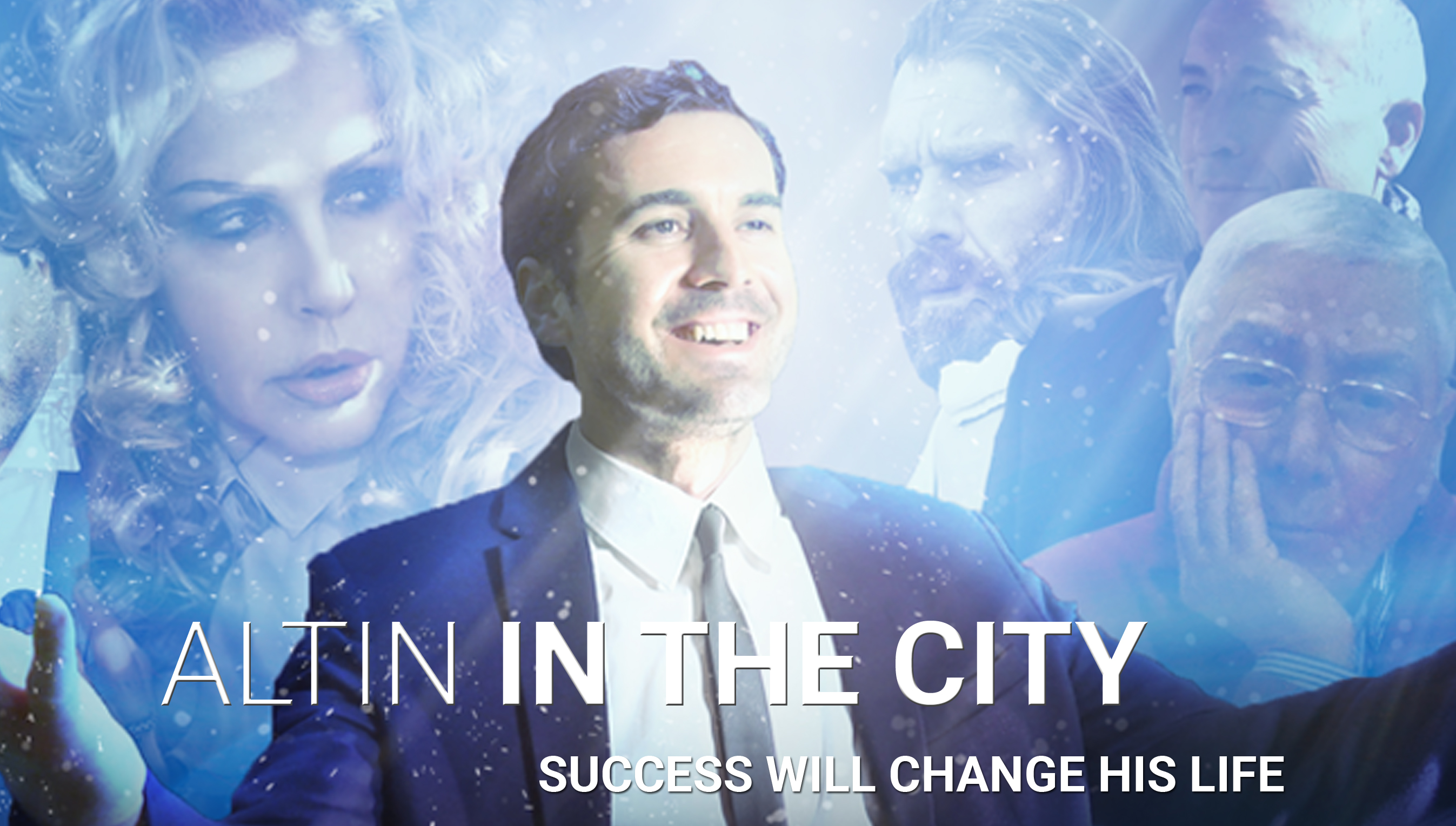
Drama, thriller, by Fabio Del Greco, Italy 2017.
Altin, aspiring Albanian writer arrived in Italy aboard a large ferry in the 90‘s, works in a butcher shop when he’s selected to audition for a reality of writers and finally sees a chance to be successful with his book “the journey of Ismail.” Unfortunately, this is the begin of the adventures which will lead him to learn about revenge, loneliness and extreme poverty, to the dark side of wealth and success.
The theme of Altin in the City should not lead to the assumption that it is merely the story of a young immigrant trying to integrate. In reality, it is a tale where greed, thirst for power and success, cynicism, and ambition intertwine, creating a sort of modern-day Faust and a new "pact with the devil" belonging to the 22nd century, which we could summarize as: show business. The reality show becomes the Mecca, the keystone, and the springboard for those who wish to achieve success without effort. Del Greco presents this world with subtle irony, characterized by kitsch nuances and parodic tones. However, success without effort comes at a price: Altin has sold his soul to the devil and, from being an easy prey of television showbiz, will soon become a victim of himself.
LANGUAGE: Italian
SUBTITLES: English, French, Spanish, German.
Born Into a Language the World Did Not Know Existed
You are born in a city made of stone, and the stone remembers everything. Gjirokastër sits in the Albanian highlands like a fist that refused to open, its Ottoman towers and grey slate rooftops pressing down on whoever grows up beneath them with the accumulated weight of centuries that the rest of the world spent arguing about other things. Ismail Kadare came into this world in 1936 inside those walls, and the particular cruelty of his birthplace was not the poverty or the isolation — it was the coincidence. The same city, the same steep streets, had already produced Enver Hoxha, the man who would eventually seal Albania behind the most hermetic border in Europe and demand that its writers serve as decorative tiles in his ideological mosaic. To be born in Gjirokastër in 1936 was to begin life already inside a trap whose dimensions you could not yet measure.
Albanian is a language that arrived in the written record late and reluctantly. It belongs to its own isolated branch of the Indo-European family, carrying traces of ancient Illyrian and Thracian that linguists still argue over, a linguistic orphan that survived precisely because the mountains that imprisoned its speakers also protected them. When Kadare published his first serious prose in the early 1960s, fewer than six million people on earth could read his sentences without mediation. That number is smaller than the population of many individual cities, smaller than the readership of a moderately successful French novelist, smaller than the audience for a single episode of a popular television programme. To choose to write seriously in Albanian was not an act of nationalism — it was an act whose consequences were closer to silence. You could be a major writer in that language and remain, for the overwhelming majority of the literate world, functionally nonexistent.
The paradox that this scarcity generates is rarely discussed with enough precision. When your potential readership is defined and enclosed, when the market mechanisms that reward universal accessibility cannot operate, the writer faces a choice that is almost never framed as a choice: you either produce work so locally specific that it calcifies into folklore, or you reach downward, past the contemporary, past the provincial, into the sediment of myth and archetype where every human culture has already left its fingerprints. Claude Lévi-Strauss spent decades demonstrating in works like Mythologiques that myths are not decorations on the surface of a culture but its structural grammar, the deep logical system through which a community processes contradiction. Kadare arrived at something similar not through anthropological theory but through the pragmatics of necessity. Albanian oral epic, the ancient cycle of the kanun, the legend of the walled-up wife sacrificed so that a fortress could stand — these were not exotic materials he chose for atmosphere. They were the frequency on which he could transmit and be received simultaneously by his small local audience and, once translated, by any reader anywhere who had ever lived inside an institution that demanded a human sacrifice to remain standing.
His novel The General of the Dead Army, published in 1963, sent an Italian military officer into communist Albania to recover the bones of soldiers killed during the Second World War. The premise is almost absurdly simple, and yet the book moves through that simplicity into something that has no nationality — the relationship between the living and the dead, between official memory and what the ground actually contains. It was translated into French by 1970, and French became the relay language through which Kadare entered the world, his sentences passing through one foreign tongue before reaching another, each translation a further act of trust or distortion. The layering was fitting. A writer working in a language that required translation to survive had already learned that meaning was never the exclusive property of its original vessel.
What small languages do, when they force their serious writers toward depth, is produce a particular kind of ruthlessness about the universal. There is no luxury of assuming a shared reference point with your reader beyond the oldest ones.

The Mythological Excavation as Political Weapon
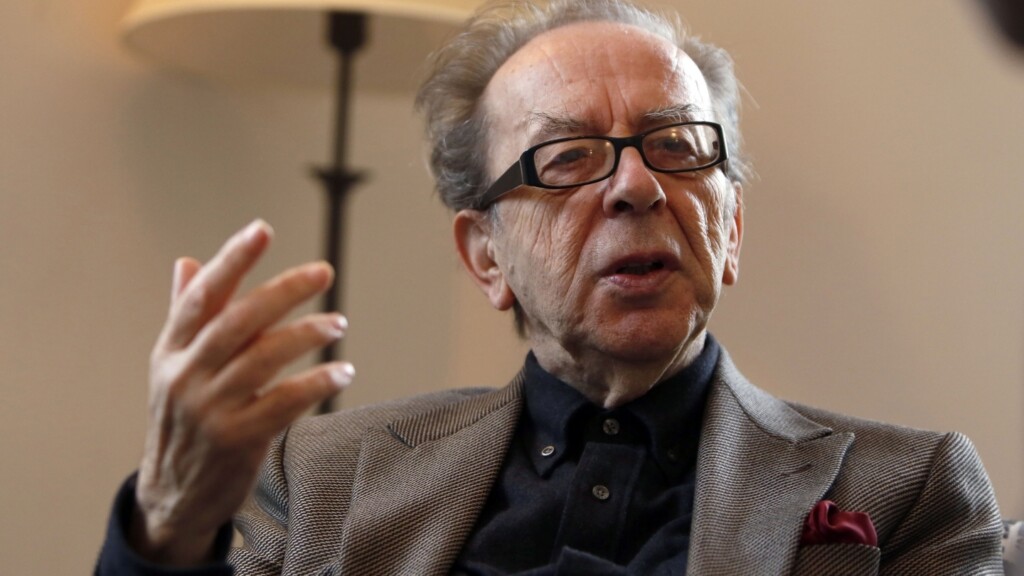
You are standing in a library in Tirana sometime in the late 1960s, and every book around you is either approved or absent. The ones that exist have been filtered through a machinery of ideological review so thorough that literature has become, in practical terms, a branch of the state. And yet on the shelf there is a novel about an Italian general sent to Albania after the Second World War to collect the bones of his nation’s fallen soldiers — a novel that is, on its surface, an act of historical accounting, a meditation on defeat, on the absurdity of war’s aftermath. You read it and feel, without being able to say precisely why, that it is talking about something happening right now.
Ismail Kadare published The General of the Dead Army in 1963, and the Albanian censors allowed it because it appeared to do what socialist realism demanded: it showed foreign imperialism as grotesque, its agents as ridiculous and spiritually hollow. What the censors did not fully reckon with was that Kadare had embedded a far older machinery inside the novel — one that did not obey the logic of ideological approval. The Albanian landscape in the book is not merely a setting. It is a force with memory, capable of reclaiming the dead, of resisting the administrative impulse to classify and retrieve human remains. The land itself operates according to a code older than the Italian invasion, older than Ottoman occupation, older than the state that was currently printing Kadare’s royalties. That code was the Kanun — the customary law of the Albanian highlands, a system of obligations, vengeance, hospitality, and honor that had governed social life for centuries before any modern political structure arrived to overwrite it.
Walter Benjamin argued in his 1928 study The Origin of German Tragic Drama that allegory, unlike the symbol, does not fuse meaning and form into a luminous whole. Allegory works through ruins — through fragments that carry meaning precisely because they are broken, because the original context has been shattered and what remains is a debris field that speaks obliquely. The intact symbol reassures; the ruined allegory unsettles. Kadare understood this not as literary theory but as survival technique. The Kanun, the epic cycle of the brothers Mujo and Halil, the concept of besa — the sworn word, the inviolable promise that functions as a moral absolute in Albanian oral tradition — these were not preserved in his fiction as objects of cultural nostalgia. They were deployed as systems of meaning that the state could not fully colonize precisely because they predated the state’s claim to total authority over truth.
When The Siege appeared in 1970, Kadare moved the strategy deeper into the past, setting the novel during the Ottoman campaigns against Albanian fortresses in the fifteenth century. The besieging army is vast, organized, ideologically certain of its historical mission. The defenders are exhausted, outnumbered, and sustained by something the invaders cannot map or measure. Critics in the West read it as a novel about national resistance. Enver Hoxha’s regime read it as a celebration of Albanian endurance against foreign domination — which is exactly what they needed it to be. But the architecture of the text was doing something neither reading fully captured: it was showing how power always narrates its own advance as destiny, and how the people living inside that advance are left to encrypt their resistance in forms the powerful will misread as decoration.
The besa — that untranslatable Albanian oath that binds a man more completely than any written contract — carries particular weight in this context, because it is a form of commitment that operates entirely outside institutional verification. It does not require a witness with authority. It requires only the self, held to its own word across time. In a totalitarian system where the self is perpetually demanded as an offering to collective ideology, the existence of a moral structure that answers to nothing external is not a cultural artifact. It is a philosophical provocation.
The Ambiguity That Cannot Be Resolved
You are in a room where the only door leads deeper into the building. There is no exit that does not pass through the center of power. You can refuse to enter, which means remaining outside entirely — erased, silent, perhaps imprisoned, perhaps dead. Or you can walk in and negotiate what you are willing to carry. This is not a metaphor designed to make you sympathetic to anyone. It is the precise architectural condition under which Ismail Kadare wrote, published, received prizes, and held a parliamentary seat in Enver Hoxha’s Albania for years while other Albanian writers rotted in Spaç labor camp or were shot in courtyards whose locations their families were not told.
The discomfort this produces in Western readers is itself a symptom worth examining. We tend to approach complicity as a moral category with clean edges — you either refused or you participated, and participation means you belong to what you participated in. Hannah Arendt spent years dismantling this geometry. In The Origins of Totalitarianism, published in 1951, she identified something that liberal moral philosophy had not equipped anyone to see: that totalitarian systems do not simply punish resistance, they actively manufacture situations in which every available action becomes a form of collaboration. The machine is engineered to eliminate the conditions under which refusal is even legible as a choice. What looks from outside like a decision to comply is, from inside, something closer to the management of an ongoing catastrophe with no exit coordinates.
Kadare’s specific position was not passive. He was a deputy in the People’s Assembly. He received the Stalin Prize for Literature, awarded by the Albanian state in 1963. His novel The General of the Dead Army, published in 1963, was eventually celebrated in France — Gallimard published it in 1970 — and became the text through which the West first encountered him as a figure of quiet, oblique dissent. But that reading was performed at a distance. Inside Albania, state approval was the condition of publication, and publication was the condition of existence as a writer. The question of whether his work contained encoded resistance or genuine ideological accommodation or both simultaneously is not a question with a resolution. It is a question designed, by the system that produced it, to be unresolvable.
What makes this harder to sit with is the fact of the others. Kasëm Trebeshina, one of the most significant Albanian literary voices of the twentieth century, spent years imprisoned and in internal exile. Vilson Blloshmi died in detention. These were not men who made different tactical calculations than Kadare — they were men the system chose to destroy rather than instrumentalize. The comparison is not there to accuse Kadare of surviving at their expense. It is there because the comparison is the thing itself: the system required some writers to be crushed and some to be displayed, and the display was part of the crushing. A literary culture with one permitted voice is not a literary culture. It is a demonstration.
Kadare himself, in interviews given after his 1990 defection to France, described his writing as an act of cultural preservation — the argument being that Albanian literature and language, maintained even under constraint, was a form of national resistance that silence could not have achieved. This is not an absurd argument. It is also not a sufficient one, and he has never claimed it was. What it reveals is that he understood himself to be operating inside a logic that had no clean outcomes, only different distributions of damage. The reader who finds this unsatisfying is the reader who has never had to calculate the cost of their own visibility, never had to decide what they were willing to put their name on in order to keep writing at all — and who mistakes that inexperience for moral clarity.
The Novel as the Only Remaining Court
You are sitting in a room where every door leads to another room full of documents, and no one can tell you which file contains the truth about who you are, because the system was not designed to find truth — it was designed to generate the permanent suspicion that truth exists somewhere just out of reach. That is not a metaphor for anxiety. That is the administrative architecture of the Tanzimat-era Ottoman dream bureau as Kadare constructed it in 1981, where the protagonist Mark-Alem inherits a position inside an imperial machine that harvests the dreams of the population, sorts them for prophetic danger, and destroys what it cannot control. The Palace of Dreams was banned within months of publication in Albania, which is itself a form of literary criticism more precise than any review: the state recognized itself in the mirror and smashed it.
Kadare had spent years building toward this. His 2006 essay collection, translated and circulated in European intellectual circles, made explicit what the fiction had only encoded: that the novel as a form is constitutionally allergic to totalitarian power, that the genre carries within its structure something the single-party state cannot metabolize. This is not a romantic claim about artistic freedom in the abstract. It is a structural argument. The novel requires interiority. It requires that at least one consciousness in the text remain partially illegible to authority, partially unsurveyed, partially its own. A bureaucratic system that demands total transparency from its subjects — confessions, self-criticisms, dream reports — cannot coexist with a form that insists on the opacity of the inner life as its basic material.
Milan Kundera arrived at the same conclusion from the Czech side of the same historical catastrophe. In The Art of the Novel, published in 1986, he described the novel’s defining property as the plurality of perspective it refuses to abandon: not two sides of a debate, but the irreducible complexity of any single human situation when followed honestly. That irreducibility is precisely what monolithic power cannot afford. A system that operates on the principle that every question has a correct answer — historically determined, ideologically certified — is threatened not by novels that argue against it, but by novels that simply keep asking. The form itself is the dissent, before a single subversive sentence appears.
What makes Kadare’s case strange and productive is that he never stopped publishing inside the system he was indicting. He negotiated, revised, strategized. The General of the Dead Army had appeared in 1963 and was celebrated; The Palace of Dreams appeared in 1981 and was suppressed. The same author, the same country, eighteen years apart, and the distance between those two receptions maps the tightening of a regime that had run out of room to tolerate even encoded ambiguity. By 1981, Albanian censors had learned to read allegorically, which meant the novel had educated its own executioners.
This is the paradox that Kundera’s theory cannot quite account for: if the novel’s democratic DNA makes it incompatible with totalitarianism, then how did so many novels survive inside totalitarian states, published, celebrated, awarded prizes by the very apparatus they allegedly threatened? The answer is that the incompatibility is not absolute — it is a pressure, a slow corrosion. The novel does not destroy authoritarian power the way a bomb destroys a building. It introduces into the culture a habit of inhabiting another person’s perspective from the inside, and that habit, accumulated across decades and readers, makes certain lies progressively harder to sustain. Not impossible. Harder. The regime that banned The Palace of Dreams in 1981 collapsed nine years later, and the causality is unprovable, which is exactly the kind of sentence the novel forces you to sit with rather than resolve — a court that issues no verdicts, only evidence that keeps arriving long after the trial was supposed to be over.
A vision curated by a filmmaker, not an algorithm
In this video I explain our vision
Exile, Translation, and the Second Life of a Text

You are working from a language you have never spoken. The manuscript arrived in Paris through channels that required no explanation and invited none — folded into luggage, passed through customs under the weight of other objects, stripped of its original context the way a bone is stripped of flesh. You sit with the French version, which is itself already a rendering of something that existed in Albanian, and you are asked to produce English. You are not translating a text. You are translating a translation. The ghost of the original stands two rooms away, and you are sketching its shadow on the wall.
This was the actual material condition of Kadare’s arrival in the West. Kadare’s French translator Jusuf Vrioni, an Albanian aristocrat who had survived labor camps and whose own biography resembled a Kadare novel, produced French versions that Éditions Fayard began publishing from the 1970s onward. These became the master texts from which English, German, Spanish, and Italian editions were made. Publishers like Harvill Press and later Canongate brought English-speaking readers a Kadare who had already passed through Vrioni’s sensibility, through the idioms of Parisian literary culture, through the gravitational field of French prose style. What arrived in London or New York was not Kadare’s Albanian so much as a Kadare reshaped by the entire apparatus of French literary reception — its preferences, its elegances, its tolerances and blind spots.
Lawrence Venuti argued in The Translator’s Invisibility, published in 1995, that Western translation culture systematically domesticates foreign texts, smoothing their strangeness into fluency, making them feel as though they were written in English all along. The translator disappears precisely when they are most present, because their labor is measured by how little trace they leave. Applied to Kadare, this principle operates with particular violence: the Albanian roughness, the Balkan oral residue, the specific political tension encoded in syntax — all of this passed through two stages of domestication before reaching most readers. The result is a writer who feels, in English, more universally literary than he may actually be, more aligned with the European novel tradition, more comfortable inside the house of Camus and Kafka than the original Albanian might warrant.
This is not a criticism of Vrioni, whose work was extraordinary under conditions that most translators never face. It is an observation about what reputation is made of. Kadare’s international standing — the Nobel Prize discussions, the comparisons to the great European modernists, the sense that here was a dissident voice speaking for all captive peoples — was constructed, in large part, from texts that most of the world’s readers and critics could not verify against any original. His authority was real, his persecution was real, the novels’ power was real. But the specific texture of that power, the way it was heard and celebrated, was mediated by a chain of decisions that began in Tirana and ended on someone’s desk in a language Kadare himself did not write in.
There is a stranger question underneath this one. When a text has lived in another language long enough, when it has been read and loved and argued over and taught in that language, does the question of fidelity to an original still carry its original weight? The English-language Kadare has now existed for decades. Readers have built real relationships with those books, real insights, real grief. The collaborative fiction Venuti might identify — author, Albanian manuscript, French translator, English retranslator, reader who knows none of them — has produced genuine literary experience.
What Europe Made of Him and What He Made of Europe
You are handed a prize and the prize tells you what you are. In 2005, the Man Booker International Prize committee named Kadare its inaugural laureate, and the citation described him as a writer who had “illuminated the predicament of the individual under totalitarianism.” The sentence is accurate. It is also an amputation.
What the Western literary establishment performed that year was not an act of recognition but an act of classification, which is something altogether different. Pierre Bourdieu argued in The Rules of Art, published in 1992, that the literary field operates through struggles over consecration — who gets to assign value, who gets to draw the perimeter of legitimate literature, and crucially, whose symbolic capital increases in the transaction. Prizes are not rewards. They are boundary instruments. When a Western institution consecrates a writer from a formerly communist country, it is simultaneously consecrating itself as the arbiter of what suffering counts, what resistance matters, what literature is serious enough to survive translation into the universal. The writer gets a trophy. The institution gets its borders confirmed.
The particular violence of this mechanism is that it requires the consecrated writer to be legible in only one register. Kadare’s novels are full of Ottoman occupation, of blood feuds encoded in the Kanun, of Byzantine administrative cruelty, of empires that crush the Balkans not because they are communist but because that is what empires do. The Siege, written in 1970, reconstructs a fifteenth-century Ottoman military campaign with a precision that makes the reader understand occupation as a structural condition of human organization, not an aberration produced by one ideological system. The Palace of Dreams, published in 1981 and promptly banned by the Hoxha regime, builds its horror around a state apparatus that harvests the unconscious of its subjects — a machinery of surveillance and interpretation that has no ideological passport, that could belong equally to Kafka’s Prague, to any court in any century where power needed to know what its people were dreaming. Kadare was writing about the skeleton beneath the skin of all governance. The Booker citation handed the reader only the skin.
This flattening is not the result of malice but of structural necessity. A literary prize that positions itself as the champion of freedom cannot afford to let the work it celebrates become a mirror pointed at the liberating institution. If Kadare’s indictment of power is genuinely universal, then it touches Paris, London, and Brussels as readily as it touches Tirana or Moscow. The moment that implication is allowed to breathe, the prize loses its ideological function, which is to install a gradient — here, freedom; there, tyranny — that justifies the cultural authority of the West to judge, to translate, to canonize. The Albanian writer becomes intelligible to the Western reader only once he has been stripped of the dimensions that would make him genuinely uncomfortable.
What Kadare made of Europe, in return, is more interesting and far less discussed. Throughout his career he insisted, sometimes polemically, that Albania and the broader Balkan world belonged to the European tradition — not as peripheral recipients of civilization but as one of its formative crucibles, carrying within its oral literature and its ancient legal codes a memory that predates and exceeds anything produced in the academies of the West. His 1995 essay Invitation to the Studio is in part a sustained argument that the Homeric world and the Albanian highlands share a continuity of imagination that no Ottoman occupation and no communist dictatorship managed to sever entirely. This was not a plea for inclusion. It was a counter-claim about who owns the origin. He was not asking to be let into the European canon. He was telling the canon that it had been living, without knowing it, inside a story that Albania had been keeping alive in its mountains for three thousand years.
The Stone City and the Question That Outlives the Regime
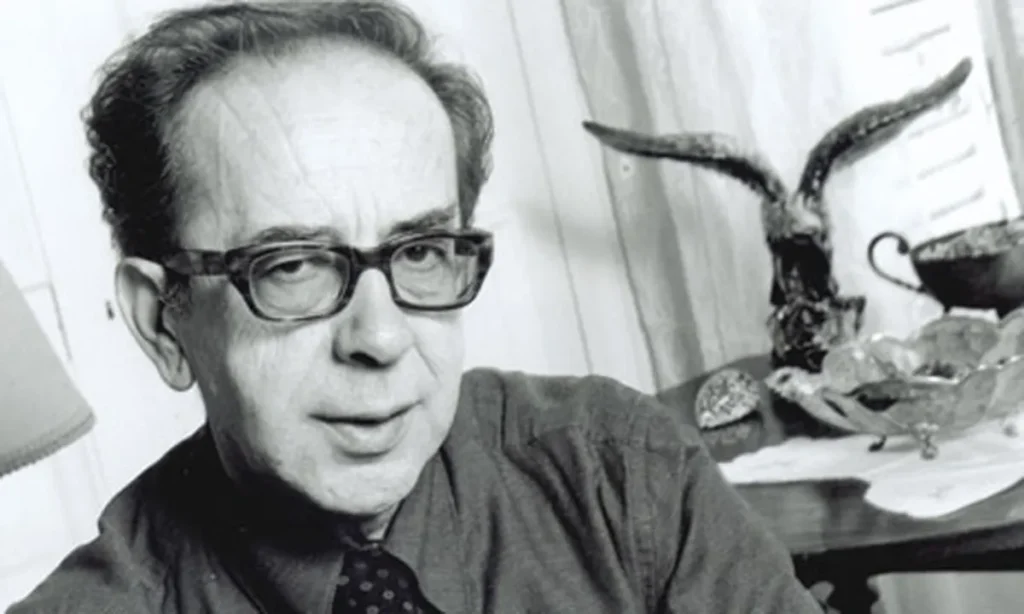
You are reading a novel set in a city you have never visited, and yet you recognize every street. The walls are not described as oppressive — they are simply there, the way walls are always there, load-bearing, necessary, the only architecture you have ever known. That is precisely the sensation Kadare produces in The Accident, published in 2008, more than a decade after the Albanian dictatorship had collapsed into rubble and transitional chaos. A man and a woman fall from a taxi in circumstances that may be accident or may be murder, and the investigation that follows is less interested in the facts of their death than in the texture of their intimacy — specifically, in how two people who loved each other had learned, without ever discussing it, to edit themselves in real time, to perform versions of their desires that were already pre-approved by an authority neither of them could name or locate.
This is the neurological afterlife of totalitarianism, and it is far more durable than the system that produced it. Michel Foucault, in Discipline and Punish published in 1975, described Jeremy Bentham‘s panopticon not as a building but as a technology of internalization — the prisoner who can never be certain whether he is being watched begins to watch himself, and eventually the external warden becomes redundant. What Foucault could not fully account for, because his analysis was structural rather than generational, is what happens when the tower is demolished but the inmates keep performing for it. The surveillance does not require infrastructure to persist. It has already been encoded into the rhythm of thought, the half-second hesitation before a sentence, the instinct to make one’s feelings legible to power before making them legible to oneself.
Agamemnon’s Daughter, written in secret during the height of Hoxha’s regime and not published in complete form until after Kadare’s death in 2024, carries this problem backward into myth with a kind of cold precision. The narrator watches a young woman sacrificed — not on an altar, but inside the machinery of a state ceremony — by a father whose loyalty to the regime has eaten so completely through his private self that he no longer experiences the sacrifice as loss. What makes the novella unbearable is not the cruelty but the fluency. The father is not a monster performing monstrous acts. He is a man who has reorganized his inner life so thoroughly that the act of destruction feels, to him, like continuity. Kadare understood, writing in secret in a country where 1 in 6 citizens was an informant by the 1980s, that the true achievement of a totalitarian state is not compliance but the colonization of desire itself.
The question this raises about Kadare’s own work is not comfortable. A literature forged under extreme constraint develops specific musculatures — the oblique approach, the mythological displacement, the narrative surface that says one thing while the architecture says another. These are not merely stylistic choices; they are survival strategies that became aesthetic convictions, habits of indirection so deeply grooved they could no longer be separated from the voice itself. When the regime fell in 1991, when Kadare was already in Paris and the censors were gone and the informants had scattered, the cage was objectively open. But the question of whether the writing that emerged from captivity could simply unfold into freedom — whether the muscles trained for compression could relax without losing the tension that made them extraordinary — is a question that the late work raises without answering.
Because freedom, it turns out, is not the opposite of captivity in any simple mechanical sense. The prisoner who walks out does not walk into absence. He walks into a different pressure, and the habits he formed in the dark do not dissolve in the light — they simply stop being called survival and start being called style.
🌀 Labyrinths of Power, Memory, and Literary Exile
Ismail Kadare’s work is defined by its labyrinthine engagement with totalitarian power, collective memory, and the fate of the individual under oppression. These themes find deep resonances across world literature, from Kafka’s bureaucratic nightmares to Eastern European meditations on history and identity. The articles below explore the literary and intellectual landscapes most closely intertwined with Kadare’s singular vision.
Kafka and Bureaucracy: The Trial and The Castle
Kafka’s two great unfinished novels construct a world where bureaucracy becomes an impenetrable maze, crushing the individual beneath the weight of an anonymous and incomprehensible system. This vision of power as labyrinth is central to understanding Kadare’s own fictional universe, where Albanian communism functions with the same opaque, totalizing logic. Reading Kafka alongside Kadare illuminates how the absurd and the political intertwine in literature born from authoritarian experience.
GO TO THE SELECTION: Kafka and Bureaucracy: The Trial and The Castle
Eco’s The Name of the Rose: Meaning and Analysis
Umberto Eco‘s medieval thriller transforms the monastery into a labyrinth of forbidden knowledge, where the search for truth is itself a mortal danger. Like Kadare, Eco uses historical settings to speak obliquely about power, censorship, and the persecution of free thought. The novel’s architecture of secrets and hidden rooms mirrors the coded writing strategies both authors employ to survive ideological scrutiny.
GO TO THE SELECTION: Eco’s The Name of the Rose: Meaning and Analysis
The Labyrinth of Knossos: History and Myth of the Minotaur
The myth of the Labyrinth of Knossos and the Minotaur is one of Western culture’s most enduring symbols of entrapment, sacrifice, and the monstrous at the heart of civilization. Kadare drew explicitly on Greek myth throughout his work, using ancient archetypes to speak about the terror and cyclical violence of modern Albanian history. This article explores how the labyrinth as symbol carries its full political and existential charge across millennia.
GO TO THE SELECTION: The Labyrinth of Knossos: History and Myth of the Minotaur
Friedrich Nietzsche and Memory: On the Uses and Disadvantages of History
Nietzsche’s meditation on the uses and disadvantages of history for life raises urgent questions about how societies remember, forget, and instrumentalize the past. Kadare’s novels are haunted by this very tension, as Albanian collective memory is continuously reshaped by political power to serve the needs of the present. Understanding Nietzsche’s critique of historicism deepens the reader’s grasp of the stakes involved in Kadare’s literary excavation of suppressed history.
GO TO THE SELECTION: Friedrich Nietzsche and Memory: On the Uses and Disadvantages of History
Explore the Cinema of Resistance and Memory on Indiecinema
If Kadare’s world of labyrinths, power, and memory has stirred something in you, Indiecinema’s streaming platform offers a curated selection of independent and world cinema that speaks the same language of courage and artistic vision. Discover films that navigate oppression, exile, and the human search for meaning with the same uncompromising depth. Join Indiecinema and let independent cinema open new corridors in your imagination.
👉 EXPLORE THE CATALOG: Watch Indie Films in Streaming
A vision curated by a filmmaker, not an algorithm
In this video I explain our vision

