
The Price of Return
You step off the train into a town that remembers your name. The platform is crowded, the faces arranged in welcome, and for a moment the warmth feels genuine — the handshakes firm, the smiles wide, the mayor’s voice carrying that particular tremor of civic emotion that small places reserve for their most dramatic occasions. Bunting has been strung between the lampposts. Children have been positioned. You notice, almost without meaning to, that the bunting is slightly frayed, that the children look rehearsed, that the smiles do not quite reach the eyes of the men standing nearest to you — the men who know, who have always known, what they need from you. The homecoming closes around you like a hand.

Friedrich Dürrenmatt understood this closing. His 1956 tragicomedy Der Besuch der alten Dame, which arrived on the world’s stages at precisely the moment Europe was learning to forget what it had recently been willing to do for money and survival, is built entirely from the architecture of that sensation — the town that greets you not because it loves you, but because it has calculated you. Güllen, the fictional Swiss municipality at the play’s center, is a place in spectacular decline: its factories shuttered, its credit exhausted, its citizens wearing the particular dignity of people who have not yet admitted to themselves how far they have already fallen. Into this ruin arrives Klara Zachanassian, once plain Clara Wäscher, who left Güllen in disgrace decades earlier and has since become, through marriages and inheritances of almost grotesque accumulation, the wealthiest woman in the world. She has returned, she announces, to be generous. The town exhales.
Dürrenmatt was writing in the aftermath of a Europe that had watched ordinary people make extraordinary moral concessions under the pressure of economic desperation and social conformity, and he was honest enough not to set his story in a dictatorship. Güllen is democratic, provincial, Protestant in its work ethic and Lutheran in its self-regard. Its citizens are not monsters. This is the trap the play sets for its audience, and it is a trap with no comfortable exit, because the horror Dürrenmatt stages is not the horror of exceptional evil but the horror of recognizable logic. When Klara announces that her billion — split between the town and Alfred Ill, her former lover who fathered and then abandoned her child, who bribed witnesses to deny his paternity and drove her into exile and prostitution — when she announces this sum is conditional on Ill’s death, the town’s first response is genuine outrage. The refusal is loud, principled, unanimous. And then the months pass.
What Dürrenmatt charts in the interval between refusal and complicity is not corruption in any dramatic sense. It is something far more familiar and far more damning: the slow accumulation of small permissions. The citizens of Güllen begin buying on credit — new shoes, new televisions, cigarettes of a better brand. Each purchase is an anticipation, a quiet vote cast not in any hall but in the body itself, in the small daily decision to live as though the money were already there, as though the thing that must be done to obtain it has already been, in some private accounting, approved. Ill watches this transformation with the particular anguish of a man who understands that his community has not changed its values so much as revealed them, stripped of the insulation that prosperity once provided. Comfort, it turns out, was always the condition under which decency operated. Remove it, and you discover that what you took for principle was largely the luxury of never having been seriously tempted.
The town does not decide to kill Alfred Ill. It simply stops protecting him, which is a different kind of decision and a much more common one.
Crazy World
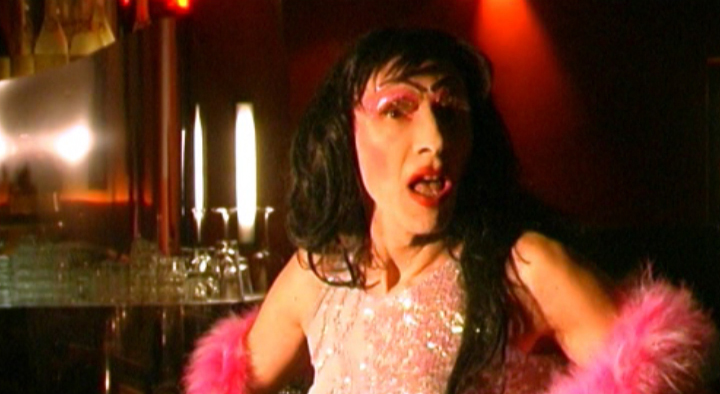
Drama, thriller, by Fabio Del Greco, Italy, 2010.
Luca is poor and works, precariously, as a waiter. He lives a problematic relationship with his girlfriend, and his life is full of doubts. One day Luca meets Chiara, a friend who had studied philosophy with him at university. She has realized her dream of opening a night and is now well-off. Luca leaves everything behind and starts a relationship with Chiara. He manages the nightclub with her and, thanks to the cocaine and call girls sold to politicians, he gets out of his hard economic situation. But Chiara does not manage to obtain the contract for an old furnace, so she blackmails Saverio, a member of the Parliament. Chiara owns a video in which Saverio has sexual intercourse with a transsexual.
LANGUAGE: Italian
SUBTITLES: English, French, Spanish, German, Dutch, Portuguese.
Dürrenmatt’s Swiss Blade
You are sitting in a theater in Zurich in 1956, and the woman who walks onto the stage does not look like a monster. She is old, she is rich, she is almost elegant, and she has returned to the dying town where she was born. She has an offer. The audience laughs at first, because the offer seems absurd — one billion marks in exchange for the life of one man. Then the laughter stops, not because anything violent has happened, but because everyone in the theater has quietly begun doing the arithmetic.
Friedrich Dürrenmatt wrote Der Besuch der alten Dame in the same decade that Hannah Arendt was documenting, with methodical horror, the administrative architecture of evil — the way ordinary clerks, mayors, schoolteachers, and shopkeepers participate in atrocity not through fanaticism but through a series of small, reasonable-seeming adjustments. Dürrenmatt was Swiss, which meant he had watched the war from a particular vantage: not innocent, not guilty in the prosecutable sense, but implicated in the European moral atmosphere the way a bystander is implicated when they watch a mugging and calculate whether intervention is worth the risk to themselves. Switzerland’s wartime neutrality was not moral purity — it was a negotiated convenience, and Dürrenmatt, born in 1921 in Konolfingen, grew up inside that convenience and recognized its smell. The play is the result of a man turning that recognition into dramatic structure.
What makes the play philosophically violent is its refusal to give the town of Güllen a villain. Alfred Ill, the man condemned, is guilty of a real thing — he had a young woman expelled from their village decades earlier by bribing two men to falsely testify that he, not Ill, had fathered her child. Clara Zachanassian, now the wealthiest woman in the world, has returned to buy the justice the community once denied her. The townspeople refuse at first. They refuse with speeches. They invoke civilization, they invoke law, they invoke human dignity. Ill himself begins to believe them. And then, so gradually it seems almost atmospheric, new shoes appear on feet that could not previously afford them. Yellow shoes. Credit extended by the local shopkeeper. A man buys a new television. Another takes out a loan. No one decides to kill Alfred Ill — they simply begin, collectively, to live as though his death is already a settled matter, as though the moral question has already been resolved somewhere upstream of any individual conscience.
Dürrenmatt called his dramatic method the Groteske, a genre-term he developed to describe a form in which the comic and the catastrophic are not merely juxtaposed but fused — where the joke is the catastrophe, and the catastrophe is structured like a joke. His 1955 essay Theaterprobleme argued that tragedy in the classical sense had become impossible in the modern world because tragedy requires a coherent moral order that can be violated. What the twentieth century had demonstrated was not the violation of moral order but its dissolution — not Oedipus discovering that fate has betrayed him, but a room full of people discovering, with mild surprise, that they have already agreed to something they cannot recall deciding. The Groteske is the only form adequate to that experience, because it makes the audience laugh at the precise moment they should be appalled, which is itself an act of self-implication.
The town of Güllen is not Germany. It is not Switzerland. It is not any particular nation that can be pointed to and quarantined. Its economy has collapsed — deliberately, by Zachanassian’s financial manipulation, as part of the long preparation for her return — and its people are not evil. They are indebted, aspirational, and tired. The conditions for their capitulation have been engineered with patience, which raises a question the play never answers: whether the engineering was necessary, or whether it simply accelerated what was always already latent in the arithmetic they were quietly doing in the dark.

The Architecture of Consent
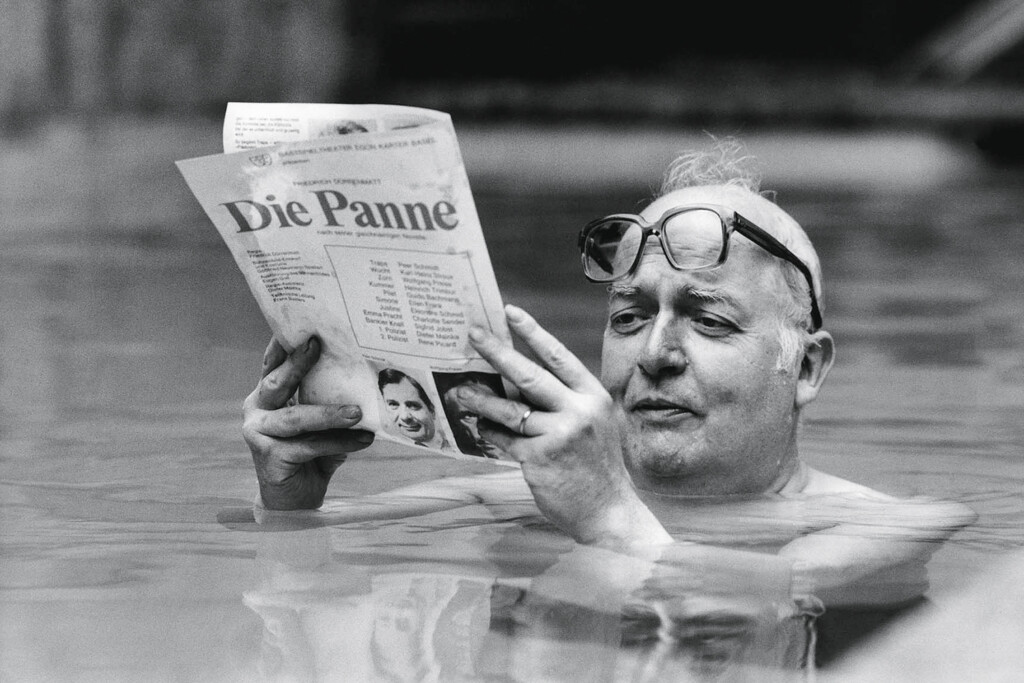
You are standing in a shop window in a town that was dying, and the new coat on your back fits perfectly. You did not decide to become someone else. The decision arrived in the form of a monthly payment, a cleared debt, a pair of shoes that did not pinch. The transformation was retail, incremental, barely perceptible — and by the time it was complete, you had built an entire philosophical architecture to explain why you were still fundamentally a decent person.
This is the mechanism Friedrich Dürrenmatt dissects with the patience of a watchmaker. The citizens of Güllen do not erupt into violence. They do not rip off masks to reveal the monsters underneath. They do something far more disturbing: they reason their way toward murder. Each step is rational. Each step follows logically from the one before it. The town is bankrupt, the town needs money, the money has a condition, the condition requires rethinking certain assumptions about justice, justice is after all a complex concept, and Alfred Ill — if one is being honest — was never entirely innocent. The scaffolding goes up beam by beam, and at no point does any single beam look like the thing it is collectively becoming.
Hannah Arendt, covering the trial of Adolf Eichmann in Jerusalem in 1961 and publishing her observations two years later, encountered exactly this structure in human form. Eichmann was not a fanatic. He was a bureaucrat who spoke in clichés, who could not think outside the procedures of his role, who had organized the logistics of mass murder the way another man might organize a rail timetable. Arendt’s phrase — the banality of evil — was misread almost immediately as a claim that evil is small or insignificant. What she actually identified was more terrifying: that the most catastrophic moral failures are often accomplished by people who have simply stopped exercising independent moral judgment, who have outsourced their conscience to a system and called it duty, efficiency, necessity, or in Güllen’s case, economic survival.
The town’s collective rationalization follows a grammar that Arendt would have recognized precisely. Notice how the citizens do not defend Clara Zachanassian’s proposal as just. They defend it as inevitable. The word “justice” appears, but it functions as a decoration on an argument that is fundamentally about financial desperation. Dürrenmatt is careful to show the order of operations: the new purchases come before the explicit agreement, which means the body has already committed before the mind has finished deliberating. By the time the community votes, they are not making a decision. They are ratifying a conclusion their spending habits reached weeks earlier.
This is what makes the play structurally different from a simple morality tale about greed. Greed would be too clean, too conscious. What Güllen exhibits is something closer to what the sociologist Zygmunt Bauman described in Modernity and the Holocaust in 1989 — moral blindness produced not by hatred but by process, by the division of a monstrous act into so many small, individually defensible steps that no single participant ever has to confront the whole. The executioner in Güllen is not one person. It is a committee. And committees do not feel guilt the way individuals do, because guilt requires a self that can be held responsible, and committees dissolve the self into procedure.
Ill himself understands this before the town does. His acceptance of his fate in the final act is not resignation — it is recognition. He sees that the community has already arrived at its destination, that what is left is administrative. The horror is not that his neighbors hate him. It is that they do not need to. They have found something more durable than hatred as a foundation for killing him: they have found bookkeeping. And a ledger, unlike a passion, never cools.
What Money Actually Purchases
You are sitting in a town council meeting where no one is lying. That is the most important thing to understand about what happens in Güllén. The men who vote, eventually, for Alfred Ill’s death do not experience themselves as murderers purchasing a contract. They experience themselves as citizens arriving, after long moral deliberation, at a painful but necessary truth. The money does not make them corrupt. It makes them legible to themselves.
Thorstein Veblen, writing in 1899 in The Theory of the Leisure Class, identified something that economists have spent the following century trying to forget: that consumption is never primarily about acquisition. It is about the social performance of one’s inner worth. What people buy, what they display, what they ostentatiously refuse — these are all moves in a grammar of self-justification. Wealth does not generate desire from nothing. It finds desire already waiting, already dressed and ready, and it gives that desire a respectable address, a narrative home from which it can operate without shame. Clara Zachanassian does not arrive in Güllén and manufacture greed in the townspeople. She arrives and offers their existing hunger a structure through which it can present itself as justice.
The precision of her offer is what makes it philosophically unbearable. She does not bribe the town to kill a man. She conditions the billion on the town achieving justice, which she defines as the formal acknowledgment that Alfred Ill once lied under oath, destroyed her reputation, and escaped consequence. This is not a technical distinction. The framing transforms every act of moral collapse in what follows into an act of moral seriousness. The citizens of Güllén begin buying on credit — shoes, appliances, cars — before any vote is taken, before any decision is formally reached, because they sense at some cellular level that the reckoning is inevitable, and they are simply living in the future they have already chosen. The purchases are not symptoms of corruption. They are the corruption wearing the costume of confidence.
What Clara actually purchases with her billion is the town’s permission to reorganize its self-narrative. Before her arrival, the people of Güllén were poor and faintly humiliated, living in a place history had passed over. After her offer, they become the protagonists of a moral drama in which they are called to bear the weight of truth at great personal cost — except, of course, the cost is ultimately a gain so enormous it erases every previous degradation. The structure of the story they tell themselves is one of sacrifice, but sacrifice that conveniently produces prosperity. Veblen would recognize this instantly: the performance of virtue as a mechanism of status acquisition, the conspicuous suffering that signals one’s fitness for the reward that follows.
What Dürrenmatt understood, with a coldness that has few equivalents in twentieth-century drama, is that this is not a story about a town that fails a moral test. It is a story about a town that passes every moral test it sets for itself. The citizens deliberate. They suffer visibly. They express reluctance. They arrive at their decision through a process that looks, from the inside, like genuine ethical reasoning. The billion does not bypass their conscience. It is routed directly through it, using their conscience as the instrument of its own justification. By the time the vote is taken, the town has not surrendered its values. It has used its values as the very machinery of the outcome Clara required.
There is a man somewhere in the background of all this who has already understood what is happening — not Ill himself, who goes through his own separate unraveling, but the audience watching, who feels the specific nausea of recognizing a process they have participated in, though perhaps at smaller scale and lower stakes, where the price paid was not a life but merely a friendship, a principle, a version of themselves they once found worth keeping.
Justice as a Costume
You are in the town meeting. You watch the hands rise, one by one, and what strikes you is not the hatred in the room but the solemnity. The faces are grave, almost tender. These are not the faces of a mob. They are the faces of a jury.
That is precisely the trick. Friedrich Dürrenmatt understood that collective violence does not sustain itself through anger, which is exhausting and unstable, but through ceremony, which is renewable and dignified. The citizens of Güllen do not hunt Alfred Ill down in an alley. They vote. They deliberate. They allow him to speak. They grant him, in other words, all the formal architecture of justice, because the architecture is not there to protect him — it is there to protect them. The ritual launders the act. What enters the room as murder exits it as verdict.
Michel Foucault, writing in 1975, traced precisely this metamorphosis in the history of punishment. In Discipline and Punish, he argued that the public execution was never merely about killing the condemned — it was a theatrical assertion of sovereign power, a spectacle designed to reconstitute social order through visible, bodily destruction. But Foucault’s deeper and more unsettling insight was that when modern societies abandoned the scaffold, they did not abandon the theater. They simply moved the stage indoors, into courtrooms and institutions, replacing the drama of the tortured flesh with the drama of the examined soul. The performance of righteous punishment did not disappear; it became more refined, more convincing, and therefore more dangerous. It learned to wear a wig and call itself due process.
Güllen performs exactly this refinement. The town does not skip the procedural steps — it insists on them. There is a formal assembly. There is a pretense of deliberation. Alfred Ill is given the opportunity to flee, which he declines, and this declination is then absorbed into the mythology of the verdict: he accepted it, they will later say, he understood. The conscience of the community is not troubled by what it did; it is soothed by how it did it. The form of justice becomes the substance of justification, and once that substitution is complete, no one in Güllen need ever feel like a killer again.
What makes Dürrenmatt’s anatomy so precise is that he never lets the citizens be cynics. A cynic would know he is pretending. The people of Güllen are not pretending — they have genuinely convinced themselves. By the time Ill dies, the moral reframing is total: they are not murderers who held a trial, they are judges who reached a necessary conclusion. The psychological mechanism here is what Leon Festinger, in his 1957 work on cognitive dissonance, would recognize as rationalization operating not privately but collectively, the entire community co-authoring a shared fiction to close the gap between what they needed to do and what they could bear to have done.
The gallows dressed as a courtroom is not a metaphor Dürrenmatt invented — it is one he recognized from history and pressed into unbearable clarity. Legal systems have always required this theater, not because law is illegitimate in itself, but because communities must be able to look at sanctioned death and see something other than what it is. The Roman damnatio memoriae, the medieval trial of heretics before the Inquisition, the twentieth century’s show trials in Moscow between 1936 and 1938 — each constructed elaborate juridical scenery precisely so that power could exercise violence while wearing the face of principle.
Dürrenmatt’s Güllen is not an allegory for exceptional historical crimes. It is a portrait of the ordinary mechanism by which any community can transform its worst impulse into its proudest institution, as long as the staging is careful and the audience is willing to believe what it needs to believe about itself — which, given the right economic pressure, turns out to be nearly everyone.
A vision curated by a filmmaker, not an algorithm
In this video I explain our vision
The Victim Who Becomes Complicit

You have probably spent most of the play’s duration inside Alfred Ill’s skin without noticing when the transfer happened. At some point in Friedrich Dürrenmatt‘s architecture, you stopped watching a man being hunted and started watching a man who had quietly decided to stop running — and the horror of that transition is that it happens with no theatrical announcement, no breaking speech, no visible moment of surrender. Ill simply becomes still. The townspeople close in, and he lets them, and something in you recognizes that stillness as something other than defeat.
What Kierkegaard mapped in Either/Or, published in 1843, was not a simple moral hierarchy but a diagnosis of how most human beings actually inhabit their lives: aesthetically, which is to say by sensation, by impulse, by the arrangement of pleasure and the avoidance of pain, without genuine commitment to anything beyond the next configuration of comfort. Ill, in his youth, seduced and abandoned Klara, not because he was a monster, but because he was living precisely at this level — responsive to opportunity, untroubled by consequence, moving through experience the way a hand moves through water. That is not villainy. That is the ordinary default mode of a man who has never been asked to account for the structural weight of his own desire.
The ethical stage, in Kierkegaard’s cartography, demands that the self take a position and hold it across time, that choices become binding rather than contingent. What Dürrenmatt does that is philosophically savage is to force Ill into contact with the ethical dimension not through moral awakening but through the imminence of death. Ill is not reformed. He is cornered into clarity. And the distinction matters enormously, because clarity purchased through terror is not virtue — it is simply a man who finally understands the invoice he has been running up for decades, now that the creditor has arrived in person, wearing a black dress and carrying a billion marks.
There is a scene in the late movement of the play in which Ill walks through the town he has lived in all his life — the baker, the mayor, the priest — each of them wearing new shoes, already spending money they have not yet been paid, already inside the transaction before the vote is cast. He sees it, he understands it, and he does not run. Critics have read this as tragic nobility, as a man choosing to face his fate. But Kierkegaard’s framework refuses that comfort. What Ill is experiencing is closer to what Kierkegaard called despair in The Sickness Unto Death, written in 1849: the condition of a self that cannot become itself, that recognizes its own dissolution without the resources to resist it. Ill’s acceptance is not dignity. It is the final aesthetic gesture — the most beautiful arrangement he can make of a situation that has already consumed his agency.
This is where your identification with him becomes the trap Dürrenmatt has been building all along. You have been rooting for Ill partly because Klara’s vengeance is so architecturally total, so inhuman in its patience and scale, that it reads as the greater monstrosity. But your sympathy for Ill is itself an aesthetic response — you have chosen him because he is proximate, familiar, small in the way that invites projection. You have not chosen him because he is innocent. He is not innocent. He destroyed a young woman’s life with a bureaucratic lie in a courtroom and then went home and lived for decades inside the ordinary texture of days, unbothered. The town that now sells him is not betraying him. It is simply finishing a sentence he began.
What Dürrenmatt refuses to grant you is the exit of moral legibility — the clean line between victim and perpetrator that would allow you to land somewhere stable in your judgment. Ill’s strange peace in the final act is not transcendence. It is the look of a man who has finally understood that he was always already on the wrong side of the ledger, and that the ledger was always going to be called in.
Tragedy Without Catharsis
You sit in the theater as the lights come up on Güllen’s final tableau — the townspeople dressed in their finest, the coffin prepared, the ritual complete — and something expected does not arrive. The sensation is not grief. It is not even discomfort in the ordinary sense. It is the specific unease of a mirror held too close, the recognition that whatever cleansing the evening was supposed to deliver has been quietly withheld.
Aristotle built his theory of tragedy on a metabolic premise: that pity and fear, properly agitated by dramatic action, produce a discharge, a purging, a restoration of internal equilibrium. The spectator enters disturbed by life and exits, through art, temporarily reconciled to it. For more than two millennia, the theater operated on this promise. Dürrenmatt, writing in his 1955 essay Theaterprobleme — one of the most precise demolitions of theatrical convention produced in the twentieth century — announces that this promise is no longer cashable. Not because playwrights lack skill, but because the historical conditions that made tragic heroism legible have dissolved. The singular protagonist who concentrates fate into a single will, who chooses and falls and thereby illuminates the moral order of the cosmos, cannot survive in a world where guilt is distributed, bureaucratized, parceled out across committees and majorities and secret ballots. Oedipus could not have been elected.
What Dürrenmatt puts in tragedy’s place is something he calls the grotesque — not as an aesthetic decoration, but as the only honest structural response to modernity’s dispersal of moral agency. The grotesque does not resolve; it deforms. It takes the shape of tragedy and distorts it just enough that the cathartic release never arrives, that the audience is left holding tension it cannot discharge through tears or identification or the safe contemplation of another’s ruin. Alfred Ill dies in Güllen, but his death does not illuminate a moral law. It confirms one — the law that communities, when offered sufficient economic incentive, will construct whatever ethical justification proves necessary to act on what they already want to do. This is not revelation. This is recognition, and recognition is a colder thing entirely.
The chorus in ancient drama existed to represent the community’s conscience, to voice the moral reckoning that the tragic hero’s fall demanded. Dürrenmatt’s townspeople are also a chorus, but one that has been systematically corrupted before the audience’s eyes. They speak in collective cadences, they dress and move with ceremonial unity, they perform the grammar of communal mourning — and the form is identical while the content has rotted through. Sociologist Zygmunt Bauman, writing decades later in Modernity and the Holocaust, would articulate what Dürrenmatt had already dramatized: that modern societies do not require monstrous individuals to commit collective atrocity, only reliable institutional structures and the ordinary human capacity for moral distancing. Güllen is that structure in miniature, and every resident who buys on credit against Clara’s coming payment has already voted.
This is where the audience’s own position becomes untenable. Catharsis required distance — the spectator pitied Oedipus precisely because Oedipus was exceptional, singular, elevated. But the people of Güllen are not exceptional. They are recognizable in their justifications, their incremental compromises, their ability to reclassify a murder as a verdict. The theater’s traditional architecture — that safe remove between the watching and the witnessed — collapses. There is no position in the house from which the audience can observe Güllen from the outside, because Güllen has been carefully constructed to include them. Every rationalization spoken from the stage has already been rehearsed somewhere in the seats.
Dürrenmatt does not want the audience purged. He wants them retained — held inside the discomfort, unable to metabolize it into the comfortable sadness that tragedy permits. The play ends, but the implication doesn’t. What they carry out of the theater is not catharsis but complicity, and complicity has no natural expiration.
The Mirror the Town Holds Up
You are sitting in a municipal meeting where the agenda item is a park renovation, but what is actually being decided is which neighborhood gets to feel like it matters and which one quietly doesn’t. Nobody says this aloud. The language is square footage and drainage coefficients and projected foot traffic, and everyone in the room understands that these numbers are not neutral, that they encode a preference already made, and yet the meeting proceeds with the gravity of genuine deliberation because the performance of deliberation is the price a community pays to avoid knowing what it has already chosen.
Güllen is not a fairy tale about a corrupt small town. It is a precise diagram of how collective moral life actually functions — not through dramatic villainy but through the slow bureaucratic accumulation of small accommodations. What Friedrich Dürrenmatt understood, writing in 1956 in a Europe still warm from its own catastrophic moral failures, is that communities do not fall into cruelty in a single moment. They arrive there through a series of individually defensible steps, each one reasonable in isolation, each one moving the threshold of the acceptable a little further in the same direction. By the time the destination is visible, the journey has already been normalized.
Sociologists who study collective behavior — most rigorously in work like Philip Zimbardo’s documentation of situational forces in his 1971 prison experiment, later expanded in The Lucifer Effect — have demonstrated that the most reliable predictor of moral collapse is not the presence of evil individuals but the presence of structures that make compliance feel like common sense. The citizens of Güllen are not monsters. They are people inside a structure that has redefined the vocabulary of necessity. And once necessity speaks, conscience becomes a luxury the community cannot afford, which is exactly what Clara Zachanassian has calculated from the beginning.
Every city budget is a moral document that refuses to call itself one. The decision to fund a jail expansion and defer a school repair is not announced as a value judgment — it appears as a fiscal constraint, a technical necessity imposed from outside the will of any individual. Hannah Arendt wrote in The Origins of Totalitarianism that one of the most dangerous political maneuvers is the transformation of political choices into administrative facts, stripping them of their human authorship so that no one can be held responsible for outcomes that everyone has collectively produced. Güllen’s town council speaks exactly this language. The billion is not a bribe. It is an economic reality. Ill’s death is not a murder. It is the restoration of justice. The grammar of inevitability does the work that moral argument cannot.
The silence in a workplace when someone is being pushed out follows the same syntax. A colleague begins arriving late to meetings. His name disappears from email threads. He is not fired in any declared sense — he is simply slowly unmade, and the people watching understand what is happening, and they say nothing because saying something would require them to name the structure they are also inside, which would require them to consider their own position within it. The buy-in is gradual, distributed, deniable. No single person did anything wrong. The outcome is nevertheless total.
What Dürrenmatt refuses to offer is the consolation of the exceptional case — the idea that Güllen is a place unlike yours, that its citizens were weaker or more corruptible or more desperate than the people in the room where you are reading this. The play insists on the typicality of its characters with almost clinical persistence. They are joiners, optimists, borrowers of hope on credit they intend to repay. The question the play leaves open, the one that does not soften with distance or time, is not whether your community would take the money, but at what point in the process you would begin to understand that it already had.
⚖️ Justice, Guilt, and the Theater of Power
Dürrenmatt’s The Visit is a devastating meditation on collective guilt, moral corruption, and the price of justice. These articles explore connected themes across literature and thought — the mechanisms of power, the pact with darker forces, the absurdity of existence, and the theatrical staging of human reckoning.
The Pact with the Devil in Literature: History and Symbolism
The pact with the devil is one of literature’s most enduring metaphors for the bargain struck between desire and damnation. Dürrenmatt’s Clara Zachanassian echoes this archetype in her offer of wealth in exchange for a life — a transaction that exposes the moral bankruptcy of an entire community. This article traces the dark symbolism of the infernal pact from Faust to Bulgakov and beyond.
GO TO THE SELECTION: The Pact with the Devil in Literature: History and Symbolism
Albert Camus: Life and Philosophical Thought
Albert Camus explored the absurd as the fundamental condition of human beings confronting a silent, indifferent universe — a vision that resonates deeply with Dürrenmatt’s grotesque moral universe. Like the citizens of Güllen who rationalize their descent into murder, Camus’s characters are trapped between lucidity and complicity. Understanding Camus illuminates the tragicomic darkness that defines Dürrenmatt’s theatrical world.
GO TO THE SELECTION: Albert Camus: Life and Philosophical Thought
Kafka and Bureaucracy: The Trial and The Castle
Kafka’s vision of bureaucracy as an impenetrable and dehumanizing force finds a theatrical twin in Dürrenmatt’s portrayal of a town paralyzed by debt and corrupted by the promise of wealth. Both The Trial and The Castle dramatize how systems — legal, economic, social — strip individuals of agency and moral responsibility. This article unpacks Kafka’s legacy and its echoes in postwar European literature.
GO TO THE SELECTION: Kafka and Bureaucracy: The Trial and The Castle
Banal Evil and Radical Evil: Kant and Arendt
Hannah Arendt‘s concept of the banality of evil — the idea that great crimes are often committed by ordinary people following the logic of a system — casts a sharp light on Dürrenmatt’s townspeople in The Visit. The citizens of Güllen do not become murderers out of passion but out of slow, incremental moral erosion driven by economic pressure. This article examines how Arendt and Kant theorized the relationship between evil, judgment, and collective responsibility.
GO TO THE SELECTION: Banal Evil and Radical Evil: Kant and Arendt
Discover the Cinema of Moral Complexity on Indiecinema
If Dürrenmatt’s vision of justice and human corruption moves you, Indiecinema streaming is the place to explore films that dare to ask the same uncomfortable questions. From European art cinema to independent provocations, our catalog brings you stories that, like The Visit, refuse easy answers and comfortable endings.
👉 EXPLORE THE CATALOG: Watch Indie Films in Streaming
A vision curated by a filmmaker, not an algorithm
In this video I explain our vision

